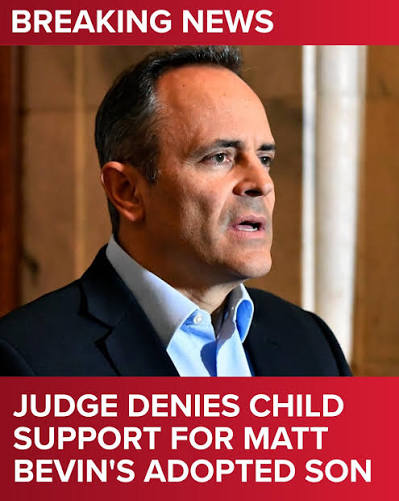
A Kentucky family court judge has denied a child support request filed by Jonah Bevin, the adopted son of former Kentucky Governor Matt Bevin. The decision marks a significant development in a lengthy family court dispute involving financial support, alleged mistreatment, parental responsibilities, and disagreements over educational expenses.
Jefferson Family Court Judge Angela Johnson issued the ruling on November 25, 2026. She concluded that Kentucky law did not provide a legal basis for Jonah to independently establish a child support claim against his adoptive parents. The judge also found that the evidence presented during the proceedings was insufficient to determine an appropriate financial award.
However, the decision was not entirely in Matt and Glenna Bevin’s favor. The court ordered both parents to contribute to Jonah’s legal expenses after finding that they had acted in bad faith during the discovery process.
Matt Bevin must pay $47,216 toward his son’s attorney fees, while Glenna Bevin must pay $18,477.50. Together, the payments total $65,693.50.
The ruling follows approximately 18 months of legal disputes and several court proceedings. It also leaves questions about Jonah’s potential educational support unresolved.
Matt Bevin Child Support Ruling: What Did the Judge Decide?

The latest Matt Bevin child support ruling addresses several requests Jonah Bevin brought before the Jefferson Family Court.
Jonah had sought financial support from his adoptive parents as part of their divorce proceedings. His request included retroactive and future child support.
However, Judge Angela Johnson rejected the child support request in her November 25 order.
The judge explained that she could not identify legal authority under Kentucky law allowing an adult child to independently establish child support against parents.
The court also considered the evidence presented during the final hearing. According to the ruling, the available financial information was limited. The judge did not receive sufficient evidence to determine what financial support Jonah had received or what amount would be appropriate.
This distinction is important.
The decision did not simply determine that Jonah had no financial difficulties. Instead, it addressed whether the court had a legal basis to award the specific child support he requested and whether the evidence supported such an award.
The judge denied the motion while maintaining the earlier decision that allowed Jonah to participate in his parents’ divorce case.
Who Is Jonah Bevin?
Jonah Bevin is one of the children adopted by former Kentucky Governor Matt Bevin and his former wife, Glenna Bevin.
Matt Bevin served as Kentucky’s governor from 2015 to 2019. His family became involved in a public legal dispute after Jonah sought court intervention during his parents’ divorce proceedings.
Jonah alleged that his adoptive parents had subjected him to years of physical and emotional mistreatment. He also raised concerns about the residential facilities where he had been placed as a teenager.
His legal claims included allegations involving an institution in Jamaica known as Atlantis Leadership Academy.
Jonah argued that his experiences at residential facilities affected his education and personal development. He also questioned whether the educational qualifications he received were valid.
These allegations became part of a complicated family court dispute.
It is important to distinguish between allegations and judicial findings. The child support ruling did not establish that every allegation made by Jonah was proven. Nor did the denial of child support establish that the alleged experiences never occurred.
Instead, the judge considered the specific legal motions and evidence presented before the court.
Why Did Jonah Bevin Seek Child Support?
Jonah sought financial assistance from Matt and Glenna Bevin because he argued that he had not received adequate support during important years of his life.
His request was connected to his experiences at residential schools and youth facilities.
According to his claims, his parents sent him to different institutions during his teenage years. He alleged that some of those experiences involved serious mistreatment.
Jonah also argued that his education had been disrupted.
One significant issue involved his high school diploma. He questioned whether the qualification he had received through an online educational program was valid.
His attorneys argued that the circumstances surrounding his education and residential placements justified financial assistance.
The legal request therefore involved more than ordinary monthly child support. It also raised questions about educational needs, financial responsibilities, and the obligations of adoptive parents.
Jonah wanted the court to consider financial support for the period in which he believed his parents had failed to provide adequate assistance.
However, the court ultimately concluded that the requested child support could not be awarded under the legal framework and evidence presented.
Judge Also Rejects Immediate Enforcement of Education Agreement
Although the judge denied Jonah’s child support request, the ruling also addressed an important provision in Matt and Glenna Bevin’s marital settlement agreement.
The agreement included a provision concerning post-secondary education expenses for their children.
Under the agreement, Matt Bevin was required to provide financial assistance for up to four years of post-secondary education or an equivalent educational arrangement.
Jonah asked the court to enforce this provision.
His argument was that the agreement created financial obligations that could benefit him directly.
The judge agreed with an important part of that argument.
The court recognized Jonah as a third-party beneficiary who could potentially enforce the educational provision against Matt Bevin.
However, the judge denied his request for enforcement at this time.
Why?
The court found that Jonah had not demonstrated that he had applied to a post-secondary institution, requested payment from Matt, or established that his father had violated the agreement.
The judge also found that there was insufficient evidence of a specific unpaid amount.
As a result, the court concluded that immediate enforcement would be premature.
This does not necessarily close the door on future educational assistance. Jonah may be able to seek relief later if he meets the requirements of the agreement and establishes that a payment obligation has been breached.
Matt and Glenna Bevin Ordered to Pay Nearly $66,000
One of the most significant parts of the ruling concerns attorney fees.
Despite denying Jonah’s child support request, Judge Johnson ordered both Matt and Glenna Bevin to contribute to his legal expenses.
The total amount awarded is $65,693.50.
The payments are divided as follows:
- Matt Bevin: $47,216.
- Glenna Bevin: $18,477.50.
- Combined total: $65,693.50.
The judge gave both parents 30 days to make the required payments.
The attorney fee award followed the court’s findings about the parents’ conduct during the discovery process.
Discovery is an important part of civil litigation. It allows parties to obtain relevant documents and information before a court makes a final decision.
In this case, Jonah’s attorneys had sought financial information from Matt and Glenna.
The judge found that the parents had not properly complied with discovery requirements.
According to the order, some financial documents were provided with extensive redactions. The court also criticized the late production of the marital settlement agreement.
Judge Johnson concluded that both parents acted in bad faith regarding discovery compliance.
She determined that their conduct delayed and frustrated the proceedings.
The court considered these circumstances when deciding whether attorney fees were appropriate.
Importantly, the judge explained that the award was based on fairness and litigation conduct rather than whether Jonah had won his other requests.
Why Did Matt Bevin Have to Pay the Larger Amount?
Matt Bevin was ordered to pay the larger share of Jonah’s attorney fees.
His required payment is $47,216, compared with Glenna Bevin’s $18,477.50.
The judge considered several factors when determining the distribution.
These included the parents’ financial circumstances and their conduct during the legal proceedings.
The court found that Matt had engaged in particularly time-consuming conduct and had greater financial resources.
The judge also criticized his failure to provide complete financial disclosures despite court orders.
The ruling described the conduct as an attempt to delay and frustrate the proceedings.
The late submission of important documents also contributed to the court’s concerns.
The attorney fee decision demonstrates that a party does not necessarily avoid financial consequences simply because the court rejects the main claim in a lawsuit.
Courts may consider whether one party’s conduct has unnecessarily increased the legal costs for another party.
In this case, the judge determined that Jonah should receive financial assistance with his legal expenses because of the discovery disputes.
Matt Bevin’s Earlier Contempt of Court Case
The latest ruling follows another controversial chapter in the legal dispute.
Matt Bevin previously faced contempt proceedings after the court found that he had failed to comply with certain court requirements.
The dispute involved financial disclosures and other discovery obligations.
According to the court proceedings, Matt was ordered to provide financial information. However, Jonah’s legal team argued that the documents supplied were incomplete and heavily redacted.
The disagreements resulted in additional motions and hearings.
In March 2026, the family court sentenced Matt Bevin to 60 days in jail and imposed a $500 fine for contempt.
An arrest warrant was subsequently issued.
Matt was arrested in September 2026 and later released after obtaining emergency relief from the Kentucky Court of Appeals.
The appellate proceedings affected the enforcement of the contempt sentence.
These developments added to the public attention surrounding the family dispute.
The November 25 ruling also referred to the earlier discovery problems when explaining why attorney fees were being awarded.
What Happened During the Family Court Proceedings?
The legal dispute developed through several stages.
In May 2025, Judge Angela Johnson allowed Jonah to intervene in his parents’ divorce proceedings.
That decision was important because it gave him an opportunity to present his financial claims within the existing family court case.
However, permission to intervene did not automatically guarantee child support.
The court made clear that Jonah would still need to establish a legal basis for the financial relief he requested.
Matt and Glenna challenged aspects of the decision through appeals.
In October 2025, the Kentucky Court of Appeals declined to provide the relief they sought at that stage, allowing the family court proceedings to continue.
In April 2026, another appellate decision addressed the distinction between Jonah’s ability to intervene and the family court’s authority to award child support.
The case then continued toward a final evidentiary hearing.
On July 28, 2026, the family court heard evidence concerning child support, enforcement of the marital settlement agreement, and attorney fees.
The judge considered testimony and the available documents before issuing the November decision.
The final order addressed all three major issues.
Judge Describes the Family Dispute as Heart-Wrenching
The court proceedings involved serious allegations about Jonah’s childhood and his experiences in residential facilities.
During the hearing, the judge heard testimony about the family’s history, the institutions Jonah attended, and disagreements between family members.
The court also considered the limited financial documentation presented during the proceedings.
Judge Johnson acknowledged the difficult nature of the family’s circumstances.
However, she explained that the court needed sufficient evidence and legal authority to make a financial award.
The emotional nature of a dispute cannot replace the legal requirements that apply to a particular claim.
This was particularly important because the court had to consider whether an adult child could independently establish a child support claim under Kentucky law.
The judge ultimately concluded that the request could not succeed under the circumstances presented.
The ruling therefore separated the broader family conflict from the specific legal questions before the court.
Does the Ruling Mean Jonah Bevin Cannot Receive Any Future Financial Support?
Not necessarily.
The denial of the child support motion does not automatically eliminate every possible financial claim Jonah might have.
The court separately considered the educational provision in the marital settlement agreement.
It recognized that Jonah could potentially enforce the agreement as a third-party beneficiary against Matt Bevin.
However, the judge found that the request was premature because Jonah had not demonstrated the necessary application, payment request, or breach.
This means the educational issue could return to court if the relevant circumstances change.
For example, Jonah may need to apply to an eligible educational program, request payment under the agreement, and establish that the required financial assistance has not been provided.
Whether a future claim succeeds would depend on the agreement’s terms, the applicable law, and the evidence available at that time.
The distinction between child support and contractual educational assistance is central to understanding the decision.
They are separate legal issues, even though both involve financial support from parents.
Can Jonah Bevin Appeal the Decision?
The November 25 order is described as final and appealable.
This means Jonah has the option of challenging the court’s decision through the appropriate appellate process.
An appeal would generally require him to identify a legal or procedural error in the ruling.
For example, his legal team could examine the judge’s interpretation of Kentucky law or the treatment of the evidence.
However, an appeal does not automatically reverse a lower court’s decision.
The appellate court would need to consider the arguments and determine whether a legal basis exists to change the outcome.
At the time of the ruling’s publication, there was no confirmed public announcement that Jonah had filed an appeal against the November decision.
The future direction of the case may therefore depend on whether he chooses to pursue further legal action.
What the Matt Bevin Ruling Means for Kentucky Family Law
The decision raises questions about the legal distinction between parental responsibilities toward minor children and financial claims brought by adult children.
Child support laws generally establish obligations through specific statutory procedures.
The judge’s decision highlights the importance of identifying who has legal authority to initiate a claim and what evidence is necessary to support it.
The case also demonstrates the importance of marital settlement agreements.
Although Jonah’s child support request was denied, the court recognized his potential rights under an educational provision in the agreement.
This shows that contractual obligations may create separate legal rights for individuals who are not direct parties to an agreement.
Another important issue is discovery compliance.
Parties involved in family court proceedings must follow court orders concerning financial disclosures and relevant documentation.
Failure to comply can result in additional legal expenses, sanctions, or contempt proceedings.
The nearly $66,000 attorney fee award illustrates how discovery disputes can create substantial financial consequences.
Conclusion: Matt Bevin Wins Child Support Dispute but Faces Legal Fee Order
The November 25 decision represents a major development in the legal dispute involving former Kentucky Governor Matt Bevin and his adopted son, Jonah.
Judge Angela Johnson denied Jonah’s request for child support, finding no legal authority for an adult child to independently establish such a claim under Kentucky law.
The court also rejected immediate enforcement of the educational provision in the marital settlement agreement because the necessary conditions had not been demonstrated.
However, Matt and Glenna Bevin were ordered to pay a combined $65,693.50 toward Jonah’s attorney fees.
The judge based that award on findings of bad-faith discovery conduct and delays during the proceedings.
The educational agreement may still provide a possible route for future financial assistance if Jonah satisfies its requirements.
For now, the ruling resolves the child support request but leaves some questions about the family’s financial obligations unanswered.
The possibility of an appeal also means the legal dispute may not be entirely over.
About the Author