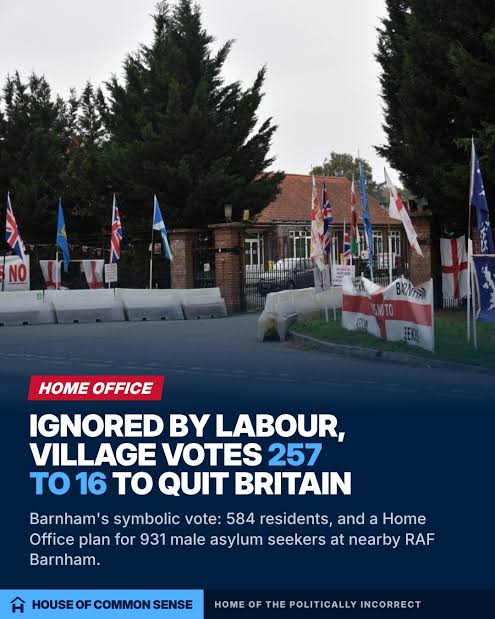
A small village in Suffolk has attracted national attention after residents overwhelmingly voted to symbolically leave the United Kingdom in protest against government plans to accommodate asylum seekers at a nearby former military base.
Barnham, a village close to Bury St Edmunds and the Norfolk border, held an unofficial referendum on Saturday, November 21, 2026. The result was decisive: 257 residents voted in favour of seeking independence, while just 16 voted against the proposal. One ballot paper was declared spoiled.
The vote represents a growing expression of frustration among residents who believe the government has failed to adequately consult local communities about large-scale asylum accommodation.
However, the result does not mean Barnham has legally separated from Britain. Instead, campaigners want the village to pursue a symbolic form of independence through a proposed crown dependency arrangement.
The controversy centres on plans to accommodate approximately 931 male asylum seekers at the former RAF Barnham site. Residents argue that such a large facility could place considerable pressure on a small rural community.
The development has also attracted political attention, with opposition figures questioning the government’s approach to asylum accommodation.
According to reporting by the BBC, The Guardian and The Independent, the referendum has become another example of growing tensions between local communities and national immigration policy.
BBC News+2
1. Barnham Residents Deliver An Overwhelming Referendum Result
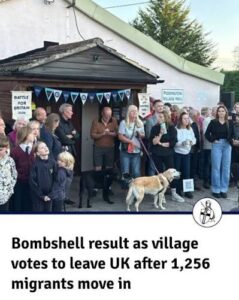
The result of the Barnham referendum sent a strong message about local opposition to the proposed asylum accommodation centre.
Out of the votes counted, 257 supported the proposal to seek a new constitutional arrangement, while 16 rejected it. One ballot was spoiled.
That means approximately 94% of valid votes supported the symbolic independence campaign.
The referendum was organised after the government identified the former RAF Barnham site as a potential location for accommodating up to 931 male asylum seekers.
For many residents, the issue goes beyond immigration. They believe decisions affecting their community should involve meaningful consultation with the people who live there.
The campaign has also focused on Barnham’s identity and its desire to preserve local control over decisions affecting the village.
Following the announcement, residents unveiled a new village flag. The design features a stone-curlew bird against a Suffolk-blue background.
The bird represents the area’s local wildlife and has become a symbol of the campaign.
Campaigners described the result as an important starting point rather than the conclusion of their efforts.
Their next objective is to attract wider attention to their concerns and challenge the proposed accommodation arrangements.
2. Why Is Barnham Protesting Against The Migrant Accommodation Plan?
The central reason behind the referendum is the government’s proposal to use the former RAF Barnham military site for asylum accommodation.
The government has identified the location as a potential facility for approximately 931 male asylum seekers.
The proposal forms part of a wider strategy to reduce the UK’s dependence on asylum hotels.
For years, the government has faced criticism over the financial cost of accommodating asylum seekers in hotels. Officials have therefore explored alternative locations, including former military properties.
However, Barnham residents argue that moving hundreds of people into a relatively small rural area could create significant challenges.
Their concerns include:
Pressure on local roads and transport infrastructure.
Questions about access to healthcare and other public services.
Community safety and security arrangements.
Limited local facilities and infrastructure.
Environmental concerns surrounding the former military site.
Insufficient consultation with residents.
Some residents also argue that the scale of the proposed facility is disproportionate to the size of their community.
Campaigners have questioned whether the government has fully considered the consequences of accommodating such a large number of people close to a small village.
However, it is important to distinguish between concerns about the proposed development and assumptions about individual asylum seekers. Asylum seekers are people whose applications for international protection are being considered. Their circumstances and backgrounds differ.
The debate therefore involves several interconnected issues, including immigration policy, local democracy, infrastructure planning and public confidence.
The Guardian+2
3. What Is The Government Planning At RAF Barnham?
The former RAF Barnham site is at the centre of the controversy.
The government wants to move away from expensive hotel accommodation and make greater use of alternative facilities.
Former military bases are among the locations being considered because they may offer larger areas of land and existing infrastructure.
RAF Barnham has consequently emerged as a potential location for a substantial asylum accommodation facility.
The proposed capacity of approximately 931 people has become one of the most controversial aspects of the plan.
Residents argue that a development of this scale could transform the character of the surrounding area.
They also want clearer information about how the accommodation would operate, what security measures would be provided and how the government would address potential pressure on local services.
The Home Office has indicated that its approach involves self-contained accommodation, round-the-clock security and CCTV.
Officials have also stated that community safety would remain an important consideration if the proposal proceeds.
Nevertheless, these assurances have not removed local opposition.
Residents want more than general promises. They are seeking specific information about the site’s management, security arrangements and the long-term impact on the village.
The government has not presented the referendum result as a legally binding decision on the site’s future.
Consequently, the dispute is likely to continue through political discussions, public campaigning and the government’s planning process.
4. Why Do Residents Want Barnham To Become A Crown Dependency?
One of the most unusual aspects of the Barnham campaign is its proposed solution.
Rather than simply demanding that the asylum accommodation plan be cancelled, campaigners have discussed seeking crown dependency status.
The idea is inspired by the constitutional arrangements of Jersey, Guernsey and the Isle of Man.
These territories have distinct constitutional relationships with the British Crown. They are not ordinary parts of the United Kingdom and have their own systems of government.
Barnham campaigners want to explore whether a similar arrangement could give their community greater independence from Westminster and the Home Office.
The proposal would involve maintaining loyalty to the Crown while seeking to remove the village from certain aspects of central government authority.
Local representatives have discussed the possibility of declaring Barnham a bailiwick.
However, there is a major legal distinction between expressing support for independence and actually achieving constitutional independence.
A village cannot become a crown dependency simply because its residents vote in an unofficial referendum.
Such a change would require extensive legal and constitutional arrangements involving the relevant authorities.
There is also no guarantee that the government would accept the proposal.
For now, the crown dependency idea remains a political campaign rather than an established constitutional process.
Nevertheless, the referendum has helped residents attract national attention to their objections.
5. The Home Office Responds To Local Concerns
The Home Office is facing difficult questions about how it intends to balance national asylum accommodation requirements with the concerns of smaller communities.
The government wants to reduce its reliance on hotels, which have attracted criticism because of their financial costs and the pressure they place on public resources.
Former military sites offer one possible alternative.
However, choosing a location does not automatically mean that the surrounding community will support the development.
In response to concerns about RAF Barnham, the Home Office has emphasised the importance of safety and security.
Its stated approach includes self-contained accommodation, 24-hour security and CCTV designed to minimise the impact on nearby communities.
The government has also indicated that a final decision on the proposal has not yet been made.
This distinction matters because residents are campaigning against a proposed development, rather than responding to a fully established accommodation facility.
The government’s challenge is to explain how the site would operate before making decisions that could significantly affect the surrounding area.
Residents want transparent communication about the number of people who would be accommodated, the expected length of their stay and the responsibilities of the authorities managing the site.
Without detailed answers, opposition could become increasingly difficult to resolve.
The Independent+1
6. Local Safety And Infrastructure Concerns Become Central Issues
Safety has become one of the most frequently discussed subjects in the Barnham controversy.
Some residents have expressed concerns about the possibility of accommodating hundreds of asylum seekers near their homes.
They fear that the village could experience changes that its existing infrastructure is not equipped to handle.
However, these concerns should be examined through evidence rather than assumptions.
The presence of asylum seekers does not establish that crime or public disorder will increase. Any assessment of community safety should consider actual evidence, policing arrangements and the management of the proposed facility.
Infrastructure is another important issue.
Small villages often have fewer public services than large towns and cities. They may have limited public transport, healthcare facilities and road capacity.
A large accommodation development could therefore require additional planning and resources.
Residents want to know whether the government will provide sufficient support to address these challenges.
Environmental questions have also entered the debate.
The Guardian reported concerns about the site’s suitability, including the presence of protected stone-curlew nesting habitat and issues involving road access.
These considerations make the controversy more complicated than a straightforward argument about immigration.
The government must consider whether the location is suitable for the proposed development, while residents want assurances that their community and surrounding environment will not be overlooked.
The Guardian+1
7. Political Leaders React To The Barnham Independence Vote
The referendum has attracted attention from politicians who have criticised the government’s approach to asylum accommodation.
Conservative leader Kemi Badenoch has expressed support for residents opposing the proposed development.
Her intervention reflects wider Conservative criticism of the government’s immigration and asylum policies.
Reform UK has also highlighted the result as an example of grassroots opposition to decisions made by central government.
The party’s home affairs spokesman, Zia Yusuf, attended the event and described the campaign as a people’s movement.
Political involvement has increased the national significance of the referendum.
What began as a local dispute has become part of a broader political argument about immigration, government accountability and the relationship between Westminster and rural communities.
However, political support does not change the legal position of the referendum.
Neither Conservative nor Reform UK backing can automatically grant Barnham independence or prevent the government from pursuing its accommodation plans.
The result instead provides political evidence of the strength of local opposition.
For opposition parties, the dispute offers an opportunity to question the government’s immigration strategy.
For the government, it creates another challenge in explaining why certain locations are selected and how local communities will be protected.
thetimes.com+1
8. Barnham Follows A Similar Secession Vote In Oxfordshire
Barnham is not the first British village to use a symbolic independence referendum to protest against asylum accommodation plans.
In September 2026, residents of Piddington in Oxfordshire held a similar vote after the government announced plans involving the former RAF Bicester site.
The proposed facility there was intended to accommodate approximately 1,256 male asylum seekers.
Residents of Piddington also explored the idea of symbolically separating from the United Kingdom.
The similarities between the two campaigns are significant.
Both communities used unconventional political demonstrations to challenge decisions involving former military properties.
Both wanted to attract national attention to concerns about local consultation, infrastructure and the scale of proposed accommodation.
However, the Piddington experience also demonstrates the limitations of symbolic secession.
Despite the campaign, the government subsequently approved the use of the former RAF Bicester site for asylum accommodation through emergency planning powers.
That development is particularly relevant to Barnham.
It suggests that even an overwhelming local referendum result may not stop a government project.
Residents can raise objections, attract political support and pursue appropriate legal challenges, but an unofficial vote does not automatically override national planning decisions.
For Barnham campaigners, Piddington provides both a warning and an example of how such protests can develop.
thetimes.com+2
9. What Does The 257-16 Vote Actually Mean?
Although the referendum result is politically significant, its legal importance is limited.
The 257-16 outcome demonstrates overwhelming support among participating voters for seeking symbolic independence.
However, the vote does not establish a new country, change Barnham’s legal status or remove the village from UK jurisdiction.
There are several reasons why the result cannot be treated as a formal declaration of independence.
First, the referendum was unofficial.
It was organised as a local expression of opposition rather than a legally recognised national constitutional referendum.
Second, the village cannot independently change its constitutional position.
The creation of a crown dependency would involve complex legal and political arrangements.
Third, the government retains its existing legal authority.
The referendum does not automatically cancel Home Office plans or prevent relevant planning decisions.
Fourth, the result reflects participating voters.
Although the margin was decisive, the figures should not be confused with unanimous support from every resident.
The referendum is therefore best understood as a protest vote with political significance.
Its greatest impact may be its ability to attract media coverage and force decision-makers to address local concerns.
10. Could Barnham Actually Become Independent From The UK?
The question of whether Barnham could become independent is likely to attract considerable attention.
However, the practical obstacles are substantial.
Jersey, Guernsey and the Isle of Man have long-established constitutional arrangements. Their status developed through centuries of legal and historical relationships with the British Crown.
A small English village does not automatically qualify for the same arrangement.
For Barnham to pursue a comparable constitutional position, campaigners would need to establish a credible legal route.
That would involve discussions about governance, public administration, taxation, legal jurisdiction and the relationship with the UK government.
It would also raise questions about how such a territory would function in practice.
For example, residents would need clarity about policing, courts, public services and the administration of local government.
There is currently no indication that Barnham has secured government agreement for such a change.
Therefore, describing the village as having officially become independent would be inaccurate.
The campaign’s language is deliberately symbolic. It is designed to communicate the strength of residents’ frustration and create pressure for political action.
Whether the proposal develops beyond that stage remains uncertain.
11. The Wider Debate Over Britain’s Asylum Accommodation Policy
The Barnham controversy highlights a wider challenge facing the British government.
The UK continues to face pressure to manage asylum applications while providing suitable accommodation for people seeking international protection.
Hotels have become a politically sensitive part of the system because of their cost and the length of time some applicants remain in temporary accommodation.
The government wants to identify alternative sites that can accommodate larger numbers of people.
Former military bases appear attractive because they can potentially provide space for secure and self-contained facilities.
However, these locations are not always close to large urban centres.
That creates difficult questions about transport, healthcare, employment opportunities and access to legal support.
It also creates tensions with nearby communities.
Local residents may feel that decisions are being imposed on them without sufficient consultation.
Meanwhile, people seeking asylum require safe accommodation and access to a fair application process.
A successful policy must consider both responsibilities.
The Barnham dispute demonstrates why consultation should happen early, rather than after a proposal has already generated significant public opposition.
The government must explain why a location has been selected, what alternatives were considered and how the needs of the surrounding community will be addressed.
Without that transparency, similar controversies could emerge elsewhere.
12. What Happens Next For Barnham?
Following the referendum, residents are expected to continue their campaign against the proposed asylum accommodation development.
The overwhelming result has provided campaigners with a significant publicity boost.
However, the most important questions remain unresolved.
Residents want to know whether the government will proceed with the RAF Barnham proposal, whether further consultations will take place and what safeguards will be introduced.
The proposed crown dependency campaign may also develop further, although its legal prospects remain uncertain.
The government’s next steps will be important.
If officials decide to proceed, they will need to explain the planning arrangements, security measures and expected impact on local infrastructure.
They will also need to address environmental concerns and communicate with residents.
For campaigners, the immediate challenge is turning public attention into meaningful political or legal action.
The experience of Piddington suggests that symbolic independence votes alone may not be enough to change government policy.
Nevertheless, Barnham’s referendum has made it harder for decision-makers to ignore the strength of local opposition.
Conclusion: Barnham’s Secession Vote Sends A Strong Political Message
The Suffolk village of Barnham has delivered an extraordinary referendum result, with 257 residents voting in favour of symbolically leaving the United Kingdom and just 16 voting against.
The protest follows government proposals to accommodate approximately 931 male asylum seekers at the nearby former RAF Barnham site.
Although the result has no direct legal effect, it demonstrates the level of frustration among participating residents.
The campaign also raises important questions about local democracy, immigration policy, community safety and the government’s responsibility to consult people affected by major developments.
The proposed crown dependency arrangement remains an idea rather than an established constitutional reality.
For now, Barnham remains part of the United Kingdom.
However, the referendum has transformed a local planning dispute into a national political story.
The next test will be whether the government can address residents’ concerns while continuing its efforts to reform the UK’s asylum accommodation system.
Frequently Asked Questions (FAQs)
1. Why did the Suffolk village vote to secede from the UK?
Barnham residents voted symbolically to leave the UK in protest against government plans to accommodate approximately 931 male asylum seekers at the nearby former RAF Barnham site.
2. What was the result of the Barnham referendum?
A total of 257 residents voted in favour of seeking symbolic independence, while 16 voted against. One ballot was spoiled.
3. Has Barnham officially left the United Kingdom?
No. The referendum was symbolic and legally non-binding. Barnham remains part of the United Kingdom.
4. Where is Barnham located?
Barnham is a village in Suffolk, England, near Bury St Edmunds and the Norfolk border.
5. How many asylum seekers could be accommodated at RAF Barnham?
The government’s proposal involves accommodating approximately 931 male asylum seekers at the former RAF Barnham military site.
6. What is crown dependency status?
A crown dependency is a self-governing territory with a constitutional relationship with the British Crown. Jersey, Guernsey and the Isle of Man are examples.
7. Who supported the Barnham independence campaign?
The campaign attracted attention from opposition politicians, including Conservative leader Kemi Badenoch and Reform UK’s home affairs spokesman Zia Yusuf.
8. Is Barnham the first UK village to hold a symbolic secession vote?
No. Piddington in Oxfordshire held a similar symbolic referendum in September 2026 over plans to accommodate asylum seekers at the former RAF Bicester site.
9. Will the referendum stop the asylum accommodation centre?
Not automatically. The referendum has no legal power to cancel government proposals or override planning decisions.
10. What happens next after the 257-16 vote?
Residents are expected to continue campaigning, seek political support and explore their proposed constitutional arrangements. The government must still address concerns surrounding the RAF Barnham proposal.
About the Author