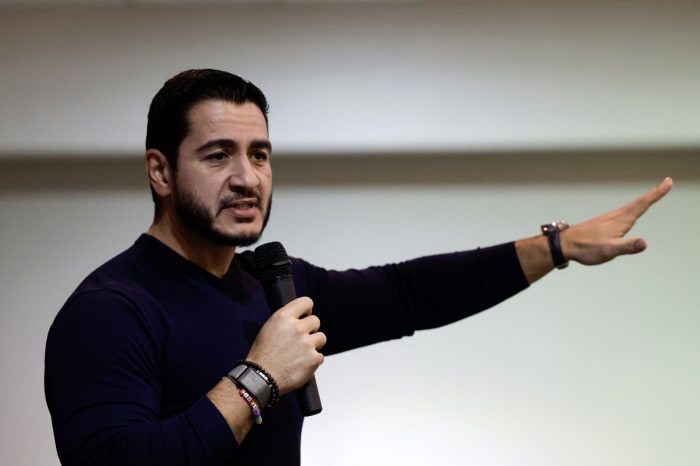
A political confrontation involving Michigan Democratic Senate candidate Abdul El-Sayed has attracted widespread attention after a campaign event exchange about the Muslim Brotherhood went viral on social media. What began as a direct question about the controversial Islamist movement quickly developed into a broader discussion about religious freedom, constitutional loyalty and the treatment of Muslim Americans in political campaigns.
The exchange gained attention because El-Sayed did more than answer the question. He challenged the assumptions behind it and asked why his religious identity appeared to be connected to questions about his loyalty to the United States.
The video spread rapidly online, generating praise from supporters and criticism from political opponents. Some viewers described his response as a powerful moment, while others questioned his approach and argued that candidates should face direct questions about controversial political movements.
The confrontation has also become a source of online jokes, memes and political commentary. However, beyond the viral reactions, the incident highlights a larger debate about religion, identity and political accountability in American elections.
According to reporting by The Washington Post and PolitiFact, the exchange took place during a Michigan campaign event on October 17, 2026.
The Washington Post+1
How the Abdul El-Sayed Muslim Brotherhood Confrontation Started
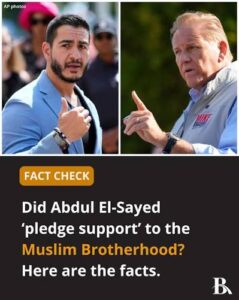
The controversy began when an attendee at an event asked El-Sayed whether he would disavow the Muslim Brotherhood.
The question was direct and politically sensitive. The Muslim Brotherhood is an Islamist movement founded in Egypt in 1928. Its political influence and activities have remained controversial across several countries.
Rather than avoiding the question, El-Sayed responded affirmatively.
“Sure, yeah, absolutely,” he said.
However, he immediately challenged the reason behind the question. He asked the attendee what he was implying and whether he assumed that El-Sayed would refuse to condemn the organization.
That response changed the direction of the exchange.
Instead of allowing the discussion to remain focused exclusively on the Muslim Brotherhood, El-Sayed questioned why his Muslim faith appeared to be treated as a reason to suspect divided loyalties.
The moment became especially significant because El-Sayed connected the issue to the constitutional rights of Americans.
He explained that he would swear an oath to the U.S. Constitution if elected to the Senate. He also emphasized that the Constitution protects the right of Americans to practice their religion or choose not to follow a religion.
The response quickly became a major talking point in the Michigan Senate race.
Why the Viral Video Attracted So Much Attention
Political videos regularly circulate online, but this confrontation attracted attention because it combined several sensitive issues.
First, the question involved a controversial international political movement. Second, it involved a Muslim candidate seeking a seat in the United States Senate. Finally, the response raised questions about whether religious identity should influence how voters judge political candidates.
El-Sayed’s campaign shared footage of the exchange online, helping it reach a much larger audience.
The video also became popular because viewers could interpret the confrontation in different ways.
Supporters considered it an effective response to what they viewed as an unfair question. They argued that a candidate should not have to repeatedly prove loyalty to the country because of his religious background.
Critics, meanwhile, maintained that public officials and candidates should answer questions about political movements and their possible influence.
The debate extended beyond the original event, with political commentators discussing the exchange and its implications for the upcoming election.
The controversy also generated memes and jokes, making the confrontation part of a wider online political conversation.
AOL+1
El-Sayed Turns the Question Toward Religious Freedom
One of the most discussed parts of the confrontation was El-Sayed’s comparison with former President John F. Kennedy.
Kennedy, who became America’s first Catholic president, faced questions during his 1960 presidential campaign about whether his religious beliefs would influence his decisions in the White House.
At the time, some voters questioned whether a Catholic president would follow the instructions of the pope rather than the American Constitution.
El-Sayed used that historical example to explain why he considered the question about the Muslim Brotherhood problematic.
He argued that being Muslim should not automatically create suspicion about his political loyalties.
During the exchange, he made clear that he was not running to become a Muslim senator. Instead, he was running to represent Americans and happened to be Muslim.
The comparison resonated with supporters who viewed the incident as part of a longer history of religious prejudice in American politics.
It also gave the confrontation a broader political dimension. Rather than being only about one candidate and one organization, the exchange became a discussion about whether religious minorities receive equal treatment in public life.
Who Was the Man Who Questioned Abdul El-Sayed?
Another important development emerged after the confrontation attracted national attention.
The man who questioned El-Sayed was identified in media reports as Thomas “Tommy” Teepell.
According to The Guardian, Teepell previously worked in Republican politics, including in the office of Republican Senator Josh Hawley.
The newspaper also reported that his father, Timothy “Timmy” Teepell, was a longtime Republican political strategist whose firm received a $250,000 payment from the conservative nonprofit America Next for canvassing and influencer marketing.
These details added another layer to the controversy.
The connection raised questions about whether the confrontation was a spontaneous interaction or part of a broader political effort to challenge El-Sayed.
However, it is important to distinguish documented information from assumptions.
The Guardian reported the family and political connections, but those connections alone do not establish that the heckler was acting under instructions from a particular campaign.
The Michigan Daily also found no evidence that Republican Senate candidate Mike Rogers’ campaign was involved in the plan to disrupt the Flint event, according to the Guardian’s reporting.
The identity and background of the questioner consequently became a separate subject of political discussion.
The Guardian+1
The Muslim Brotherhood Controversy Explained
The Muslim Brotherhood is an Islamist political and social movement established in Egypt in 1928 by Hassan al-Banna.
Over the decades, the organization developed branches and affiliated movements across parts of the Middle East and other regions.
Its political role has been controversial. Some supporters have viewed it as a movement for political participation and social reform, while critics have accused it of promoting political Islam and undermining democratic institutions.
Different governments have taken different positions toward the organization and its branches.
Some countries have banned or designated particular branches as terrorist organizations. The United States has also taken action against certain entities and individuals associated with the movement.
In 2025, President Donald Trump issued an executive order initiating a process to consider designating certain Muslim Brotherhood branches as foreign terrorist organizations.
It is important, however, to distinguish between the organization as a whole, its various branches and individuals associated with different political movements.
These distinctions matter when discussing allegations involving a particular person.
In El-Sayed’s case, the central political question has been whether he personally has any connection to the Muslim Brotherhood.
El-Sayed has repeatedly denied having ties to the organization.
The controversy intensified after political opponents highlighted older statements and documents involving his family and his views on Egyptian politics.
However, public reporting has not established that El-Sayed himself is a member of the Muslim Brotherhood.
PolitiFact+1
What Did El-Sayed Say About His Alleged Connections?
El-Sayed has pushed back against allegations that he or his family has direct connections to the Muslim Brotherhood.
In earlier interviews, he described the assumption that he had such connections as unreasonable.
One source of controversy involved older social media posts attributed to his half-sister.
Those posts reportedly discussed their mother’s activism and historical involvement with the Muslim Brotherhood during the 1970s.
Republican critics used the posts to raise questions about El-Sayed’s family background.
However, El-Sayed responded that he was not raised by his mother and did not know what she was doing in Egypt during that period.
He also argued that claims based on relatives’ social media posts should not be treated as proof of his own political affiliations.
This distinction is important.
A relative’s political views or historical activities do not automatically establish another family member’s membership in or support for an organization.
The allegations have nevertheless remained part of the political debate surrounding his Senate campaign.
El-Sayed has maintained that his focus should be on voters’ concerns, including economic pressures, healthcare and the direction of the country, rather than repeatedly answering accusations about his religious background.
AOL+1
Mike Rogers Challenges El-Sayed’s Response
The viral confrontation also created an opportunity for Republican Senate candidate Mike Rogers to criticize his political opponent.
Rogers argued that El-Sayed had not adequately answered the question about the Muslim Brotherhood.
In an October 18 interview with CNN, Rogers claimed that El-Sayed had not disavowed the organization.
However, the video provided important context.
El-Sayed had explicitly answered, “Sure, yeah, absolutely,” when asked whether he would disavow the Muslim Brotherhood.
That detail became central to a fact-check published by PolitiFact on October 19, 2026.
PolitiFact rated Rogers’ claim that El-Sayed did not disavow the organization as false.
The fact-check explained that El-Sayed clearly gave an affirmative answer before challenging the assumptions behind the question.
The distinction is significant because answering a question and challenging its framing are not mutually exclusive.
A candidate can condemn an organization while also questioning why the issue is being raised in a particular way.
That is precisely what happened during the exchange.
The disagreement between Rogers and El-Sayed demonstrates how a short campaign video can become a larger political dispute when candidates interpret the same moment differently.
PolitiFact+1
Why the Exchange Became a Political Meme
The confrontation quickly moved beyond traditional political reporting.
Social media users began sharing screenshots, short clips and humorous captions about the interaction.
The phrase “What are you implying?” became one of the most recognizable parts of the exchange.
The viral joke angle emerged from the contrast between the questioner’s attempt to put El-Sayed on the defensive and the candidate’s decision to challenge the question itself.
For supporters, the moment demonstrated confidence and quick thinking.
For critics, the exchange raised questions about whether the candidate should have focused more heavily on the organization’s ideology and political activities.
Political memes often simplify complicated issues into short, memorable moments. This can help a video reach millions of people, but it can also remove important context.
In this case, the full conversation matters.
El-Sayed did not simply refuse to answer the question. He gave an affirmative answer and then challenged the implication that his Muslim identity made his loyalty questionable.
That context is essential for understanding why the video generated such different reactions.
The confrontation also illustrates how modern political campaigns use social media to communicate directly with voters.
A single exchange at a campaign event can become a national talking point within hours, influencing how supporters and opponents discuss a candidate.
Religious Identity Becomes a Major Issue in the Michigan Senate Race
The confrontation comes at a politically important time for Michigan.
El-Sayed is seeking election to the U.S. Senate and has faced scrutiny over his background, political positions and religious identity.
If elected, he would become the first Muslim to serve in the United States Senate.
That possibility has added significance to the debate surrounding his campaign.
Supporters argue that his candidacy represents an important moment for political representation and religious freedom. They believe voters should evaluate him based on his policies, experience and ability to represent Michigan residents.
Critics argue that candidates must be prepared to answer difficult questions about their political beliefs and associations, regardless of their personal background.
Both arguments have become part of the wider campaign discussion.
However, questions about a candidate’s personal beliefs should be supported by evidence rather than assumptions based solely on religious identity.
The controversy also highlights the challenges faced by candidates from religious minority communities when national security and international political movements become campaign issues.
For El-Sayed, the challenge is to keep the campaign focused on Michigan voters while responding to controversies that continue to attract national attention.
What the Controversy Means for El-Sayed’s Campaign
The viral confrontation could have several implications for El-Sayed’s political future.
First, it has increased his visibility among voters who may not have previously followed his campaign.
A widely shared video can introduce a candidate to new audiences and create opportunities to communicate political messages without relying entirely on traditional media coverage.
Second, the exchange has strengthened the discussion around religious freedom.
By comparing his experience with Kennedy’s historical campaign, El-Sayed presented the confrontation as part of a broader American debate about religious tolerance.
Third, the incident has given political opponents another opportunity to challenge his statements and campaign positions.
Republicans may continue highlighting the Muslim Brotherhood controversy, particularly when discussing national security and foreign policy.
Democrats, meanwhile, may use the exchange to criticize what they describe as attempts to question Muslim Americans’ loyalty without sufficient evidence.
Ultimately, the impact will depend on whether voters consider the controversy relevant to the issues that matter most in Michigan.
Economic conditions, healthcare, employment, immigration and national security are likely to remain important campaign subjects.
The viral moment may attract attention, but election outcomes are rarely determined by a single social media confrontation.
Social Media Reactions Reveal a Wider Political Divide
The online reaction to the video reflects the political divisions surrounding religion and national identity in the United States.
Many supporters praised El-Sayed for refusing to accept what they considered an unfair premise.
They argued that American citizens should not be expected to prove their loyalty simply because they belong to a particular religious community.
Others defended the questioner’s right to ask about the Muslim Brotherhood, arguing that public candidates should be prepared to discuss controversial organizations.
The disagreement illustrates a difficult balance in democratic politics.
Candidates should face legitimate questions about their beliefs, associations and policy positions. At the same time, those questions should be based on evidence and applied fairly.
The viral exchange has also demonstrated how social media can amplify political disagreements.
Short clips encourage rapid reactions, while longer videos and fact-checks provide additional context.
For voters, understanding the complete exchange is more useful than relying on isolated statements or humorous captions.
The Bigger Picture: Faith, Politics and Constitutional Loyalty
Beyond the immediate controversy, the confrontation raises an important question about the relationship between religious freedom and public service.
The U.S. Constitution protects religious liberty and establishes the framework through which elected officials exercise their responsibilities.
Candidates from different religious backgrounds can seek public office while remaining bound by the same constitutional obligations.
El-Sayed used this principle to challenge the implication behind the Muslim Brotherhood question.
His comparison with John F. Kennedy also demonstrated that concerns about religious identity in American politics are not entirely new.
However, the current political environment adds different challenges, particularly when debates about terrorism, international conflicts and national security become connected to domestic elections.
The key distinction is between legitimate scrutiny of political beliefs and assumptions about a person’s loyalty based on religion.
That distinction will likely remain important throughout the Michigan Senate campaign.
Conclusion
The viral confrontation between Abdul El-Sayed and an attendee questioning him about the Muslim Brotherhood has become one of the more talked-about moments in Michigan’s Senate campaign.
El-Sayed answered that he would disavow the organization before challenging the assumptions behind the question. His response transformed a brief exchange into a national conversation about religious freedom, constitutional loyalty and political accountability.
The controversy also expanded after reports revealed the questioner’s political background and connections to a Republican strategist.
While supporters praised El-Sayed’s response, critics continued questioning his political positions and the broader controversy surrounding his family background.
PolitiFact’s review confirmed that El-Sayed did explicitly disavow the Muslim Brotherhood during the exchange, contradicting Rogers’ claim that he had not done so.
As the campaign continues, the incident will remain an example of how religion, politics and social media can collide during an American election.
Ultimately, Michigan voters will decide whether this controversy matters more than the policy questions shaping their future.
Frequently Asked Questions (FAQs)
1. Who is Abdul El-Sayed?
Abdul El-Sayed is a Democratic politician and physician from Michigan who is running for the U.S. Senate. His campaign has attracted national attention because of his political positions and the controversy surrounding questions about his alleged connections to the Muslim Brotherhood.
2. Why did Abdul El-Sayed confront someone about the Muslim Brotherhood?
An attendee asked El-Sayed whether he would disavow the Muslim Brotherhood. El-Sayed answered yes but challenged the implication that his Muslim faith made his loyalty to the United States questionable.
3. Did Abdul El-Sayed disavow the Muslim Brotherhood?
Yes. During the viral exchange, El-Sayed responded, “Sure, yeah, absolutely.” PolitiFact subsequently rated Mike Rogers’ claim that El-Sayed had not disavowed the organization as false.
4. Who was the man who questioned El-Sayed?
Media reports identified the questioner as Thomas “Tommy” Teepell, who previously worked in Republican politics and served in Senator Josh Hawley’s office.
5. Why did the Abdul El-Sayed video go viral?
The video attracted attention because El-Sayed challenged the assumptions behind a question about his religious identity and constitutional loyalty. Supporters praised his response, while critics questioned his approach.
6. What is the Muslim Brotherhood?
The Muslim Brotherhood is an Islamist political and social movement founded in Egypt in 1928. Its activities and political influence have generated significant controversy, and different countries have adopted different policies toward its branches.
7. Has Abdul El-Sayed admitted having ties to the Muslim Brotherhood?
No. El-Sayed has denied having personal connections to the organization and has challenged allegations based on his family’s historical background.
8. What did Mike Rogers say about the confrontation?
Republican Senate candidate Mike Rogers claimed that El-Sayed had not disavowed the Muslim Brotherhood. However, PolitiFact reviewed the video and found that El-Sayed had explicitly answered yes.
9. Did El-Sayed compare himself with John F. Kennedy?
Yes. El-Sayed referenced Kennedy’s experience as America’s first Catholic president, explaining that religious identity should not determine assumptions about a candidate’s constitutional loyalty.
10. Why is the confrontation important for the Michigan Senate race?
The incident has increased attention on El-Sayed’s campaign and highlighted debates about religious freedom, national security, political accountability and representation in American politics.
About the Author