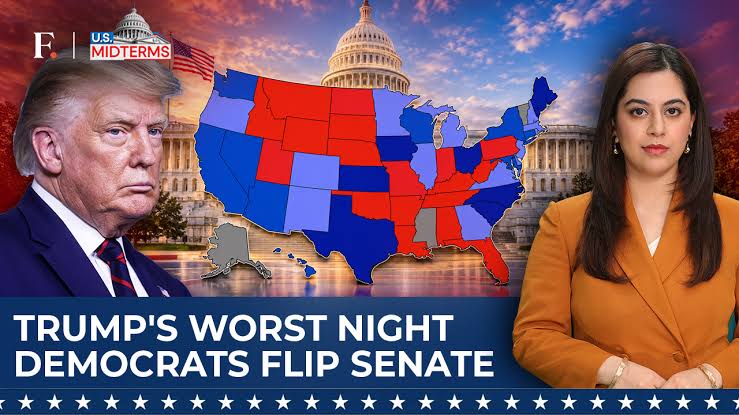
The Associated Press called the House for Democrats early Wednesday morning, confirming a historic victory that followed the party’s successful return to control of the Senate. The results end two years of unified Republican control of Congress and set the stage for a new era of divided government under President Donald Trump.
The election delivered a powerful message about voter dissatisfaction with the economy, rising living costs, the administration’s policies and the direction of the country. Democrats now have an opportunity to reshape congressional priorities, strengthen oversight of the executive branch and challenge Republican policies.
However, the election victory does not mean Democrats can immediately implement every part of their agenda. They will face a Republican president with veto power, intense political divisions and difficult negotiations over major legislation.
The stunning sweep also raises important questions about the future of the Republican Party, the direction of the Democratic leadership and the political consequences of the election for the 2028 presidential race.
Democrats secure majorities in both chambers

The 2026 midterm elections produced a dramatic change in the balance of power in Washington. Democrats won control of the House and Senate, giving the party a powerful position in the legislative branch.
According to the Associated Press, Democrats secured a decisive victory in the House early Wednesday. The party also regained the Senate after winning several Republican-held seats.
The results represent a significant setback for Republicans, who entered the election with control of both chambers. Democrats had campaigned on affordability, economic concerns and the need for stronger congressional oversight.
The election also demonstrated that competitive races can change the balance of power even in states that have traditionally favored Republicans.
Democrats made substantial gains in several states that President Trump carried in the 2024 presidential election. Their victories in traditionally Republican territory helped deliver the congressional majorities.
The new Congress will begin its work in January 2027. Until then, Republicans will continue to control the current Congress, while both parties prepare for the transition.
The election results therefore create an important period of political uncertainty. Democrats have secured a new mandate from voters, but the practical consequences will depend on the final composition of Congress and the policies the incoming leadership chooses to pursue.
A major setback for President Donald Trump
The Democratic sweep represents one of the most consequential political setbacks of Trump’s second presidency.
Midterm elections often serve as a referendum on the president’s performance. This election was no exception. Voters expressed dissatisfaction with economic conditions, the cost of living and the administration’s handling of major national issues.
Reuters reported that frustration over the war with Iran, concerns about living costs and dissatisfaction with Trump’s leadership contributed to the Democratic gains.
Investing.com+1
The results also suggest that the Republican coalition that delivered Trump’s 2024 victory faced significant challenges in the midterm elections.
Democrats made gains in states where Republicans had previously enjoyed strong support. Their victories demonstrated that economic concerns and national political issues can influence voting patterns even in traditionally Republican areas.
Trump has acknowledged the possibility of political gridlock under a Democratic-controlled Congress. He has also indicated that he remains open to negotiations while warning that he could veto legislation he opposes.
ksl.com+1
The president’s ability to shape national policy will therefore depend increasingly on his willingness to negotiate with Democratic congressional leaders.
Democrats gain a powerful position in the Senate
The Senate results were among the most significant developments of the election.
Democrats regained control after flipping several Republican-held seats. The Associated Press reported that the party secured enough victories to take control of the chamber, while Reuters described the results as a sweeping rejection of the Republican-controlled Congress.
AP News+1
The Senate plays a central role in confirming presidential appointments, approving treaties and considering legislation.
With a Democratic majority, the chamber will have greater power to scrutinize the Trump administration’s nominees and policies.
The change could have significant consequences for judicial appointments, executive branch leadership and the administration’s legislative priorities.
Democratic control of the Senate will also strengthen the party’s position in negotiations with the White House.
However, the precise balance of power will depend on the final results of every Senate race and the membership of the incoming chamber.
House Democrats prepare to take the speaker’s office
The Democratic victory in the House has positioned House Minority Leader Hakeem Jeffries to become the next speaker.
Jeffries has led House Democrats since 2023 and is now expected to play a central role in shaping the party’s legislative agenda.
If elected speaker by his colleagues, he would become the first Black speaker of the House. The position would give him significant influence over the chamber’s legislative schedule, committee assignments and oversight priorities.
Forbes+1
Jeffries has emphasized that Democrats must focus on delivering results for voters rather than pursuing political revenge.
His leadership will be tested by the challenge of uniting Democrats with different priorities and political approaches.
Progressive members may demand aggressive investigations and sweeping legislative changes. More moderate Democrats may prefer a narrower agenda focused on economic issues and bipartisan agreements.
The incoming speaker will need to balance those competing demands while maintaining party unity.
Republicans, meanwhile, will have to adjust to their new position in the minority. The party will lose control of the House’s agenda and committee leadership, limiting its ability to advance legislation without Democratic support.
Cost of living becomes a central Democratic priority
Affordability was one of the most important issues in the 2026 election.
Democrats have promised to make lowering everyday expenses a central part of their congressional agenda.
Their proposals include efforts to reduce the cost of groceries, gasoline and other essential goods. They have also promised to address healthcare expenses and the affordability of housing.
According to the Associated Press, Democratic leaders are preparing a 100-day agenda that includes measures to lower living costs and restore certain provisions of the Affordable Care Act and Medicaid.
ksl.com+1
The election results give Democrats an opportunity to pursue these priorities from a position of greater legislative strength.
However, passing major economic legislation will not be straightforward.
Republicans may oppose Democratic proposals that involve significant federal spending, tax increases or changes to existing economic policies.
The White House will also have the power to veto legislation.
Democrats will therefore need to identify proposals that can attract enough support to overcome political divisions.
Their ability to deliver meaningful economic improvements will be an important test of whether the election victory translates into lasting political support.
Investigations and congressional oversight could intensify
One of the most immediate consequences of the Democratic sweep could be a major expansion of congressional oversight.
Democratic leaders have indicated that they intend to investigate the Trump administration and examine its handling of government programs, spending and executive authority.
Control of congressional committees gives the majority party important investigative powers.
Committees can hold hearings, request documents, question administration officials and examine the implementation of federal policies.
Democrats are expected to use those powers to scrutinize the administration’s actions and demand greater accountability.
The Associated Press reported that Democrats are preparing an extensive oversight agenda, including investigations of the Trump administration.
AP News+1
Some Democrats have also raised the possibility of impeachment proceedings.
However, an impeachment process would involve major constitutional and political challenges. The House can impeach federal officials through a majority vote, but conviction in the Senate requires a two-thirds majority of senators present.
Democratic control of both chambers does not automatically guarantee the votes needed for conviction.
The extent of future investigations will depend on the priorities of congressional leaders, the evidence available and the political consequences of pursuing particular cases.
Republicans face a difficult leadership transition
The election results have created an immediate leadership challenge for Republicans.
House Speaker Mike Johnson announced that he would not seek reelection as the party’s leader following the Republican losses. His decision marks a significant moment for a party that had controlled the House before the election.
ksl.com+1
Republicans must now decide how to organize their opposition and identify leaders who can unite the party.
The leadership transition could expose divisions between lawmakers who favor cooperation with Democrats and those who want a more confrontational approach.
Republicans will also need to reassess their campaign strategy after losing congressional seats in states that had previously supported Trump.
The party’s future direction may depend on how its leaders respond to the election results and whether they change their approach to economic policy, immigration and national security.
The loss of congressional control also creates uncertainty for Republican lawmakers preparing for the next presidential election cycle.
Historic victories reshape the political landscape
The Democratic sweep included several historic victories that will change the composition of Congress.
In Michigan, Abdul El-Sayed defeated Republican Mike Rogers in the Senate race. His victory will make him the first Muslim member of the United States Senate.
Democrat James Talarico also won a major Senate victory in Texas, where the party had faced a long period of statewide electoral difficulties.
The election produced other notable victories in states including Maine, Iowa, Kansas and North Carolina.
Forbes+1
These results demonstrate the changing political landscape across the United States.
Democrats also gained ground in areas where Republicans had previously enjoyed strong support, showing that electoral coalitions can shift significantly between election cycles.
The historic victories are likely to influence both parties’ future strategies as they prepare for upcoming elections.
What happens next in Washington?
The next major milestone will be the opening of the new Congress in January 2027.
Until then, the current Republican-controlled Congress will continue its work. Lawmakers must also prepare for the transition of leadership and committee responsibilities.
Once the new Congress convenes, Democrats will have the opportunity to organize the House and Senate around their priorities.
The first months of the new Congress will likely focus on government funding, economic policy and congressional oversight.
The government funding deadline could become an early test of whether Democrats and Republicans can reach an agreement.
A failure to negotiate could increase the risk of a government shutdown, particularly if both parties take hard positions on spending and policy conditions.
Democratic leaders will also need to decide which campaign promises can be translated into legislation quickly.
The party’s ability to manage its new majorities will be closely watched by voters, political analysts and the White House.
What the election means for the 2028 presidential race
The 2026 midterm results are likely to influence the early political calculations surrounding the 2028 presidential election.
Democrats will enter the next election cycle with renewed confidence after their congressional victories.
The results could strengthen the position of Democratic leaders who argue that the party should focus on economic issues, democratic institutions and opposition to Trump’s agenda.
However, winning congressional elections does not automatically determine the outcome of a presidential race.
The political environment may change significantly over the next two years. Economic conditions, international developments and the performance of the new Congress will all influence voter attitudes.
Republicans will also have an opportunity to rebuild their political position and develop a new strategy for the next election.
The coming years will therefore be important for both parties as they attempt to turn the midterm results into lasting political support.
Conclusion: A stunning sweep with major consequences
The Democratic victory in the 2026 midterm elections marks a dramatic turning point in American politics.
By reclaiming control of both the House and Senate, Democrats have gained a powerful position to influence legislation, investigate the Trump administration and challenge Republican policies.
The results also represent a significant setback for Republicans and create new challenges for the White House.
However, the election victory is only the beginning of a difficult governing process.
Democrats must now demonstrate that they can deliver on their promises, maintain party unity and work effectively within a divided government.
Their success will depend on whether they can turn electoral gains into meaningful improvements in the lives of American voters.
The coming months will reveal whether the stunning sweep becomes a lasting political realignment or simply another dramatic moment in the country’s closely divided political landscape.
Frequently asked questions
1. Did Democrats win control of both chambers of Congress in 2026?
Yes. Democrats won control of both the House of Representatives and the Senate in the November 3, 2026, midterm elections. The Associated Press confirmed the party’s victory in the House early Wednesday morning.
AP News+1
2. Why is the Democratic congressional victory significant?
The victory ends two years of unified Republican control of Congress. Democrats will have greater power to influence legislation, oversee the administration and scrutinize presidential appointments.
3. Will Hakeem Jeffries become the next House speaker?
Jeffries is positioned to become the next speaker, but he must first be elected by members of the incoming House. If elected, he would become the first Black speaker of the House.
Forbes+1
4. What issues will Democrats prioritize?
Democrats have identified affordability, healthcare costs, economic policy and congressional oversight as major priorities. Their proposed agenda includes measures aimed at lowering everyday expenses and restoring certain healthcare provisions.
5. Can Democrats stop President Trump’s agenda?
Democratic control of Congress gives the party greater power to challenge the administration. However, Trump retains presidential authority and can veto legislation. Major policy changes will therefore require negotiations or sufficient congressional support to overcome a veto.
6. Will Democrats investigate the Trump administration?
Democratic leaders have indicated that they intend to expand congressional oversight and investigate the administration. The scope and timing of any investigations will depend on congressional priorities and the evidence available.
7. When will the new Congress begin?
The incoming Congress is scheduled to convene in January 2027. Until then, the current Congress will continue its work and prepare for the transition.
8. Does the Democratic victory guarantee a Democratic president in 2028?
No. Midterm elections and presidential elections have different dynamics. The 2026 results may influence the 2028 campaign, but the presidential outcome will depend on future candidates, voter priorities and political developments.
About the Author