MARCO RUBIO ZELENSKYY INTEL: Secretary Of State Denies Pause In US Intelligence Sharing With Ukraine
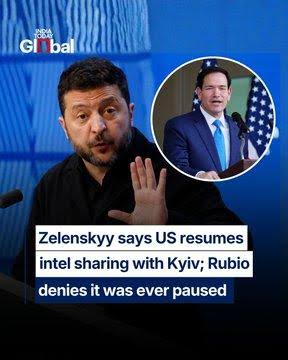
U.S. Secretary of State Marco Rubio has denied claims that Washington temporarily suspended intelligence sharing with Ukraine, contradicting Ukrainian President Volodymyr Zelenskyy’s account of a brief interruption. The disagreement comes amid rising tensions between Washington and Kyiv over military assistance, Russian attacks, and efforts to negotiate an end to the war.
Rubio’s remarks have raised fresh questions about the reliability of U.S.-Ukraine coordination at a critical moment in the conflict. Although American officials insist that intelligence cooperation has continued, Ukrainian officials have expressed concern about missing early warnings before Russian missile attacks.
The dispute also highlights a wider diplomatic challenge for both governments: maintaining military cooperation while disagreeing over the best way to bring the war to an end.
Marco Rubio rejected claims that the United States had temporarily stopped sharing intelligence with Ukraine. Speaking to reporters in Samarkand, Uzbekistan, on October 19, 2026, the secretary of state said there had been no interruption in the intelligence relationship between the two countries.
Rubio directly challenged Zelenskyy’s public account and questioned why the Ukrainian president had described the situation as a temporary suspension. He also urged Kyiv to concentrate on diplomatic efforts to end the war with Russia.
The statement came after Zelenskyy told NBC’s Meet the Press that intelligence sharing had been interrupted but was subsequently restored. The Ukrainian leader expressed appreciation that the information flow was working again.
Consequently, the two leaders offered different descriptions of the same period. Zelenskyy described a disruption followed by a restoration, while Rubio maintained that intelligence sharing had never stopped.
This distinction matters because intelligence cooperation is central to Ukraine’s ability to anticipate Russian attacks and protect civilians.
What Did Zelenskyy Say About US Intelligence?

Zelenskyy’s remarks followed reports of Russian missile strikes that Ukrainian officials said occurred without the usual advance warnings from Western partners.
In his television interview, the Ukrainian president said the intelligence-sharing issue had been resolved. He welcomed the restoration of cooperation, but his account suggested that the interruption had affected Ukraine’s access to important information.
The disagreement has not established exactly what happened to every intelligence channel during the period in question. Public statements alone do not reveal whether there was a technical disruption, a delay in particular information, or a broader change in intelligence policy.
For that reason, it is important to distinguish between a temporary interruption in specific information flows and a formal suspension of the entire intelligence-sharing relationship.
The available reporting confirms that Zelenskyy described a disruption and that Rubio denied a pause. However, the public evidence cited in these reports does not independently establish the full operational details of the alleged interruption.
Why US Intelligence Is Important to Ukraine
U.S. intelligence plays an important role in Ukraine’s defence against Russian military operations. It helps Ukrainian authorities assess threats, understand battlefield developments, and respond to incoming attacks.
One particularly important task is detecting ballistic missiles. These weapons can travel at high speeds, leaving civilians and military personnel with limited time to react. Early warnings can help authorities activate air-defence systems, alert residents, and move people toward shelters.
Ukraine has relied on information from Western partners throughout the war. However, intelligence cooperation is not the same as supplying weapons. Intelligence provides information about threats and military activity, while weapons and air-defence systems provide the means to respond.
Therefore, even a short delay in receiving important information could raise concerns about operational readiness. Nevertheless, a reported absence of warnings does not, by itself, prove that an intelligence-sharing agreement has been suspended.
The latest disagreement has made this distinction especially important. Kyiv is concerned about the information available to it, while Washington insists that its overall intelligence-sharing policy remains unchanged.
Russian Missile Attacks Increase Security Concerns
The controversy comes as Ukraine continues to face Russian missile and drone attacks.
According to reporting published on October 20, Russian aerial attacks killed at least nine civilians and caused damage and power outages across multiple Ukrainian regions. Zelenskyy was in Norway for discussions with U.S. and European officials about continued support for Ukraine.
These attacks have intensified concerns about air defence, military preparedness, and the ability of Ukrainian forces to receive timely warnings.
For Ukrainian communities, the issue is not simply a diplomatic disagreement between two governments. Reliable warnings can make a difference in how quickly civilians seek shelter and how effectively authorities respond to incoming threats.
At the same time, the exact relationship between individual attacks and the alleged intelligence disruption remains unclear from the public information available. It would be premature to conclude that any particular strike caused casualties because intelligence sharing had stopped.
Still, the timing has increased pressure on both Washington and Kyiv to explain what happened and clarify whether any operational problems remain.
Why Early Warnings Matter
Early-warning systems support several important defensive activities:
Civilian protection: Alerts give residents more time to reach shelters.
Air-defence readiness: Military units can prepare to intercept incoming threats.
Emergency response: Authorities can coordinate medical teams and rescue services.
Infrastructure protection: Warning systems help facilities prepare for potential attacks.
Military coordination: Reliable information allows different units to respond more effectively.
These functions are especially important during sustained missile attacks. Even when air-defence systems are available, their effectiveness can depend on receiving accurate information quickly.
Marco Rubio and Zelenskyy Face Growing Diplomatic Tensions
The intelligence dispute is part of a wider deterioration in relations between the United States and Ukraine.
President Donald Trump has criticised Zelenskyy in recent days and questioned whether Ukraine’s leadership is sufficiently committed to negotiations. Meanwhile, Ukrainian officials have expressed concern about developments affecting military support and the country’s ability to defend itself.
The disagreement has become more complicated because Washington and Kyiv have different public accounts of several developments involving intelligence, weapons, and satellite communications.
Rubio has maintained that the Trump administration has not deliberately interrupted intelligence sharing. He has also emphasised that ending the war remains a central priority for the United States.
Zelenskyy, by contrast, has highlighted Ukraine’s immediate security needs and the importance of receiving dependable support while Russian attacks continue.
These positions illustrate a difficult diplomatic balance. Washington wants progress toward a settlement, while Kyiv wants assurances that negotiations will not leave Ukraine exposed to further attacks.
Both objectives affect the future of the relationship. However, disagreements over tactics and timing can make cooperation more difficult, particularly when public statements from the two governments conflict.
Trump’s Position Adds to the Uncertainty
Trump has repeatedly criticised Ukraine’s approach to the conflict. His administration has also pursued policies that have raised concerns among Ukrainian officials and some of Kyiv’s supporters.
On October 19, The Washington Post reported that approval for certain transfers of U.S.-made Patriot interceptor missiles had been delayed. The report said the transfers had not been formally rejected, but the required approval had not been completed. It also noted that some U.S. assistance continued.
This distinction is significant. A delay in approving specific weapons transfers is not the same as ending all military assistance, just as a disagreement about intelligence does not automatically establish a complete suspension of intelligence cooperation.
Nevertheless, delays can create practical problems for a country facing repeated attacks. Ukraine needs predictable support, while the Trump administration is attempting to balance military assistance with its diplomatic and political priorities.
The uncertainty surrounding these decisions has contributed to questions about how Washington intends to manage its relationship with Kyiv in the coming weeks.
Rubio Clarifies US Policy Following Talks With Zelenskyy
On October 20, Rubio spoke with Zelenskyy as the dispute continued to attract attention.
According to Axios, Rubio told the Ukrainian president that Trump had not issued orders intended to harm Ukraine. He also said the administration had not changed its position on intelligence sharing, weapons sales, or restrictions affecting the Starshield satellite system.
Zelenskyy subsequently expressed appreciation for Rubio’s readiness to help and his clear position. The call appeared aimed at preventing the disagreement from escalating further.
The conversation was important because it gave both governments an opportunity to clarify their positions directly rather than relying entirely on public statements.
However, a diplomatic reassurance does not necessarily resolve every operational concern. Questions about the timing of intelligence, missile warnings, and military assistance may require further communication between officials.
The call also demonstrated that the relationship remains active despite disagreements. Both sides continue to have reasons to maintain contact, particularly while the war remains unresolved.
What the Clarification Means
Rubio’s latest statements reinforce the administration’s position that there has been no formal change to intelligence-sharing policy.
For Ukraine, the central issue is whether the information it receives remains timely, reliable, and sufficient for its defence needs.
For Washington, the challenge is to communicate its policies clearly while pursuing diplomatic efforts to end the war.
The two positions are not necessarily impossible to reconcile. However, rebuilding confidence will require consistent communication and a clear understanding of how intelligence cooperation operates in practice.
Until more detailed evidence becomes available, the public should treat claims about a complete suspension or an entirely uninterrupted flow of intelligence with appropriate caution.
Starshield and the Wider Intelligence Debate
The controversy extends beyond traditional intelligence sharing. Ukraine has also raised concerns about restrictions affecting satellite communications, including Starshield, a military-oriented system based on SpaceX technology.
Satellite communications help military forces exchange information, coordinate operations, and maintain connectivity in difficult conditions. As a result, changes to satellite services can have consequences for battlefield communications, even when those changes do not amount to a formal intelligence-sharing suspension.
Zelenskyy has suggested that U.S. involvement was behind restrictions affecting Ukraine’s use of satellite technology. American officials have rejected allegations that the administration deliberately imposed those restrictions to harm Ukraine.
These are related but distinct issues. Intelligence sharing involves providing information about threats and military activity. Satellite communications involve transmitting data and maintaining connections. A problem with one system does not automatically establish a failure in the other.
Nevertheless, both capabilities contribute to Ukraine’s military effectiveness. Any uncertainty about their availability can therefore become a significant diplomatic issue.
Why Satellite Access Matters
Modern warfare depends increasingly on communication networks and rapid information exchange. Satellite connectivity can support coordination between units operating across large areas, especially when ground-based infrastructure is damaged.
For Ukraine, maintaining reliable communications is particularly important because Russian attacks have repeatedly targeted infrastructure and disrupted normal services.
However, the precise impact of any recent restrictions depends on which services were affected, how widely the changes applied, and what alternatives were available. Those details should not be assumed without further confirmation.
Could Europe Replace US Intelligence Support?
The disagreement has renewed attention on Europe’s ability to support Ukraine independently.
European countries have provided military equipment, financial assistance, and other forms of support since Russia launched its full-scale invasion in 2022. They have also discussed ways to strengthen Ukraine’s ability to defend itself over the longer term.
However, replacing U.S. intelligence capabilities would be a substantial challenge.
The United States has extensive intelligence infrastructure, satellite assets, surveillance capabilities, and experience coordinating information with military partners. European countries possess important capabilities of their own, but their resources and systems are distributed across multiple governments.
Consequently, European assistance can help reduce Ukraine’s dependence on any single partner, but it may not immediately replace every American capability.
According to recent reporting, Ukraine is pursuing European alternatives in areas including air defence and satellite communications. These efforts reflect the broader desire to make its defence arrangements more resilient.
What European Governments Could Do
European governments could strengthen their contribution in several ways:
Expand intelligence coordination. Sharing information more efficiently could help reduce gaps in situational awareness.
Invest in satellite capabilities. Additional communications and observation systems could improve resilience.
Increase air-defence assistance. More interceptors and compatible systems could help protect Ukrainian cities.
Improve joint planning. Coordinated procurement and training could reduce duplication and operational delays.
Support long-term defence production. European manufacturing could help address shortages of equipment and ammunition.
These measures would take time and sustained investment. They would also require coordination between countries with different defence priorities and budgets.
For now, U.S. intelligence and military support remain important parts of the wider security picture. The latest dispute reinforces why Ukraine and its European partners are interested in developing additional capabilities.
What Happens Next in US-Ukraine Relations?
The next phase will depend on whether Washington and Kyiv can resolve their disagreements while continuing diplomatic engagement.
First, officials may need to clarify the difference between the reported interruption described by Zelenskyy and Rubio’s denial that any pause occurred. A more detailed explanation of the relevant systems and information flows could help reduce uncertainty.
Second, both governments must manage the wider disagreement over military assistance. Questions about Patriot missile transfers, satellite services, and other forms of support are likely to remain important as Ukraine faces continued attacks.
Third, diplomatic negotiations will influence the relationship. The Trump administration wants progress toward ending the war, while Ukraine continues to seek security assurances and the ability to defend its territory.
Finally, European involvement may become increasingly important if uncertainty over U.S. support persists. Additional European assistance could strengthen Ukraine’s position, although it would not automatically eliminate the need for American cooperation.
The October 20 call between Rubio and Zelenskyy suggests that communication between the two governments remains possible despite the public dispute. However, the long-term impact will depend on whether diplomatic reassurances translate into consistent practical cooperation.
Why the Intelligence Dispute Matters Beyond Ukraine
The disagreement has implications for international security beyond the immediate conflict.
For NATO members and other U.S. partners, the dispute highlights the importance of dependable information-sharing arrangements. Military partnerships depend not only on formal agreements but also on confidence that information will arrive when it is needed.
For Russia, disagreements among Ukraine’s supporters could create diplomatic opportunities. However, it would be speculative to claim that the dispute alone will change battlefield outcomes.
For other countries, the episode demonstrates how intelligence, satellite technology, military equipment, and diplomacy have become closely connected. Decisions affecting one area can influence perceptions of support across an entire partnership.
The controversy also highlights the importance of transparent public communication. When two governments provide conflicting explanations, uncertainty can spread quickly among policymakers, military observers, and the public.
Ultimately, the issue is not simply whether a pause occurred. It is whether Ukraine can rely on predictable cooperation as it continues defending itself and whether Washington and Kyiv can manage their disagreements without weakening their broader relationship.
Conclusion: Rubio Denies a Pause as Questions Remain
Marco Rubio’s denial of a pause in U.S. intelligence sharing with Ukraine has added another chapter to the increasingly strained relationship between Washington and Kyiv.
Zelenskyy said intelligence sharing had been interrupted and later restored, while Rubio insisted that no pause had occurred. Subsequent communication between the two leaders offered an opportunity to reaffirm the administration’s position, but it did not publicly resolve every question about the alleged disruption.
Meanwhile, Russian attacks, concerns about air-defence supplies, and uncertainty surrounding satellite services continue to shape Ukraine’s security challenges.
The key distinction is between a government’s stated policy and the practical performance of individual systems. Rubio says the policy has not changed, while Ukraine has raised concerns about the warnings and support it receives.
Further clarification from the governments involved will be important in determining what happened and whether any operational problems remain.
For now, the dispute underscores the importance of reliable intelligence, clear communication, and sustained international cooperation as efforts to end the war continue.
Frequently Asked Questions (FAQs)
1. Did Marco Rubio confirm that the United States stopped sharing intelligence with Ukraine?
No. Rubio denied that intelligence sharing had been paused. He directly contradicted Zelenskyy’s account of a temporary interruption.
2. What did Volodymyr Zelenskyy say about intelligence sharing?
Zelenskyy said intelligence sharing had been interrupted but was subsequently restored. He welcomed the return of cooperation, while Rubio maintained that no interruption had occurred.
3. Why is US intelligence important to Ukraine?
U.S. intelligence helps Ukraine assess military threats, monitor battlefield developments, and prepare for incoming Russian missile attacks. Timely information can support air-defence operations and civilian warnings.
4. Did the United States change its intelligence-sharing policy?
Rubio said there had been no change to the administration’s intelligence-sharing policy. However, the public disagreement means the specific circumstances surrounding Ukraine’s reported lack of warnings remain an important question.
5. What role does Starshield play in the dispute?
Starshield is a military-oriented satellite communications system. Ukraine has raised concerns about restrictions affecting satellite services, but satellite connectivity and intelligence sharing are separate capabilities.
6. Is the United States still providing military support to Ukraine?
Recent reporting indicates that some U.S. assistance has continued, although certain weapons transfers have faced delays. The status of individual transfers should not be confused with the status of all American military support.
7. Can European countries replace US intelligence support?
European countries can expand intelligence cooperation and strengthen their own defence capabilities. However, replacing the full range of U.S. intelligence resources would be difficult and would require time, investment, and coordination.
8. Why are relations between Rubio, Trump, and Zelenskyy under scrutiny?
Relations are under scrutiny because Washington and Kyiv disagree over the war’s direction, military support, and the best path toward negotiations. Conflicting statements about intelligence sharing have added to those tensions.
9. What happens next in the intelligence-sharing dispute?
Further clarification from U.S. and Ukrainian officials may help establish the circumstances surrounding the reported interruption. Continued diplomatic engagement will also be important for maintaining cooperation.
10. Has the intelligence-sharing dispute been fully resolved?
The public statements have clarified the positions of both governments, but they have not conclusively established every detail of the reported disruption. It is therefore too early to say that all related concerns have been resolved.
How useful was this post?
Click on a star to rate it!
Average rating 0 / 5. Vote count: 0
No votes so far! Be the first to rate this post.
About the Author

usa5911.com
Administrator
Hi, I’m Gurdeep Singh, a professional content writer from India with over 3 years of experience in the field. I specialize in covering U.S. politics, delivering timely and engaging content tailored specifically for an American audience. Along with my dedicated team, we track and report on all the latest political trends, news, and in-depth analysis shaping the United States today. Our goal is to provide clear, factual, and compelling content that keeps readers informed and engaged with the ever-changing political landscape.