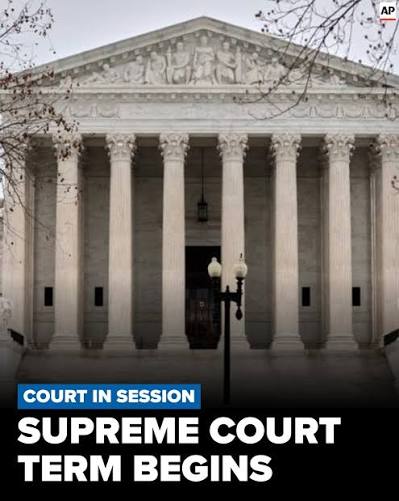
The Supreme Court new term 2026 has officially begun, opening another consequential chapter in American constitutional law.
The nine justices returned to the bench on October 5 for the Court’s October Term 2026. The docket already contains cases involving climate change, gun rights, immigration, voting laws, religious freedom and federal regulatory power. Several disputes could produce rulings with consequences extending well beyond the individual parties.
The Court normally begins its annual term on the first Monday of October. The term can continue into the following year, with major opinions traditionally released before the Court’s summer recess.
This year’s docket arrives during a period of intense political and legal debate. President Donald Trump’s administration is facing challenges involving immigration and executive authority, while states and local governments are pursuing disputes over guns, elections, environmental policy and religious rights.
The justices will therefore confront questions that could affect government power, corporate liability and individual rights.
Why the Supreme Court’s New Term Matters
The Supreme Court hears only a small fraction of the cases presented to it. Thousands of petitions can arrive during a term, but only a limited number receive full consideration.
The Court’s own description says approximately 5,000 to 7,000 new cases are filed each term.
That makes the cases selected for oral argument particularly important.
A ruling from the Supreme Court establishes binding precedent for lower federal courts. Depending on the legal question, a decision can also influence state courts, government agencies, businesses and millions of Americans.
The October 2026 term is particularly notable because several cases involve conflicts between federal authority and state power.
Climate Change Case Opens the Term
One of the first major cases before the justices concerns climate-related lawsuits against major energy companies.
The dispute involves Boulder County and the City of Boulder, Colorado, which brought state-law claims against ExxonMobil and Suncor Energy. Local officials argue that fossil-fuel companies contributed to climate-related damage and should face legal responsibility for some of the resulting costs.
The energy companies are asking the Supreme Court to block the litigation.
The case could determine whether state courts can hear climate-related claims against fossil-fuel companies or whether federal law prevents those lawsuits from moving forward.
The stakes are substantial because similar lawsuits have been filed in other jurisdictions.
Reuters reported that the case could affect a much wider group of climate lawsuits across the country. The companies argue that climate change is fundamentally an international and federal issue rather than a matter for individual state courts.
Why the Climate Case Matters
The dispute is not simply about environmental policy.
At its core, the case raises questions about federalism, state authority and the legal responsibility of corporations.
If the Court allows the Boulder lawsuit to proceed, other cities and states could have greater opportunities to pursue similar claims.
If the justices side with the energy companies, many existing climate lawsuits could face significant obstacles.
The decision could therefore influence how American courts handle future litigation involving climate-related damages.
Gun Rights Take Center Stage
The new Supreme Court term also includes major Second Amendment disputes.
The justices are expected to consider challenges involving state restrictions on semiautomatic rifles, including laws concerning AR-15-style firearms.
These cases arrive after the Supreme Court’s recent Second Amendment decisions, which have established a historical-tradition framework for evaluating modern firearm restrictions.
The next round of cases could clarify how that framework applies to modern weapons and state-level bans.
The issue is politically divisive.
Gun-rights advocates argue that commonly owned firearms receive constitutional protection under the Second Amendment. States defending restrictions argue that governments retain authority to regulate dangerous weapons and protect public safety.
The Court’s ruling could provide lower courts with additional guidance on how to evaluate firearm restrictions.
Because gun laws vary substantially between states, a major ruling could affect legislation across the country.
Immigration Cases Could Test Executive Power
Immigration is another major issue during the Supreme Court’s new term.
The justices are scheduled to consider disputes connected to the Trump administration’s immigration policies.
Among the questions are issues involving the detention of undocumented immigrants and whether certain people are entitled to bond hearings.
Another dispute concerns the government’s treatment of migrants facing deportation under agreements involving third countries.
These cases could determine how much authority the federal government has when carrying out immigration enforcement.
Why Immigration Rulings Could Be Significant
Immigration law frequently involves a complicated interaction between federal statutes, executive authority and constitutional protections.
The federal government has broad power over immigration. However, that authority is not unlimited.
The Supreme Court’s decisions could therefore establish boundaries affecting detention, deportation procedures and judicial review.
The cases are also politically significant because immigration enforcement remains one of the most contested issues in Washington.
Voting Laws Face Supreme Court Review
Election law is another major area to watch.
The Court is expected to consider challenges involving Arizona voting rules, including provisions concerning proof of citizenship and voter-registration procedures.
The dispute comes at a sensitive time, with the 2026 midterm elections approaching.
Election cases can have consequences beyond the immediate parties because courts must balance election administration with constitutional protections for voters.
Supporters of stricter voting requirements argue that states need strong safeguards to maintain election integrity.
Opponents warn that additional documentation requirements can create barriers for eligible voters.
The Supreme Court’s ruling could influence how states design voter-registration systems and election procedures.
Religious Freedom and LGBTQ+ Rights
Another significant dispute involves religious freedom and government-funded preschool programs.
The case concerns a Catholic preschool in Colorado and whether its religious views and admissions policies can affect its eligibility for participation in a state universal preschool program.
The dispute places religious freedom alongside anti-discrimination requirements.
The legal question could have consequences for other religious organizations that receive government funding or participate in public programs.
The Larger Constitutional Question
The case illustrates a recurring conflict in American constitutional law.
Religious organizations claim protections under the First Amendment and other constitutional principles.
Governments, meanwhile, argue that public programs can impose neutral rules designed to prevent discrimination.
The Supreme Court’s decision could clarify when government funding programs must accommodate religious institutions and when eligibility requirements can be enforced.
The Court and Presidential Power
Although several major cases concern specific policies, the broader theme of the new term is the balance of government power.
The Supreme Court has increasingly become an important forum for disputes involving presidential authority.
During the current administration, lower courts have already confronted questions involving immigration, federal agencies, executive orders and administrative authority.
Some of those disputes could eventually reach the Supreme Court.
The justices may therefore have another opportunity to define the limits of executive power.
Federal Versus State Authority
One of the clearest themes across the docket is the continuing struggle between federal and state authority.
The climate case asks whether states can pursue claims involving a global environmental problem.
Gun cases concern whether states can impose restrictions on firearms.
Voting cases examine how much freedom states have to design election systems.
Immigration disputes involve an area traditionally dominated by federal power.
These cases may look unrelated, but they share an important constitutional question:
Who has the authority to make the rules?
The answer could shape American law for years.
The Role of the Court’s Conservative Majority
The Supreme Court currently has a conservative majority.
That ideological balance makes its approach to constitutional interpretation particularly important in cases involving guns, abortion-related issues, religious freedom, executive power and administrative regulation.
However, predicting outcomes based solely on ideology can be misleading.
Justices sometimes disagree with assumptions about how they will vote, particularly when cases involve complex statutory questions rather than straightforward constitutional disputes.
The legal arguments presented during oral hearings can also influence how the Court frames a final decision.
What Happens During Oral Arguments?
During oral arguments, attorneys for each side present their strongest legal arguments.
The justices then question the lawyers.
These questions can reveal which legal issues concern the Court.
However, questions from individual justices should not automatically be interpreted as predictions of the final ruling.
After oral arguments, the justices meet privately to discuss cases and eventually issue opinions.
Some decisions are unanimous.
Others produce sharply divided opinions accompanied by concurring and dissenting writings.
Decisions Could Arrive Months Later
The Supreme Court’s term stretches across many months.
Cases argued during the fall can receive decisions much later.
The Court’s official calendar lists the October 2026 session beginning October 5, followed by additional sessions in November and later months.
That means Americans will likely spend much of the next year waiting for answers to major constitutional and statutory questions.
Some decisions could arrive before the 2026–27 term concludes.
Why Businesses Are Watching Closely
The consequences of the Supreme Court’s new term extend beyond politics.
Businesses are watching cases involving corporate liability, environmental regulation, retirement plans and government regulation.
The climate litigation dispute is particularly important for energy companies.
A decision allowing state climate lawsuits to proceed could expose corporations to additional litigation risks.
A ruling restricting such lawsuits could provide greater legal certainty for energy producers.
Other cases involving federal agencies could similarly affect how businesses interact with regulators.
Why States Are Watching Closely
State governments also have significant interests in the upcoming decisions.
States frequently pass laws covering guns, elections, environmental policy and education.
When those laws are challenged, the Supreme Court can determine whether state governments have exceeded constitutional or statutory boundaries.
That makes the Court a critical part of the federal system.
A ruling can invalidate a state law, permit it to remain in force or establish a legal test that affects similar laws elsewhere.
The 2026 Elections Add Another Layer
The Supreme Court’s new term is beginning as American politics moves toward the 2026 midterm elections.
That timing could increase public attention surrounding election-related cases.
However, the justices are not political lawmakers.
Their role is to resolve legal disputes based on the Constitution, federal statutes and applicable precedent.
Still, when election laws are before the Court, even technical legal decisions can have practical consequences for campaigns, voters and election administrators.
Public Attention Will Remain High
The Supreme Court has faced continuing scrutiny over its decisions, ethics questions and role in American politics.
The new term will likely renew that attention.
Supporters and critics of the Court will closely monitor cases involving voting rights, guns, immigration, religion and environmental policy.
The Court’s decisions could affect public policy long after the headlines disappear.
What Could Reshape U.S. Law?
Several categories deserve particular attention.
First, climate liability could determine whether local governments can use state courts to pursue major fossil-fuel companies.
Second, gun rights could establish clearer constitutional limits on state firearm restrictions.
Third, immigration could define the government’s authority over detention and deportation.
Fourth, voting law could influence how states administer elections.
Fifth, religious freedom could establish important rules for religious organizations participating in publicly funded programs.
Together, these disputes could create significant legal precedents.
What Americans Should Watch Next
The most important developments will come as the justices hear arguments, issue orders and eventually publish opinions.
The official Supreme Court calendar provides the authoritative schedule for oral arguments during the October 2026 term.
News coverage will likely intensify as the Court hears its first major cases.
For Americans, the most important point is that the consequences may not be immediately visible.
A Supreme Court ruling can establish a legal standard that lower courts must apply for years.
That is why even a narrow decision can have broad effects.
Conclusion
The Supreme Court new term 2026 begins with a docket filled with consequential legal disputes.
From climate change and gun rights to immigration, voting and religious freedom, the justices face questions that touch some of the most contested issues in American society.
The opening climate case involving ExxonMobil and Suncor immediately demonstrates the stakes. Other disputes could further define the relationship between federal and state authority, individual rights and government power.
Not every case will produce a sweeping constitutional ruling.
Yet taken together, the October 2026 term could become an important period in the development of U.S. law.
As arguments continue and opinions arrive, Americans will learn how the Court intends to approach some of the country’s most difficult legal questions.
The decisions could influence government policy, corporate responsibility, civil liberties and constitutional interpretation for years to come.
Frequently Asked Questions
1. When did the Supreme Court’s 2026 term begin?
The Supreme Court’s October Term 2026 began on October 5, 2026. The Court’s official calendar confirms that the first session of the term began that day.
2. What are the biggest Supreme Court cases in 2026?
Major cases involve climate change lawsuits, gun rights, immigration, voting laws and religious freedom. Several disputes could establish legal rules affecting states, businesses and federal agencies.
3. Why is the climate change case important?
The climate case involves Boulder, Colorado, and energy companies including ExxonMobil and Suncor. The Supreme Court will consider whether the litigation can proceed under state law, potentially affecting similar climate lawsuits around the country.
4. Will the Supreme Court hear major gun-rights cases?
Yes. The 2026 term includes challenges involving state restrictions on semiautomatic rifles, raising important questions under the Second Amendment.
5. Will immigration be a major issue before the Supreme Court?
Yes. Several immigration disputes are connected to the Trump administration’s enforcement policies, including questions concerning detention and deportation procedures.
6. Could the Supreme Court affect voting laws?
Yes. Cases involving Arizona election rules could influence how states regulate voter registration and election administration.
7. How long does a Supreme Court term last?
A Supreme Court term begins on the first Monday in October and generally lasts until the following October.
8. When will the Supreme Court issue decisions?
The timing varies by case. Some decisions can come months after oral arguments, with many major opinions traditionally released toward the end of the term.
9. Can Supreme Court decisions change state laws?
Yes. When the Court determines that a state law conflicts with the U.S. Constitution or applicable federal law, the ruling can prevent that law from being enforced.
10. Why is the 2026 Supreme Court term important?
The term includes cases involving several major areas of American law. Decisions could influence climate litigation, firearm regulations, immigration enforcement, voting procedures, religious freedom and the balance between federal and state power.
About the Author