Legal News Update: Progressive DA Larry Krasner Referred to DOJ for Perjury and Obstruction
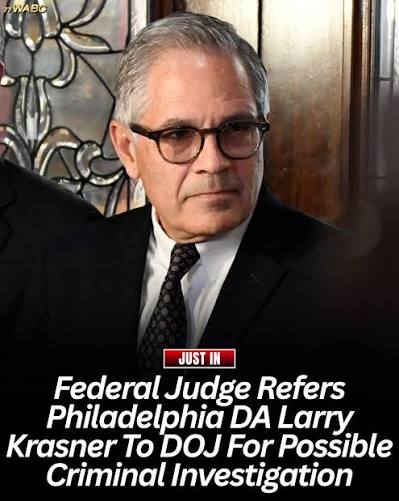
Philadelphia District Attorney Larry Krasner has been referred to the U.S. Department of Justice following a federal judge’s findings in a contentious post-conviction case. The referral concerns possible false statements, perjury, obstruction of justice and conspiracy involving Krasner and one of his senior prosecutors.
The development emerged from the federal case involving Dennis Johnson, a man convicted of second-degree murder in Philadelphia in 2009. Johnson has been seeking to overturn his conviction through a federal habeas corpus petition.
On September 15, 2026, U.S. District Judge Paul S. Diamond issued a lengthy memorandum that removed Krasner and Matthew Stiegler, chief of the Philadelphia District Attorney’s Office Conviction Integrity Unit, from further participation in the case. Diamond also referred the matter to federal prosecutors for investigation and possible further action.
Importantly, the referral does not mean Krasner has been charged or convicted of a crime. It asks federal prosecutors to investigate conduct described by the judge and determine whether criminal laws were violated.
What Led to the Larry Krasner DOJ Referral?

The dispute centers on the handling of Johnson’s effort to overturn his murder conviction.
Johnson was convicted in 2009 of second-degree murder, robbery and a firearms offense. He was subsequently sentenced to life imprisonment for the murder conviction. Years later, he filed a federal habeas petition arguing that his constitutional rights were violated because of ineffective assistance by his trial lawyer.
The Philadelphia District Attorney’s Office initially opposed Johnson’s effort. However, in 2022, an assistant prosecutor, Jaclyn Mason, filed a brief taking a different position and agreeing that Johnson’s trial counsel had been ineffective.
That filing later became the center of a dispute inside the District Attorney’s Office.
According to reporting on the federal proceedings, supervisors reviewing the filing identified significant problems and sought to withdraw or correct it. Mason later resigned and alleged that she had been pressured by her supervisors to file the document.
The controversy eventually led Judge Diamond to hold evidentiary hearings during 2026.
Federal Judge Paul Diamond’s Findings
Judge Diamond’s September 15 memorandum was the key development behind the Larry Krasner DOJ referral.
According to reports based on the memorandum, Diamond concluded that testimony and other evidence raised serious concerns about the conduct of Krasner and Stiegler.
The judge said the evidence could potentially constitute false statements, false declarations under oath, perjury, obstruction of justice and conspiracy.
Diamond therefore referred Krasner, Stiegler and the relevant district attorney’s office matter to the U.S. Attorney’s Office for investigation and appropriate action.
The referral is significant because federal judges do not ordinarily make criminal referrals involving the head of a major elected prosecutor’s office.
However, the legal process remains at an investigative stage.
What Is the Dennis Johnson Case About?
The underlying case involves Johnson’s effort to obtain federal habeas relief.
A habeas corpus petition can allow a person in custody to challenge the legality of detention under certain circumstances. In Johnson’s case, the petition concerns allegations involving the performance of his trial lawyer.
The District Attorney’s Office’s position changed during the litigation. That change became important because prosecutors later questioned aspects of the filing supporting Johnson’s claim.
According to the Philadelphia Inquirer, senior prosecutors later identified what they described as significant errors in Mason’s filing. The disagreement expanded into an internal dispute about how the office should handle the case.
The controversy eventually reached a federal evidentiary hearing.
During those proceedings, prosecutors and other employees provided testimony about internal discussions within the District Attorney’s Office.
The judge then examined whether the conduct surrounding the case created conflicts of interest and whether statements presented to the court were accurate.
Why Were Krasner and Matthew Stiegler Removed?
Judge Diamond did not simply refer the matter to federal prosecutors. He also disqualified Krasner and Stiegler from participating in the Johnson litigation.
The judge concluded that their involvement created conflicts that prevented them from continuing to handle the case.
Reporting on the ruling indicates that prosecutors within the office had raised concerns that the case should be transferred to the Pennsylvania Attorney General’s Office because of the conflicts. Krasner opposed that approach and argued that he needed to remain involved to protect the interests of his office.
The judge ultimately determined that Krasner and Stiegler could no longer participate.
However, Diamond did not disqualify the entire Philadelphia District Attorney’s Office from the case.
That distinction is important because the Johnson litigation can continue through other prosecutors.
What Are the Perjury Allegations?
Perjury generally involves knowingly making a materially false statement under oath when the legal requirements for the offense are satisfied.
The federal statutes potentially relevant to the allegations include laws covering perjury, false declarations and obstruction of justice.
Federal law separately addresses perjury and false declarations under 18 U.S.C. §§ 1621 and 1623, while obstruction offenses can arise under provisions including 18 U.S.C. § 1503.
In the Krasner matter, the judge’s referral does not establish that perjury occurred.
Instead, Diamond concluded that the evidence warranted investigation into whether statements or conduct met the legal standards for those offenses.
That distinction matters because a judicial referral and a criminal conviction are two very different stages of the legal process.
What Does Obstruction of Justice Mean Here?
Obstruction of justice generally involves conduct intended to interfere with the administration of justice or a judicial proceeding.
The precise elements depend on the statute prosecutors might ultimately consider.
In this case, Judge Diamond’s concerns reportedly involved allegations that staff members were pressured regarding how information was presented to the federal court.
The judge’s memorandum reportedly described evidence that could potentially amount to obstruction, among other offenses.
Again, these are allegations and judicial findings supporting a referral, not a criminal conviction.
Federal prosecutors would need to conduct their own investigation and determine whether additional legal action is appropriate.
Krasner Disagrees With the Judge’s Findings
Krasner has rejected the judge’s conclusions.
According to the Associated Press and Washington Post, Krasner said he respectfully and vigorously disagreed with the decision and indicated that he intended to appeal when permitted.
That response is an important part of the story because the allegations remain contested.
Krasner has not been found guilty of perjury or obstruction through a criminal trial.
The DOJ referral creates the possibility of further investigation, but the outcome is not predetermined.
The U.S. Attorney’s Office for the Eastern District of Pennsylvania had not publicly indicated whether it would open a formal criminal investigation at the time of the latest reports.
Why the DOJ Referral Matters
The Larry Krasner DOJ referral has several legal implications.
First, it places allegations involving a local elected prosecutor before federal authorities.
Second, it separates the judge’s concerns from the question of criminal liability. Judge Diamond identified conduct he believed warranted investigation, while federal prosecutors would have to independently assess whether a crime occurred.
Third, the referral could affect the ongoing Johnson case because Krasner and Stiegler have been removed from participation.
Finally, the case raises broader questions about prosecutorial conflicts of interest and how prosecutors should respond when their own office becomes the subject of scrutiny in litigation.
What Happens After a Judicial Referral?
A referral to the DOJ does not automatically result in criminal charges.
Federal prosecutors can review the referral, examine evidence, interview witnesses and determine whether further investigative steps are warranted.
Several outcomes are possible.
1. Further Investigation
Federal prosecutors may conduct additional investigative work to determine whether federal criminal laws were violated.
2. No Criminal Charges
After reviewing the evidence, prosecutors could decide that the available information does not justify charges.
3. Criminal Charges
If prosecutors conclude that the evidence establishes probable violations of federal law and satisfies applicable charging standards, they could pursue criminal charges.
4. Additional Court Proceedings
The underlying Johnson case can continue independently of any criminal investigation involving Krasner or Stiegler.
Therefore, the DOJ referral and the habeas case should not be treated as the same proceeding.
What Happens to Dennis Johnson’s Case?
Johnson’s post-conviction case remains unresolved.
Judge Diamond removed Krasner and Stiegler but did not remove the entire District Attorney’s Office.
The next stages will involve determining how Johnson’s habeas petition should proceed and how the prosecution’s position will be represented following the judge’s disqualification order.
The case therefore continues to have two distinct legal dimensions.
One concerns whether Johnson should receive relief from his conviction.
The other concerns whether conduct by prosecutors during the litigation warrants further investigation.
Those questions can develop separately.
Why the Case Has Attracted National Attention
Krasner is one of the best-known progressive prosecutors in the United States.
He was elected Philadelphia district attorney in 2017 and became nationally associated with criminal-justice reform and changes in prosecutorial policy. His approach has attracted both support and criticism.
The latest controversy is different from ordinary political disagreements over prosecution policy.
It concerns allegations about conduct during a specific federal court proceeding.
That distinction is important for understanding the legal story.
The DOJ referral is based on evidence and testimony arising from the Johnson litigation rather than simply on disagreement over Krasner’s broader criminal-justice philosophy.
Legal Significance of the Judge’s Referral
Judicial referrals can become important when a judge believes evidence developed during litigation may indicate criminal conduct.
In this case, Diamond’s memorandum reportedly connected the evidence to several possible federal offenses.
The judge’s language, however, does not itself establish guilt.
The next question belongs to federal prosecutors, who must evaluate the evidence under applicable federal law.
This process also illustrates why allegations involving public officials require careful reporting.
A referral means that a judge has asked prosecutors to investigate. It does not mean that an indictment has been issued, that prosecutors have decided to bring charges, or that a jury has found wrongdoing.
Political and Legal Dimensions Should Be Kept Separate
Because Krasner is a prominent progressive district attorney, the case has generated substantial political commentary.
However, the underlying legal questions can be examined separately from partisan arguments.
The central factual issues are:
- What statements were made during the Johnson litigation?
- What did prosecutors know when those statements were made?
- What internal instructions were given?
- Were any statements knowingly false?
- Did anyone attempt to influence testimony improperly?
- Did any conduct satisfy the legal elements of a federal offense?
- What action, if any, will federal prosecutors take?
Those questions will determine the legal significance of the referral.
Political reactions do not by themselves answer them.
Latest Status of the Investigation
As of September 17, 2026, the most significant development is Judge Diamond’s referral of Krasner and Stiegler to federal prosecutors.
Public reporting indicates that the U.S. Attorney’s Office for the Eastern District of Pennsylvania had not announced whether it would pursue a criminal investigation.
Krasner has indicated that he intends to challenge the judge’s decision.
Meanwhile, the Johnson case remains pending.
Therefore, headlines describing Krasner as having committed perjury or obstruction would go beyond what has currently been established. The more precise description is that a federal judge referred him for investigation over possible offenses including perjury and obstruction.
That distinction is essential in responsible legal reporting.
What Could Happen Next?
The next phase could involve several legal developments.
Federal prosecutors may first review Judge Diamond’s memorandum and the evidence developed during the hearings.
They could also examine testimony, filings, communications and other records connected with the Johnson case.
At the same time, Krasner and his legal team may pursue appellate remedies concerning the judge’s rulings.
The Johnson case itself will also continue under the remaining prosecutors.
For now, there is no final criminal judgment against Krasner.
The case is therefore best understood as an evolving legal investigation rather than a completed criminal prosecution.
Frequently Asked Questions
What is the Larry Krasner DOJ referral?
The Larry Krasner DOJ referral involves a federal judge sending matters concerning Philadelphia District Attorney Larry Krasner and prosecutor Matthew Stiegler to federal prosecutors for investigation. The referral followed proceedings involving Dennis Johnson’s effort to overturn a 2009 murder conviction.
Why was Larry Krasner referred to the DOJ?
U.S. District Judge Paul Diamond said evidence from the case raised concerns about possible false statements, false declarations under oath, perjury, obstruction of justice and conspiracy.
Has Larry Krasner been charged with perjury?
No. The referral is not a criminal conviction or an indictment. It asks federal prosecutors to investigate whether criminal laws may have been violated.
Who is Dennis Johnson?
Dennis Johnson is a Philadelphia defendant who was convicted of second-degree murder in 2009. He has sought federal habeas relief, arguing that his constitutional rights were violated because of ineffective assistance of counsel.
Who is Matthew Stiegler?
Matthew Stiegler is a senior prosecutor in the Philadelphia District Attorney’s Office and chief of its Conviction Integrity Unit. Judge Diamond also disqualified him from the Johnson case and referred the matter to federal prosecutors.
Did Judge Diamond remove the entire Philadelphia DA’s Office?
No. The judge removed Krasner and Stiegler from the case but did not disqualify the entire District Attorney’s Office.
Will the DOJ definitely prosecute Krasner?
There is no indication that prosecution is automatic. Federal prosecutors must independently review the evidence and determine whether further investigation or charges are appropriate.
What has Krasner said about the referral?
Krasner has said that he disagrees with the judge’s decision and intends to appeal when legally permitted.
Is the Dennis Johnson case finished?
No. Johnson’s post-conviction proceedings remain unresolved. The case can continue with other prosecutors handling the matter.
Why is this case important?
The case involves allegations concerning the conduct of a major elected prosecutor during federal litigation. It also raises questions about conflicts of interest, prosecutorial responsibilities and the treatment of statements made to a federal court.
Conclusion
The Larry Krasner DOJ referral marks a significant new development in the legal dispute surrounding Dennis Johnson’s murder conviction challenge. U.S. District Judge Paul S. Diamond referred Krasner and senior prosecutor Matthew Stiegler to federal prosecutors after finding that evidence presented during the proceedings could warrant investigation into possible false statements, perjury, obstruction of justice and conspiracy.
At the same time, the referral should not be confused with a criminal conviction. Krasner disputes the judge’s findings and has indicated that he plans to appeal. Federal prosecutors had not publicly announced whether they would pursue charges as of the latest reports.
The Johnson case also remains active, meaning further court proceedings could provide additional information about both the underlying conviction challenge and the conduct that prompted the referral.
For now, the central legal question is whether federal investigators will determine that the evidence supports criminal charges or other action.
How useful was this post?
Click on a star to rate it!
Average rating 0 / 5. Vote count: 0
No votes so far! Be the first to rate this post.
About the Author

usa5911.com
Administrator
Hi, I’m Gurdeep Singh, a professional content writer from India with over 3 years of experience in the field. I specialize in covering U.S. politics, delivering timely and engaging content tailored specifically for an American audience. Along with my dedicated team, we track and report on all the latest political trends, news, and in-depth analysis shaping the United States today. Our goal is to provide clear, factual, and compelling content that keeps readers informed and engaged with the ever-changing political landscape.