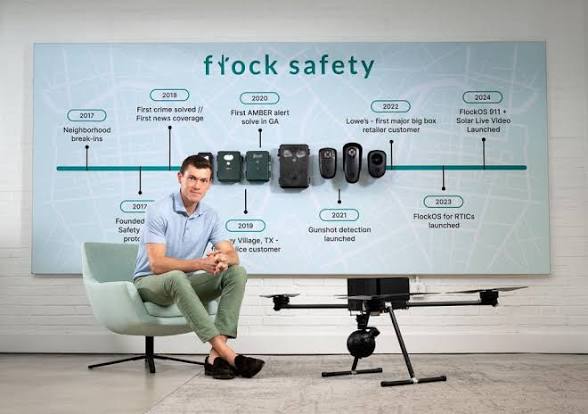
The debate over surveillance technology in America has reached a new level as Flock Safety CEO Garrett Langley faces growing questions about privacy, data ownership, police access and the expanding use of automated license plate reader cameras.
Flock Safety has become one of the most prominent companies in the American public-safety technology sector. Its network includes automated license plate readers, cameras, drones and other technologies used by thousands of communities and law-enforcement agencies. Supporters say the systems provide investigators with valuable evidence and can help locate stolen vehicles, missing people and suspects. Critics argue that the technology creates an enormous record of where ordinary drivers travel.
That conflict has intensified in 2026.
Langley recently addressed the surveillance controversy publicly, including during a TED2026 appearance, where he argued that communities should not have to choose between public safety and privacy. He also discussed concerns about data ownership, officer access, retention periods and potential misuse of the technology.
At the same time, several communities and law-enforcement agencies have questioned whether the safeguards surrounding Flock cameras are strong enough. The Los Angeles Police Department, for example, allowed its Flock contract to expire in July amid concerns involving civil liberties, privacy and data policies.
So what exactly did the Flock CEO say, and why has the surveillance debate become so heated?
What Is Flock Safety?
Flock Safety is a public-safety technology company that provides automated license plate reader systems and other surveillance-related technologies to law-enforcement agencies and communities.
Its cameras can capture information about vehicles passing through an area, including license plates and characteristics such as vehicle make, model and color. That information can then be used by authorized investigators to search for vehicles connected with particular investigations.
Flock has expanded beyond traditional license plate readers. The company also markets drones, gunshot-detection technology and software designed to help law enforcement combine information during investigations. Recent company statements say Flock technology was involved in more than one million criminal investigations and incidents during 2025.
The company’s rapid growth is one reason the controversy has become so significant.
The technology is no longer limited to a handful of experimental deployments. Flock says its systems are used by thousands of communities and law-enforcement organizations across the United States.
That scale has created a fundamental question: When does technology designed to solve individual crimes become a broader surveillance network?
Flock CEO Garrett Langley Addresses the Controversy
Garrett Langley, Flock Safety’s co-founder and CEO, has repeatedly argued that the company’s objective is public safety rather than unrestricted surveillance.
During his TED2026 appearance, Langley directly addressed concerns about privacy and surveillance. According to Flock’s account of the presentation, he pointed to safeguards including customer ownership of data, limits on retention and auditing of officer access.
His central argument is that technology can make investigations more objective.
Traditional investigations often depend on eyewitness accounts, officer observations and other evidence that can be incomplete or subjective. Flock argues that a vehicle captured by a camera can provide investigators with a concrete lead.
That distinction is central to Langley’s defense.
The company says its systems are designed to help police identify vehicles associated with crimes rather than continuously identify individual people.
But privacy advocates argue that tracking vehicles can still reveal highly sensitive information about people’s movements.
That is where the debate becomes complicated.
Why Are Flock Cameras Causing Concern?
The biggest concern surrounding Flock Safety is not simply the presence of cameras.
It is the amount of information that can potentially be collected and searched.
A single camera may appear relatively limited. But when many cameras operate across a city or region, records can potentially show where vehicles were observed at different times.
Critics say that creates the possibility of reconstructing patterns of movement.
For example, a vehicle could potentially be observed near a person’s home, workplace, hospital, religious institution, political gathering or another sensitive location. Even if the system is not designed to identify someone’s identity directly, information about vehicle movements can still reveal a great deal.
That is why privacy advocates have pushed communities to establish clear rules governing the technology.
Questions include:
- Who owns the collected data?
- How long is information retained?
- Who can search the database?
- Can agencies from other states access the information?
- What qualifies as a legitimate police search?
- Are officers’ searches audited?
- What happens when an officer misuses the system?
- Can information be shared with federal authorities?
These questions have become increasingly important as more communities adopt automated license plate readers.
The Data Ownership Question
One of Langley’s most important arguments is that customers own the data generated through Flock systems.
Flock’s public statements say that the customer, rather than Flock itself, owns the data. Langley has also emphasized auditing of activity within the system.
That distinction matters because government agencies are ultimately responsible for deciding how surveillance technology is used within their jurisdictions.
However, critics argue that ownership alone does not answer every privacy question.
A city can own data while still allowing broad access to it.
That is why transparency policies, access controls, retention rules and data-sharing agreements are so important.
A strong privacy framework must explain not only who owns the information but also who can use it and under what circumstances.
The 30-Day Retention Debate
Flock has highlighted a 30-day retention period as one of its privacy safeguards.
The basic concept is straightforward: information that is not needed for an investigation should not remain available indefinitely.
But there is an important distinction between ordinary stored data and information that investigators download or preserve as part of a case.
Once information becomes part of a police investigation or evidence file, different retention rules may apply.
This distinction has contributed to public confusion about how long surveillance information actually remains accessible.
For residents, the practical question is simple: If a camera captures my vehicle today, when does that information disappear?
The answer can depend on how the information is used, the agency’s policies and whether the information becomes part of an investigation.
That is why local contracts and public records matter.
LAPD Contract Raises Bigger Questions
One of the most significant developments in the 2026 debate came from Los Angeles.
The Los Angeles Police Department allowed its three-year contract with Flock Safety to expire in July. Reporting cited concerns surrounding civil liberties, privacy and data policies.
The decision does not necessarily mean Los Angeles has rejected surveillance technology permanently.
Instead, it illustrates a growing demand for clearer rules before such systems are used at scale.
For Flock, the LAPD decision is important because large metropolitan deployments demonstrate both the value and the risks associated with automated surveillance.
Langley has said he hopes relationships with agencies can be restored once policies concerning data, privacy and security are clarified.
The controversy therefore appears to be shifting from a simple argument over whether cameras are useful to a more complicated question about how they should be governed.
Public Backlash Is Growing
The Flock controversy is not limited to Los Angeles.
Communities across the United States have debated whether to install, renew or remove Flock cameras.
Recent reporting has described cities considering contract cancellations, camera deactivations and new restrictions. Other communities continue to support the technology because of its potential role in crime investigations.
In Connecticut, for example, concerns about surveillance technology and data sharing have contributed to political pressure for stronger restrictions. Recent reporting highlighted concerns about access to Flock data by authorities outside the state.
Houston-area communities have also been debating whether voters should have a say in the continued use of Flock cameras.
These developments demonstrate that the controversy is increasingly becoming a local-government issue.
Residents are asking city councils to explain exactly what they are buying, how the technology works and what legal protections are in place.
Flock’s Argument: Safety Should Be a Right
Langley’s public defense of Flock is built around a straightforward idea: communities deserve effective tools to prevent and solve crime.
In his TED2026 presentation, Langley argued that safety should be treated as a fundamental right rather than a privilege. He also presented examples in which Flock technology helped investigators locate people and identify vehicles involved in criminal investigations.
This argument has considerable appeal.
If a stolen car is captured by an automated license plate reader, the technology can potentially give police a lead that would otherwise be difficult to obtain.
Similarly, in missing-person cases, a vehicle location can sometimes provide investigators with an important clue.
Supporters therefore see Flock cameras as a modern extension of traditional investigative tools.
The technology does not necessarily replace police work. Instead, supporters say it gives officers another source of evidence.
Critics Say Public Safety Cannot Come at Any Cost
Privacy advocates do not necessarily reject every use of surveillance technology.
Instead, their concern is about proportionality and oversight.
The question is whether a system designed to help solve crimes can operate without creating a permanent infrastructure capable of tracking ordinary citizens.
Critics worry about mission creep.
A technology introduced to locate stolen vehicles could eventually be used for broader purposes unless strict policies prevent that expansion.
There is also concern about data sharing.
If multiple law-enforcement agencies can access information collected in another jurisdiction, local residents may have little understanding of who can search information about their movements.
That is why critics increasingly demand public transparency before cameras are installed.
The CEO Controversy Adds Another Layer
The debate surrounding Langley became even more heated after he apologized for previously describing nonviolent activists opposing Flock as “terroristic” organizations.
Forbes reported in July that Langley acknowledged the language was inappropriate and expressed regret.
That episode became significant because privacy activists already viewed Flock’s rapid expansion with suspicion.
When the company’s chief executive used harsh language to describe opponents, critics argued that it intensified distrust.
Langley’s subsequent acknowledgment was an attempt to lower the temperature.
But the broader debate remains.
The controversy is ultimately less about one CEO’s comments and more about the rules governing a powerful surveillance infrastructure.
Does Flock Mean Mass Surveillance?
The answer depends partly on how the term is defined.
Flock says its technology is designed to collect vehicle information rather than create a system for unrestricted personal surveillance.
Critics argue that a sufficiently large network of automated license plate readers can nevertheless function as a mass-surveillance system because it records the movements of large numbers of people who are not suspected of crimes.
Both perspectives highlight an important reality.
Technology itself does not determine the final privacy outcome. Policy does.
A camera with strict access controls, short retention periods, transparent contracts and strong auditing is different from a camera network with unlimited searches and broad data sharing.
That means communities have a major role in determining how surveillance technology affects civil liberties.
What Safeguards Should Communities Require?
Before approving an automated license plate reader program, local governments can consider several safeguards.
1. Clear retention limits
Communities should establish how long non-investigative data remains available.
2. Strict access controls
Only authorized personnel should be able to search the system.
3. Search auditing
Every search should be logged so officials can identify misuse.
4. Transparent data-sharing rules
Residents should know whether other agencies can access local data.
5. Public reporting
Cities should periodically publish information about system use, searches and investigations when legally possible.
6. Independent oversight
A police department should not necessarily be the only institution reviewing how surveillance tools are used.
7. Contract transparency
Residents should be able to examine contracts and understand what the vendor and government agency are permitted to do.
These safeguards can help communities balance public safety with privacy.
What Happens Next?
The future of Flock Safety is likely to depend on whether the company and local governments can convince the public that surveillance technology can be controlled effectively.
Flock is continuing to expand its technology portfolio while simultaneously emphasizing privacy, compliance and accountability.
Its Trust & Compliance efforts include tools intended to help agencies monitor system use and strengthen oversight.
At the same time, public opposition is unlikely to disappear.
As surveillance networks become more common, residents will probably demand more information about what cameras collect, who can access the information and how long records remain available.
The debate may ultimately produce stronger regulations rather than an outright rejection of the technology.
Final Verdict: The Real Issue Is Trust
The Flock Safety controversy is not simply a story about cameras.
It is a story about trust.
Law-enforcement agencies want tools that can help solve crimes faster. Residents want safer communities. Privacy advocates want protection from unnecessary government surveillance. Technology companies want to provide products that can meet those demands.
All three objectives can exist at the same time—but only if strong rules are established.
Garrett Langley’s recent public defense of Flock makes clear that the company believes its technology can improve public safety while protecting privacy. But the continuing backlash demonstrates that many residents remain unconvinced.
The most important question is therefore not whether surveillance cameras can help solve crimes. They clearly can.
The more difficult question is whether society can build a system in which those powerful tools are used responsibly, transparently and only for legitimate purposes.
As Flock Safety expands, that question will become increasingly difficult for cities, police departments and lawmakers to avoid.
For now, the surveillance debate remains unsettled. Flock says it is building technology for safer communities. Critics warn that without strong oversight, the same technology could create an unprecedented record of everyday movement.
The future of public surveillance may depend on which side can earn the public’s trust.
Frequently Asked Questions
What is Flock Safety?
Flock Safety is a public-safety technology company that provides automated license plate readers, cameras, drones, gunshot-detection technology and software to communities and law-enforcement agencies.
Who is Garrett Langley?
Garrett Langley is the co-founder and CEO of Flock Safety. He has publicly defended the company’s surveillance technology while addressing concerns about privacy, data ownership and law-enforcement access.
Why is Flock Safety controversial?
Flock Safety is controversial because its automated license plate reader network can collect information about vehicles traveling through monitored areas. Critics are concerned about privacy, data sharing, retention and potential misuse.
Does Flock Safety track people?
Flock primarily markets its technology as a system for identifying vehicles and vehicle characteristics rather than directly tracking people. However, critics argue that vehicle-location information can reveal patterns about people’s movements.
How long does Flock keep camera data?
Flock has highlighted a 30-day retention limit for certain camera data. Information that is preserved as part of an investigation can be subject to different retention rules.
Does Flock own the data?
Flock says its customers own the data generated by their systems. The company’s CEO has emphasized that distinction when addressing concerns about data control.
Why did LAPD stop using Flock?
The Los Angeles Police Department allowed its Flock contract to expire amid concerns involving privacy, civil liberties and data policies. The decision reflected the broader debate over how surveillance technology should be governed.
Is Flock Safety illegal?
Flock Safety technology is not generally illegal simply because it uses automated license plate readers. However, its use can be affected by local, state and federal laws, contracts and privacy policies.
Can police share Flock data with other agencies?
Data-sharing rules depend on the policies and agreements governing a particular deployment. This is one of the major issues communities are examining as Flock networks expand.
What is the biggest concern about Flock cameras?
The biggest concern is the potential for large-scale collection and searching of vehicle-location information. Supporters emphasize crime-solving benefits, while critics emphasize privacy and civil-liberty risks.
What did the Flock CEO say about surveillance?
Garrett Langley has argued that Flock technology can improve public safety while protecting privacy through measures such as customer data ownership, retention limits and auditing of system access.
What happens next for Flock Safety?
Flock is continuing to expand its public-safety technology while communities and lawmakers debate privacy safeguards. The company’s future growth will likely depend partly on its ability to address concerns about transparency, data access and accountability
About the Author