Supreme Court Redistricting Fight: Virginia Map Battle, Voting Rights Pressure
The latest Supreme Court redistricting fight has placed Virginia at the center of a nationwide political storm. As legal battles over congressional district maps continue across the United States, the Virginia map controversy has become one of the most closely watched election disputes ahead of the 2026 midterms.
Democrats, Republicans, voting rights activists, and constitutional scholars are all paying attention to how the courts respond. The stakes are enormous because redistricting can determine which party controls the U.S. House of Representatives for years.
The Supreme Court recently rejected an emergency request from Virginia Democrats seeking to restore a voter-approved congressional map that could have dramatically changed the state’s political landscape.
The decision immediately intensified discussions about voting rights, partisan gerrymandering, judicial power, and election fairness.
What Is the Virginia Redistricting Fight About?
The Virginia redistricting conflict began after lawmakers approved a constitutional amendment that allowed new congressional districts to be drawn before the 2030 census.
Supporters argued the move was necessary to counter Republican-led redistricting efforts in other states. Opponents claimed it was an attempt to engineer a partisan advantage for Democrats.
Virginia voters narrowly approved the proposal in a statewide referendum earlier this year. However, the Virginia Supreme Court later struck down the amendment, ruling that lawmakers violated constitutional procedures during the approval process.
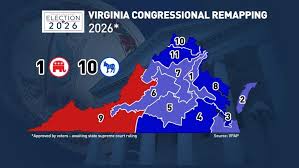
The ruling blocked the implementation of a new congressional map that analysts believed could have shifted several Republican-held districts toward Democrats.
Under the existing map, Virginia’s congressional delegation currently leans 6-5 in favor of Democrats. Under the proposed map, Democrats hoped to gain up to four additional competitive seats.
Why the Supreme Court Became Involved
After the Virginia Supreme Court invalidated the referendum and new maps, Democratic leaders filed an emergency appeal with the U.S. Supreme Court.
They argued that millions of voters had already approved the measure and that blocking it would undermine democratic participation and election fairness.
The U.S. Supreme Court, however, declined to intervene.
In a brief order issued without detailed explanation, the justices allowed the Virginia court ruling to remain in effect.
That decision effectively guarantees that Virginia’s current congressional districts will remain in place for the 2026 elections.
Why Redistricting Matters So Much
Redistricting determines how political boundaries are drawn after population changes.
Every congressional district influences:
- Representation in Congress
- Electoral competitiveness
- Minority voting power
- Legislative priorities
- National political control
Because the U.S. House of Representatives is often decided by only a handful of seats, even small map adjustments can have enormous national consequences.
That is why both parties aggressively pursue favorable maps whenever possible.
The Virginia case has become symbolic of a much larger battle happening nationwide.
Gerrymandering and Political Power
One of the biggest issues connected to the Supreme Court redistricting fight is gerrymandering.
Gerrymandering occurs when political districts are intentionally designed to favor one party over another.
Critics say both Democrats and Republicans use the practice to protect incumbents and reduce competition.
In Virginia, Republicans argued the proposed Democratic-backed map would have unfairly tilted the state toward one-party dominance. Supporters of the amendment countered that Republican-controlled states had already engaged in aggressive redistricting elsewhere.
The debate reflects a broader national trend where redistricting has become increasingly partisan.
Voting Rights Concerns Intensify
Voting rights organizations have closely monitored the Virginia case because it may influence future election law disputes.
Civil rights advocates worry that recent court decisions could weaken protections against racial and partisan discrimination in redistricting.
Several recent Supreme Court rulings involving Alabama, Louisiana, and South Carolina have already triggered intense debate over minority representation and the Voting Rights Act.
Critics argue that reducing federal oversight may allow states to dilute minority voting strength more easily.
Supporters of the court’s approach argue that redistricting should remain largely under state control rather than federal judicial supervision.
The Virginia fight has now become another major chapter in that national debate.
The Role of the Voting Rights Act
The Voting Rights Act of 1965 has historically served as one of the strongest protections against discriminatory election practices.
Section 2 of the law prohibits voting systems that dilute minority political influence.
However, recent Supreme Court rulings have narrowed how the law can be applied in redistricting disputes.
As a result, many legal analysts believe states now have more flexibility when drawing congressional maps.
That legal shift has encouraged both parties to pursue increasingly aggressive redistricting strategies before the 2026 elections.
National Redistricting Battles Expand
Virginia is far from the only state involved in map litigation.
Several states are currently facing lawsuits or legislative fights over district boundaries, including:
- Texas
- Florida
- Alabama
- Louisiana
- South Carolina
- Ohio
- Missouri
- California
Political strategists understand that congressional control may ultimately depend on these map battles.
According to election analysts, redistricting changes nationwide could shift enough seats to influence the balance of power in Washington for the rest of the decade.
Democrats’ Strategy in Virginia
Democrats viewed Virginia as a key opportunity to offset Republican advantages elsewhere.
The proposed map would have increased Democratic competitiveness in several suburban and swing districts.
Supporters framed the effort as a temporary correction designed to restore electoral fairness after Republican-led redistricting in southern states.
Governor Abigail Spanberger and Attorney General Jay Jones publicly supported the appeal effort.
They argued that voters themselves had approved the measure and that overturning the referendum ignored democratic participation.
Republican Response
Republicans celebrated the Supreme Court’s refusal to intervene.
Conservative legal groups argued that the Virginia legislature violated constitutional procedures and that courts were correct to stop implementation.
They also claimed the proposed map represented an extreme partisan gerrymander.
Many Republican strategists now view the ruling as a major political victory heading into the 2026 midterms.
Constitutional Questions at the Center
The case also raised important constitutional questions.
The Virginia Supreme Court ruled lawmakers failed to follow the required amendment process because the proposal was approved too close to an election cycle.
The court emphasized that voters deserve sufficient opportunity to evaluate constitutional changes before electing representatives connected to those proposals.
This procedural issue ultimately became central to the case.
The U.S. Supreme Court appeared unwilling to override a state court interpretation of state constitutional law.
Public Reaction Across America
The Supreme Court redistricting fight quickly generated strong reactions online and across political media.
Many progressives argued the decision weakens voting rights protections and empowers partisan manipulation.
Conservatives largely praised the outcome as a defense of constitutional procedure and judicial restraint.
The issue also reignited broader conversations about:
- Judicial activism
- Election legitimacy
- Federalism
- Partisan polarization
- Democratic representation
Because congressional control remains highly competitive nationally, every redistricting ruling now attracts enormous public attention.
How the Decision Impacts 2026 Elections
The immediate impact is clear: Virginia’s existing congressional districts will remain in place for the upcoming elections.
That outcome likely reduces Democratic opportunities to gain several additional House seats.
Political analysts say the ruling could influence campaign spending, candidate recruitment, and national party strategy.
Candidates who expected new districts may now need to completely rethink their campaigns.
National parties are also adjusting their electoral calculations based on the court’s decision.
Could More Legal Challenges Happen?
Yes.
Election law experts expect additional lawsuits across multiple states as redistricting conflicts continue.
Because the Supreme Court has become increasingly involved in election-related disputes, future cases involving:
- racial representation
- partisan gerrymandering
- constitutional procedure
- federal voting protections
could eventually return to the justices.
The Virginia battle may therefore represent only one stage in a much larger national struggle over electoral power.
Why This Story Matters Beyond Virginia
Although the conflict centers on Virginia, its implications stretch nationwide.
The case reflects growing tensions surrounding:
- trust in elections
- partisan competition
- court authority
- voting access
- minority representation
It also demonstrates how redistricting has evolved into one of the most powerful political tools in modern American politics.
For many voters, district maps may seem technical or confusing. However, they directly shape political outcomes and representation in Congress.
That reality explains why both parties invest enormous resources into legal and political map battles.
The Future of Redistricting in America
The future of redistricting remains uncertain.
Some reform advocates continue pushing for independent commissions rather than legislatures to draw maps.
Others believe courts should play a larger role in preventing partisan manipulation.
Meanwhile, many lawmakers argue redistricting is inherently political and should remain under elected officials’ control.
The Supreme Court’s recent approach suggests federal judges may continue limiting intervention in state redistricting disputes unless clear constitutional violations are involved.
That direction could encourage even more aggressive map battles nationwide before future elections.
Conclusion
The Supreme Court redistricting fight involving Virginia has become one of the defining election law controversies of 2026.
At the heart of the dispute are difficult questions about democracy, constitutional procedure, voting rights, and partisan power.
The Supreme Court’s decision to leave Virginia’s current maps in place represents a major political and legal victory for Republicans while frustrating Democrats hoping to reshape the congressional landscape.
More importantly, the case highlights how redistricting battles are increasingly shaping the future of American politics.
As the 2026 elections approach, the fight over congressional maps will likely remain one of the most influential stories in the country.
FAQs
What is the Supreme Court redistricting fight?
The Supreme Court redistricting fight refers to legal disputes over congressional district maps, including the recent Virginia case involving voting rights and partisan representation.
Why did the Supreme Court reject Virginia’s appeal?
The U.S. Supreme Court declined to intervene after Virginia’s highest court ruled that lawmakers violated constitutional procedures during the amendment process.
What is gerrymandering?
Gerrymandering is the practice of drawing political district boundaries to favor one political party or group.
How does redistricting affect elections?
Redistricting can influence which party wins congressional seats by changing district boundaries and voter distribution.
Why is Virginia important in the redistricting debate?
Virginia became a national focus because the proposed map could have significantly changed the balance of political power in the U.S. House of Representatives.
What role does the Voting Rights Act play?
The Voting Rights Act protects minority voters from discriminatory election practices, including some forms of unfair district mapping.
Could more redistricting cases reach the Supreme Court?
Yes. Legal experts expect additional election and redistricting disputes nationwide ahead of future elections.
How useful was this post?
Click on a star to rate it!
Average rating 0 / 5. Vote count: 0
No votes so far! Be the first to rate this post.
About the Author

usa5911.com
Administrator
Hi, I’m Gurdeep Singh, a professional content writer from India with over 3 years of experience in the field. I specialize in covering U.S. politics, delivering timely and engaging content tailored specifically for an American audience. Along with my dedicated team, we track and report on all the latest political trends, news, and in-depth analysis shaping the United States today. Our goal is to provide clear, factual, and compelling content that keeps readers informed and engaged with the ever-changing political landscape.