LANDMARK RULING: Supreme Court Delivers BIG WIN In Gun Rights Case
LANDMARK RULING: Supreme Court Delivers Big Win In Gun Rights Case
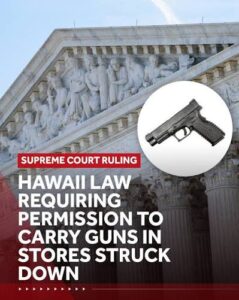
The Supreme Court gun rights ruling has once again reshaped the legal landscape surrounding the Second Amendment in the United States. In a closely watched 6-3 decision, the U.S. Supreme Court struck down a Hawaii law that required individuals with concealed-carry permits to obtain explicit permission before carrying firearms onto private property that is open to the public, including businesses, restaurants, hotels, and gas stations.
The landmark decision is being viewed as another significant expansion of constitutional protections for lawful gun owners. Legal experts believe the ruling will influence similar firearm laws across multiple states while continuing the Court’s trend of applying a robust interpretation of the Second Amendment.
Supreme Court Rules Against Hawaii Gun Restrictions
The case centered on a Hawaii statute enacted after the Court’s landmark 2022 decision in New York State Rifle & Pistol Association v. Bruen. Hawaii lawmakers attempted to regulate where concealed firearms could be carried by requiring permit holders to receive affirmative permission before bringing guns onto private property that was accessible to the public.
Gun-rights organizations and several Hawaii residents challenged the law, arguing that it effectively prevented lawful firearm owners from exercising their constitutional rights in most everyday locations.
The Supreme Court agreed.
By a 6-3 vote, the Court concluded that Hawaii’s permission requirement violated the Second Amendment because it imposed restrictions that lacked sufficient historical support under the constitutional framework established in earlier decisions.
What the Court Actually Decided
The ruling does not require every private business to allow firearms.
Instead, the Court held that states cannot automatically presume firearms are prohibited on all private property open to the public unless the owner grants permission.
Following the decision:
Businesses may still prohibit firearms if they choose.
Property owners retain the right to post “No Firearms” signs.
Concealed-carry permit holders generally may carry firearms unless property owners expressly forbid them.
The ruling affects the legal default established by Hawaii’s law.
This distinction has become one of the most important aspects of the decision.
Why This Supreme Court Gun Rights Ruling Matters
Legal scholars say the decision continues the Supreme Court’s recent pattern of strengthening Second Amendment protections.
Since the 2022 Bruen ruling, courts have increasingly evaluated firearm regulations by asking whether comparable restrictions existed during America’s historical tradition of firearm regulation.
The Hawaii law failed that historical test according to the Court’s majority.
The decision also signals that states may face greater difficulty defending broad restrictions on where licensed firearm owners can legally carry weapons.
Impact Beyond Hawaii
Although the case originated in Hawaii, its implications extend much further.
Several states have enacted comparable restrictions governing firearms on private property open to the public.
Legal experts anticipate that:
Existing lawsuits may gain momentum.
Similar state laws could face constitutional challenges.
Legislatures may revise firearm regulations to comply with the Supreme Court’s guidance.
Lower courts will likely rely on this ruling in future Second Amendment cases.
For policymakers, the ruling represents another important benchmark in defining the limits of state authority over public firearm carry.
A Continuing Trend in Second Amendment Cases
The Hawaii ruling is not an isolated decision.
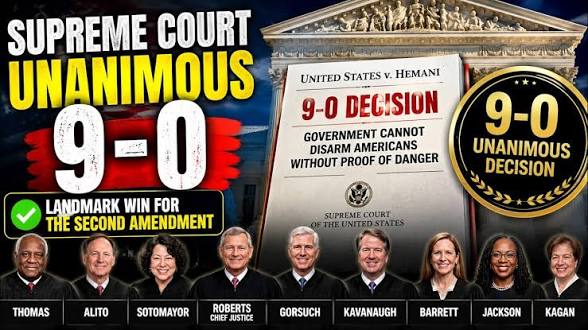
Only one week earlier, the Supreme Court unanimously ruled that the federal government cannot broadly prohibit firearm ownership simply because someone is an unlawful user of controlled substances, finding that such prosecutions must be consistent with the Second Amendment and historical tradition. The Court emphasized that its decision was narrow and did not eliminate all firearm restrictions for dangerous individuals.
Together, these decisions illustrate the Court’s continued willingness to scrutinize firearm regulations under constitutional standards established in recent years.
Reactions From Both Sides
Gun-rights advocates celebrated the decision as a victory for constitutional freedoms.
Supporters argue that licensed firearm owners should not lose their constitutional rights simply because they enter restaurants, stores, or other businesses that are open to the public.
Many organizations described the ruling as reaffirming that the Second Amendment protects ordinary citizens carrying firearms for lawful self-defense.
Gun-control advocates, however, expressed concern.
Critics argue that expanding firearm access in public settings could complicate efforts to reduce gun violence and may limit states’ ability to adopt regulations tailored to local public safety concerns. They contend that legislatures should retain flexibility to address unique circumstances within their jurisdictions.
What Businesses Should Know
Although the Court struck down Hawaii’s law, private property rights remain intact.
Businesses still have the authority to establish their own firearm policies.
Owners who do not wish to allow firearms on their premises may generally continue to prohibit them through clear policies or posted notices, subject to applicable state laws.
This balance between constitutional rights and private property rights will likely remain a significant issue in future legal debates.
How useful was this post?
Click on a star to rate it!
Average rating 0 / 5. Vote count: 0
No votes so far! Be the first to rate this post.
About the Author

usa5911.com
Administrator
Hi, I’m Gurdeep Singh, a professional content writer from India with over 3 years of experience in the field. I specialize in covering U.S. politics, delivering timely and engaging content tailored specifically for an American audience. Along with my dedicated team, we track and report on all the latest political trends, news, and in-depth analysis shaping the United States today. Our goal is to provide clear, factual, and compelling content that keeps readers informed and engaged with the ever-changing political landscape.