In the heart of New York City, an atmosphere of intense anxiety and grim determination has gripped the borough of Brooklyn. Following the catastrophic collapse of a multi-story residential and commercial structure in the Flatbush neighborhood, first responders dig through rubble in a desperate, round-the-clock race against time. With the confirmed death toll rising to eight and numerous others injured, the disaster has triggered one of the most complex and hazardous urban search-and-rescue operations in recent municipal memory.
The catastrophe, which occurred on Wednesday afternoon along a bustling commercial and residential corridor on Flatbush Avenue, turned a routine weekday into an absolute nightmare. As tons of unstable brick, fractured timber, and twisted concrete crashed into an adjacent excavation pit, dozens of residents were trapped beneath unstable voids. For hundreds of firefighters, elite urban search specialists, paramedics, and K-9 handlers, the mission shifted immediately into a high-stakes battle where every single movement carried life-or-death consequences.
Anatomy of a Crisis: The Flatbush Avenue Disaster
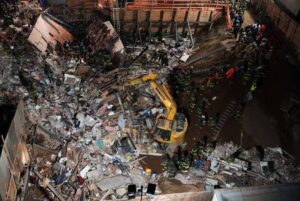
The emergency unfolded shortly before 4:00 p.m., sending a massive plume of choking gray dust billowing across Flatbush Avenue near Bedford Avenue and Clarendon Road. The three-story building gave way suddenly, its outer facade peeling away to expose cross-sections of everyday domestic life—hanging closets, unmade beds, and stairwells now open to the elements.
Initial reports from the Fire Department of New York (FDNY) indicated that roughly 250 firefighters rushed to the scene within minutes. They were met with a volatile landscape: a towering, unstable pile of wreckage sitting directly on the precipice of an open construction excavation site.
“This has been an incredibly challenging and fast-moving situation, with precarious wreckage to navigate and dangerous voids beneath the surface,” said New York City Mayor Zohran Mamdani during an emergency press briefing.
The structural instability of the remaining walls meant that heavy mechanical excavation equipment could not be deployed initially. Instead, the burden fell squarely on the shouldersshoulders of frontline personnel forced to dig by hand, utilizing flashlights, optical scopes, and thermal imaging drones as night fell over Brooklyn.
The Perilous Operation: Inside the Search for Survivors
Describing the gravity of the mission, FDNY Commissioner Lillian Bonsignore didn’t mince words, noting that rescue teams were performing exceptionally “dangerous and perilous” work.
“Every move is choreographed,” Bonsignore told reporters at the scene. Because shifting a single slab of concrete or pulling a twisted steel beam could trigger a secondary collapse, engineers and rescue technicians mapped out every centimeter of the debris field before making entry.
The rescue strategy relied on a synchronized, multi-tiered protocol:
Acoustic and Thermal Sweep: Search teams periodically ordered absolute silence across the entire block.Generators, power tools, and heavy machinery were shut down completely so sensitive listening equipment and specialized K-9 units could detect faint taps, breathing, or cries for help beneath the rubble.
Manual Excavation and Shoring: Urban Search and Rescue (USAR) specialists installed temporary wooden and hydraulic shoring struts to stabilize adjacent standing walls. Firefighters then tunneled into narrow pockets by hand,passing chunks of masonry and debris back in bucket lines.
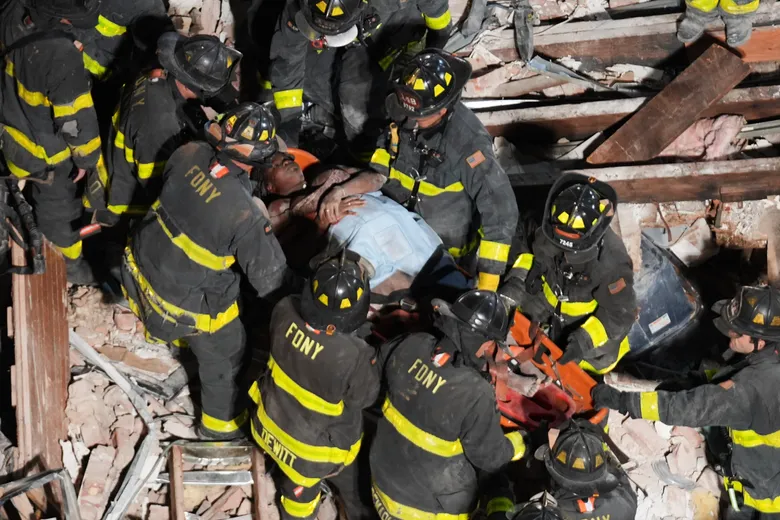
Targeted Extractions: In dramatic moments that brought temporary cheers through the police barricades, crews successfully extracted survivors from tight subterranean pockets. Among the most emotional recoveries on Wednesday evening was a woman—later identified alongside her young children—who was hoisted out of a narrow hole on a stretcher and rushed to an awaiting ambulance.
Despite the extreme danger, only minor injuries were reported among the rescue personnel, a testament to the rigorous training and disciplined execution of the FDNY’s specialized units.
Human Stories Amid the Dust and Devastation
Behind the logistical scale of the emergency response lie heartbreaking personal narratives. Because the collapse took place mid-afternoon, many children had just returned home from school or were inside their apartments with family members, accounting for a significant number of the injured.
Anderson Velez, a resident of the collapsed building, recounted the harrowing final moments of communication he had with his family. Velez was at work when his wife called him frantically as the structure gave way around her.
“She called me when the building collapsed while she was inside with rubble on top of her,” Velez told reporters, holding back tears. “She was screaming for someone to help get my son out, and then the call cut off”. After hours of agonizing uncertainty behind police lines, Velez received the miraculous news that his wife and their two children, aged 7 and 2, had been located, pulled safely from the wreckage, and transported to a hospital.
For other families, the wait concluded in tragedy. As the operation stretched from an active rescue into a recovery phase,city officials confirmed that the death toll had climbed to eight. The Office of Chief Medical Examiner worked through the night to identify victims and notify grieving relatives.
Safety and Scrutiny: Why Did the Building Collapse?
As first responders dig through rubble and secure the perimeter, investigators from the New York City Department of Buildings (DOB), the Brooklyn District Attorney’s Office, and federal safety regulators have launched a comprehensive joint probe into the root cause of the disaster.
Initial focus has centered on the active construction site directly next door to the collapsed structure. Property records show that a single-story building on the adjacent lot had recently been demolished, and contractors had been actively excavating the earth to lay foundations for a new development.
In dense urban environments like New York City, excavation work immediately adjacent to older, masonry-bearing buildings requires meticulous engineering controls. If an excavation digs deeper than neighboring foundations without robust underpinning, soil retention, or continuous structural monitoring, the supporting earth can shift rapidly. This movement can undermine load-bearing walls, triggering sudden structural failure.
Investigators have subpoenaed architectural blueprints, engineering logs, and daily inspection reports for the construction project. City officials have also placed stop-work orders across the immediate site while structural engineers evaluate the safety of neighboring properties along Flatbush Avenue.
The Broader Impact on the Flatbush Community
The tragedy has left an indelible mark on the Flatbush neighborhood, disrupting local commerce, displacing dozens of residents, and snarling transportation corridors.
Traffic and Transit Disruptions: The New York Police Department (NYPD) maintained a wide security perimeter, keeping Flatbush Avenue closed to vehicular traffic between Clarendon Road and Bedford Avenue.Commuters faced heavy delays as MTA bus routes were detoured around the active emergency zone.
Emergency Assistance for Displaced Families: Recognizing that neighboring buildings were evacuated out of an abundance of caution, New York City Emergency Management (NYCEM) and the American Red Cross established a reception center at the nearby Flatbush YMCA (1401 Flatbush Avenue). Displaced tenants received emergency housing vouchers, food, clothing, and mental health counseling.
State and local leaders have pledged unwavering support to help the community rebuild. Governor Kathy Hochul and local elected officials visited the perimeter to thank emergency personnel and promise a transparent, thorough investigation into whether any regulatory violations contributed to the loss of life.
A Reminder of Urban Vulnerability
The Flatbush Avenue catastrophe serves as a sobering reminder of the complex risks inherent in aging city infrastructure colliding with modern urban density and rapid construction. As heavy cranes begin the slow, methodical process of clearing the remaining debris from the excavation pit, the dedication displayed by the firefighters, paramedics, and engineers who spent endless hours sifting through unstable ruins remains a beacon of resilience.
For New York City, the hard work of healing, investigating, and ensuring stricter accountability for urban construction safety has only just begun.
Frequently Asked Questions (FAQs)
1. Why are first responders digging through rubble in Brooklyn?
First responders are conducting intensive search, rescue, and recovery operations following the sudden collapse of a three-story residential and commercial building at 1321 Flatbush Avenue in Brooklyn.
2. How many people were killed or injured in the Flatbush collapse?
Authorities confirmed that at least eight people have died and 17 others were injured (including multiple
About the Author