DIPLOMATIC SHOCKWAVE: White House Confirms Trump Requested Kimberly Guilfoyle Resignation
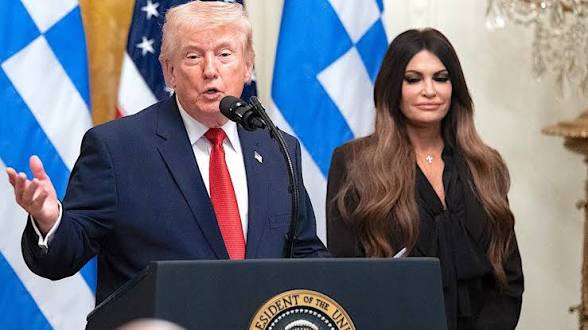
The White House confirmed on Tuesday, October 13, that the Trump administration had asked Kimberly Guilfoyle to resign from her position as the United States ambassador to Greece.
New White House press secretary Katie Zacharia announced the decision during her first press briefing. She described Guilfoyle as a valuable member of the administration’s team and expressed goodwill toward her future.
The announcement followed several days of growing scrutiny over allegations about Guilfoyle’s conduct before and during her diplomatic assignment in Athens.
President Trump had already indicated his dissatisfaction with the situation. On October 12, when reporters asked whether he was considering removing Guilfoyle, he said the administration was reviewing the matter and that officials were unhappy with the reports.
The White House announcement therefore marked a significant development in a controversy that had continued to attract attention in Washington and Greece.
However, it is important to distinguish between the confirmed resignation request and the allegations that prompted it. The administration confirmed that Guilfoyle was asked to resign, but the accusations against her remain disputed. She has denied wrongdoing.
Why Did Donald Trump Ask Kimberly Guilfoyle to Resign?
 6
6
The decision followed a series of media reports alleging questionable financial requests, potential conflicts of interest and inappropriate conduct in diplomatic settings.
Reports by The Wall Street Journal described concerns involving Guilfoyle’s relationships with political donors and Greek business interests. Other reporting raised questions about her management of embassy personnel and the handling of gifts and private travel.
These allegations created pressure on the administration to address whether her conduct met the standards expected of a U.S. ambassador.
According to reporting by the Associated Press and other news organizations, the State Department’s inspector general was reported to be reviewing the allegations. The precise status and scope of any formal investigation remained unclear in the reporting available on October 13.
The White House has not publicly established that every allegation is true. Instead, its request for Guilfoyle’s resignation came amid an increasingly damaging controversy.
For the administration, the situation presents a difficult political calculation. Keeping a controversial ambassador in office can prolong scrutiny, while requesting a resignation can raise questions about the process used to assess allegations and determine responsibility.
The $100,000 Credit Card Allegation
One of the most significant allegations concerns a reported request for $100,000 to cover a personal American Express credit card bill.
According to reporting by The Wall Street Journal, businessman Eric Deters alleged that Guilfoyle asked him to arrange payment of the bill shortly before her Senate confirmation hearing in 2025. Deters said the request was connected to the possibility of gaining access to senior officials in the Trump administration.
The allegation attracted attention because it raised questions about the relationship between private financial arrangements and access to government officials.
However, the reported payment was not made, according to the coverage. Guilfoyle’s lawyers challenged the allegations and disputed the interpretation and authenticity of messages cited in reporting. Her legal representatives argued that the money involved compensation owed for earlier speaking engagements and related appearances.
These competing accounts are important. An allegation involving a political donor does not, by itself, establish that a crime occurred. Determining whether any conduct violated financial disclosure rules, ethics requirements or other laws would require examination of the relevant evidence.
The controversy has nevertheless become a major part of the public discussion surrounding the Kimberly Guilfoyle resignation.
It also highlights a broader issue in American politics: how officials should manage financial relationships with donors, supporters and private individuals while seeking or holding government positions.
Public confidence can suffer when those relationships appear to overlap with official responsibilities. Clear documentation, independent review and transparent explanations are therefore essential.
Allegations Involving Greek Business Interests
A second area of concern involves Guilfoyle’s diplomatic activities in Greece.
Media reports raised questions about whether she promoted the interests of a Greek construction and energy company, Aktor Group, and whether a person described as a company lobbyist was allowed to participate in private diplomatic meetings.
Such allegations can be particularly sensitive because an ambassador represents the United States government, not an individual business or private network.
Ambassadors regularly meet business leaders, government officials and investors. These discussions can support trade, investment and wider bilateral cooperation. However, official meetings must be conducted in accordance with applicable ethics rules and diplomatic protocols.
The central question is not whether an ambassador meets business representatives. Such meetings are a normal part of diplomacy. Instead, scrutiny concerns whether private commercial interests may have received inappropriate access or preferential treatment.
The available reporting does not establish that every alleged interaction constituted an ethics violation. Guilfoyle’s representatives have denied wrongdoing, and the claims require careful assessment against the relevant records and rules.
The controversy could encourage further scrutiny of how American diplomats document meetings with private companies, manage potential conflicts of interest and distinguish public responsibilities from personal relationships.
Questions About Diplomatic Conduct and Embassy Management
The allegations extend beyond financial matters and business contacts.
Reports have also described concerns about Guilfoyle’s treatment of embassy employees, management decisions and conduct during travel and official activities. Some accounts raised questions about the handling of staff responsibilities and the acceptance of hospitality or services.
These claims matter because an ambassador’s performance involves more than public appearances and meetings with foreign leaders.
Ambassadors oversee diplomatic missions, coordinate with State Department officials, communicate American policy and maintain professional working relationships with embassy personnel. Their behaviour can influence morale within the mission and the credibility of the country they represent.
Nevertheless, allegations about workplace conduct should be evaluated carefully. Reports based on unnamed sources or disputed accounts may identify issues that deserve examination, but they are not equivalent to final investigative findings.
The State Department’s inspector general is an important part of the oversight framework because the office can examine potential misconduct and recommend appropriate action when warranted. Reporting on October 13 indicated that the inspector general was reviewing allegations involving Guilfoyle, although the precise status of a formal investigation was not clear.
The distinction between a preliminary review and a completed investigation is significant. A review can determine whether further action is justified, while a full investigation may involve records, interviews and additional evidence.
Until the relevant facts are established, the allegations should not be treated as proven findings.
Kimberly Guilfoyle Denies Wrongdoing
Guilfoyle has strongly rejected the accusations.
In a public statement reported by the Associated Press, she described the allegations as false and said she intended to defend her name, reputation and integrity. Her legal representatives have also disputed the claims involving financial requests and private travel.
Her response places the controversy in a familiar position in public life: the administration has taken a personnel decision, while the individual concerned disputes the claims that contributed to the decision.
A request to resign is not the same as a criminal conviction or a final finding of misconduct. It is possible for an administration to change a diplomatic appointment because of political pressure, concerns about performance or the need to protect institutional credibility without a court having determined that criminal conduct occurred.
At the same time, a denial does not automatically resolve the underlying questions. Those questions must be addressed through evidence, appropriate oversight and fair procedures.
The public will be watching whether the allegations receive further scrutiny and whether any official review produces findings that can be disclosed.
Guilfoyle’s departure may end her immediate diplomatic responsibilities, but it does not necessarily settle the issues raised by the reporting.
Who Is Kimberly Guilfoyle?

Kimberly Guilfoyle is an American lawyer, former television personality and political figure who became closely associated with the Trump political movement.
She previously worked as a prosecutor in California and later became a familiar face on Fox News. She also played a prominent role in political campaigning and fundraising within Republican circles.
Her personal relationship with Donald Trump Jr., President Trump’s eldest son, brought additional attention to her political profile. The couple became engaged, but their relationship ended in 2024.
In December 2024, President Trump nominated Guilfoyle to serve as U.S. ambassador to Greece. The Senate confirmed her appointment in September 2025, according to contemporary reporting.
Her appointment placed her in an important diplomatic role in a country that holds strategic significance for the United States.
Guilfoyle’s supporters could point to her political experience, communication skills and close connections to the administration as strengths. Critics, however, have questioned whether political loyalty and personal relationships should carry significant weight in diplomatic appointments.
The current controversy has intensified that debate.
Why the U.S. Ambassador to Greece Matters
The position of U.S. ambassador to Greece is more than a ceremonial appointment.
Greece is a NATO ally and a member of the European Union. Its geographical position gives it importance for security, regional diplomacy, maritime activity and American engagement across the eastern Mediterranean.
The United States and Greece cooperate on defence, regional stability, trade, investment and other shared interests. Diplomatic representatives help coordinate those relationships and communicate policy priorities.
An ambassador also serves as a senior representative of the American government in discussions with the host country’s political leadership.
Consequently, allegations involving an ambassador can have implications beyond domestic political debate. They may affect perceptions of American diplomatic standards and create additional work for officials responsible for maintaining bilateral cooperation.
That does not mean the resignation request will automatically damage U.S.-Greece relations. Diplomatic partnerships generally involve established institutions and long-term interests that extend beyond a single ambassador.
However, the administration will need to manage the transition carefully to ensure that ongoing discussions, official meetings and cooperation programmes continue without unnecessary disruption.
The central challenge is to separate the personnel controversy from the broader relationship between Washington and Athens.
Political Fallout Inside the Trump Administration
The Kimberly Guilfoyle resignation controversy presents a political challenge for the Trump administration because of her longstanding connections to the president and his political circle.
When an administration faces allegations involving a prominent ally, it must balance loyalty, fairness, accountability and the need to maintain public confidence.
The White House’s decision to request her resignation signals that the controversy had become serious enough to warrant a change in personnel. Trump’s public comments on October 12 had already indicated dissatisfaction with the situation.
However, the decision should not automatically be interpreted as proof of every allegation or as confirmation of a wider internal political conflict. The publicly available information supports a more measured conclusion: the administration acted after a series of damaging reports and growing pressure for answers.
The episode may nevertheless fuel debate among political supporters and critics.
Critics could argue that senior officials should face clear consequences when credible allegations raise concerns about public service. Supporters may insist that allegations should be assessed fairly and that media reporting should not substitute for evidence.
Both accountability and due process are important. Government institutions must take credible concerns seriously while avoiding premature conclusions about individual responsibility.
The administration’s handling of any subsequent review will help determine whether the resignation is viewed primarily as a personnel decision or as part of a broader effort to strengthen oversight.
Congressional Calls for Accountability
The controversy has also drawn attention from Democratic lawmakers.
According to reporting by the Associated Press, Democratic members of Congress called for an investigation into the allegations. Lawmakers associated with the House Foreign Affairs Committee, Senate Foreign Relations Committee and House oversight proceedings raised concerns about the reported conduct.
Congressional scrutiny is relevant because lawmakers have oversight responsibilities involving foreign policy, government ethics and the use of public office.
An investigation could examine whether any applicable rules were violated, whether official resources were used appropriately and whether the State Department followed its established procedures.
However, the scope and outcome of any congressional inquiry remain separate from the White House’s decision to seek Guilfoyle’s resignation.
The resignation request does not, by itself, establish whether further disciplinary action is necessary. Nor does it determine whether any conduct meets the legal threshold for a criminal offence.
For now, the key questions concern the evidence, the applicable standards and whether oversight bodies identify substantiated violations.
The administration and congressional investigators may also face questions about transparency. Where legally permissible, clear explanations of the review process can help reassure the public that allegations involving senior officials are not being ignored.
What Happens After the Resignation Request?
The next stage involves the formal end of Guilfoyle’s appointment and the arrangements needed to maintain the work of the U.S. Embassy in Athens.
The White House’s October 13 announcement confirmed that the administration had asked her to resign. Reporting that day also indicated that Guilfoyle had announced that her time as ambassador was coming to an end.
The precise administrative timetable and any remaining formalities should be distinguished from the announcement itself.
In the meantime, the State Department must ensure that the embassy continues to operate effectively. Diplomatic missions have professional staff and established procedures designed to maintain continuity during leadership changes.
A replacement process could involve a new nomination and the applicable appointment procedures. Depending on the circumstances, officials may also arrange interim leadership while a permanent successor is considered.
The administration may need to address several practical matters:
Maintaining regular communication with Greek government officials.
Continuing defence and regional security cooperation.
Ensuring that diplomatic meetings and bilateral initiatives proceed.
Reviewing any outstanding ethics or personnel concerns.
Providing clarity about the leadership transition at the embassy.
These steps are important because the United States has ongoing interests in Greece that do not depend on one individual.
Any further review of the allegations would follow its own procedures and should not be confused with the administrative process for changing ambassadors.
Could the Controversy Affect U.S.-Greece Relations?
The immediate diplomatic consequences remain uncertain.
On one hand, the resignation request could create temporary questions about the direction of the American mission in Athens. Greek officials, businesses and other diplomatic partners may seek clarity about who will represent Washington and how ongoing priorities will be managed.
On the other hand, the United States and Greece have longstanding institutional ties. Their relationship includes cooperation through NATO, bilateral security arrangements, trade and wider engagement across Europe and the eastern Mediterranean.
Those interests are unlikely to disappear simply because an ambassador leaves office.
The more important issue may be how the administration manages the transition and whether the controversy creates lasting concerns about the conduct of American diplomatic representatives.
If officials provide a clear explanation of the transition and maintain normal diplomatic channels, disruption could remain limited. If additional substantiated findings emerge, the political and institutional consequences could be more significant.
Greek political reactions will also matter. Reporting on October 13 indicated that opposition figures in Greece had called for an explanation of the allegations, while Greek government officials had addressed questions about whether a formal diplomatic summons was necessary.
Even so, it would be premature to conclude that the controversy has fundamentally altered the bilateral relationship.
What the Kimberly Guilfoyle Resignation Means for Diplomatic Standards
The controversy has renewed attention to the standards expected of people appointed to senior diplomatic positions.
Ambassadors are expected to exercise sound judgment, protect confidential information, comply with applicable financial and ethics rules, and act in ways that preserve confidence in the United States government.
They also need to understand that private relationships can create risks when they overlap with official responsibilities.
Several principles are especially relevant.
First, transparency matters. Clear records of meetings, gifts, travel and relevant financial arrangements can help officials demonstrate compliance with established rules.
Second, conflicts of interest require careful management. A diplomat must distinguish legitimate engagement with businesses from conduct that could improperly benefit a private party.
Third, oversight must be credible. Allegations should be assessed through appropriate procedures, with findings based on evidence rather than political pressure alone.
Finally, public accountability must coexist with fairness. Officials should face appropriate consequences for substantiated misconduct, but accusations should not be presented as established facts before the evidence supports that conclusion.
These principles apply regardless of political party or personal connections.
The Guilfoyle case illustrates how quickly questions about an individual appointment can develop into a wider debate about public trust, political accountability and the professionalism of government institutions.
What to Watch Next
Several developments will determine how the story progresses.
The first is the formal status of Guilfoyle’s departure. The White House confirmed the resignation request, but the administrative details of her exit are a separate matter.
The second is the status of the State Department inspector general’s review. Further information could clarify which allegations are being examined and whether officials have identified potential rule violations.
The third is the response from Guilfoyle and her legal representatives. They have denied wrongdoing, and any further statements or evidence could shape the public understanding of the allegations.
The fourth is congressional oversight. Lawmakers may seek additional information or pursue formal inquiries, depending on the evidence and their assessment of the matter.
Finally, the administration’s selection of future leadership for the embassy in Athens will indicate how it intends to maintain diplomatic continuity.
Readers should look for information from official government statements, the State Department and established news organizations rather than relying on unverified claims circulating on social media.
Conclusion: A Major Test for the White House
The Kimberly Guilfoyle resignation request marks a significant development for the Trump administration. Confirmed by the White House on October 13, 2026, the decision followed allegations involving financial dealings, diplomatic conduct and relationships with private business interests.
Guilfoyle has denied wrongdoing and pledged to defend her reputation. The allegations should therefore be distinguished from proven misconduct, while any official review should be allowed to establish the relevant facts.
The episode raises broader questions about political appointments, ethics oversight and the responsibilities of American diplomats. It also highlights the importance of maintaining strong diplomatic relationships during a leadership transition.
For now, the most important developments to watch are the formal arrangements surrounding Guilfoyle’s departure, any findings from the reported oversight review and the administration’s next steps in Athens.
Whether the controversy produces further institutional changes will depend on the evidence and the outcome of subsequent proceedings.
Frequently Asked Questions (FAQs)
1. Why did the White House ask Kimberly Guilfoyle to resign?
The White House confirmed on October 13, 2026, that the Trump administration had asked Guilfoyle to resign as U.S. ambassador to Greece. The decision followed reports alleging questionable financial dealings, potential conflicts of interest and concerns about diplomatic conduct.
2. Did Donald Trump personally request Kimberly Guilfoyle’s resignation?
The White House confirmed that the administration had asked Guilfoyle to resign. Trump had publicly expressed dissatisfaction with the reports the previous day and said he was considering her removal.
3. Has Kimberly Guilfoyle resigned officially?
The White House confirmed the resignation request on October 13. Guilfoyle also indicated that her time as ambassador was coming to an end. The formal administrative details should be distinguished from the initial announcement.
4. What are the allegations against Kimberly Guilfoyle?
Media reports have raised questions about an alleged $100,000 request to a political donor, possible promotion of private business interests in Greece, workplace conduct, gifts and private travel. Guilfoyle and her legal representatives have disputed the allegations.
5. Did Kimberly Guilfoyle admit wrongdoing?
No. Guilfoyle has denied the accusations and stated that she intends to defend her name, reputation and integrity.
6. Is Kimberly Guilfoyle under investigation?
News reports on October 13 indicated that the State Department’s inspector general was reviewing allegations concerning her conduct. The precise scope and status of any formal investigation were not fully clear in the available reporting.
7. Why is Kimberly Guilfoyle’s position important?
As U.S. ambassador to Greece, Guilfoyle represented the American government in a NATO ally and European Union member. The role involves diplomatic relations, security cooperation, trade and regional policy.
8. Will her resignation affect U.S.-Greece relations?
The long-term effect remains uncertain. The two countries have established diplomatic and security relationships that extend beyond a single ambassador. Maintaining continuity at the U.S. Embassy in Athens will be important.
9. Who is Kimberly Guilfoyle?
Guilfoyle is an American lawyer, former Fox News personality and political figure. She was a prominent Trump supporter and was nominated by President Trump to serve as U.S. ambassador to Greece in December 2024.
10. What happens next in the Kimberly Guilfoyle resignation case?
The next developments may include completion of her departure, further information about the reported inspector general review, possible congressional oversight and arrangements for future leadership at the U.S. Embassy in Athens.
How useful was this post?
Click on a star to rate it!
Average rating 0 / 5. Vote count: 0
No votes so far! Be the first to rate this post.
About the Author

usa5911.com
Administrator
Hi, I’m Gurdeep Singh, a professional content writer from India with over 3 years of experience in the field. I specialize in covering U.S. politics, delivering timely and engaging content tailored specifically for an American audience. Along with my dedicated team, we track and report on all the latest political trends, news, and in-depth analysis shaping the United States today. Our goal is to provide clear, factual, and compelling content that keeps readers informed and engaged with the ever-changing political landscape.