Iranian President declares total war : US confrontation, Israel conflict, global crisis

Pezeshkian said, “In my opinion, we are in a state of full-scale war with the United States, Israel and Europe. They want to bring our country to its knees.” Today we will discuss about Iranian President declares total war : US confrontation, Israel conflict, global crisis
Iranian President declares total war : US confrontation, Israel conflict, global crisis
The global political landscape has entered a dangerous new phase after Iranian President Masoud Pezeshkian declared that Iran is now engaged in a state of “total war” against the United States, Israel, and their European allies. The statement, delivered through state-backed media and official channels, has sent shockwaves through diplomatic circles, raising fears of a widening Middle East conflict with global consequences.
This declaration does not represent a formal war announcement under international law, yet its language and intent are unmistakable. By describing the confrontation as “total,” Iran’s leadership is signaling that the struggle extends far beyond missiles and military clashes — it includes economic sanctions, cyber warfare, political isolation, and ideological confrontation. The statement underscores how deeply entrenched the crisis has become and how rapidly it is reshaping international relations.
A Declaration That Changed the Tone of Global Politics
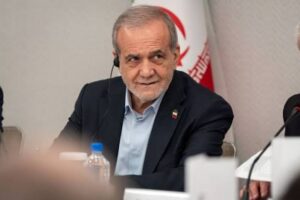
President Pezeshkian’s remarks marked one of the strongest and most direct warnings issued by Iran in decades. He stated that Iran is facing coordinated pressure from the United States, Israel, and Europe across all domains, portraying the nation as the target of a comprehensive strategy designed to weaken, destabilize, and ultimately subjugate it.
According to Iranian leadership, this is not a conventional conflict with defined battlefields. Instead, it is an all-encompassing confrontation involving military strikes, economic blockades, psychological warfare, media influence, and diplomatic marginalization. The president emphasized that Iran’s sovereignty, national dignity, and independence were under direct attack.
By invoking the phrase “total war,” Pezeshkian deliberately evoked memories of existential struggles from Iran’s past, particularly the devastating Iran-Iraq War of the 1980s. However, he stressed that today’s confrontation is even more dangerous because it is global in scope and technologically advanced.
The Road to Escalation: How Tensions Reached This Point
Iran and Israel: From Shadow War to Open Confrontation
For years, Iran and Israel engaged in what analysts often called a “shadow war,” marked by covert operations, cyberattacks, intelligence sabotage, and proxy conflicts across Syria, Lebanon, and Gaza. That uneasy balance began to collapse as tensions intensified in 2025.
Israeli strikes targeting Iranian military infrastructure and alleged nuclear facilities pushed the conflict into open confrontation. Iran responded with missile and drone attacks, demonstrating both capability and willingness to escalate. These exchanges shattered long-standing red lines and fundamentally altered regional security dynamics.
US Involvement and the Nuclear Question
The United States, long Israel’s closest ally, became directly involved after launching strikes on key Iranian nuclear sites. Washington framed these actions as preventive measures to stop Iran from advancing its nuclear program, while Tehran condemned them as acts of aggression and violations of international sovereignty.
Simultaneously, nuclear negotiations collapsed. Iran accused Western powers of using diplomacy as a façade while pursuing military and economic pressure. In response, Tehran hardened its stance, accelerating nuclear enrichment and rejecting further concessions.
Sanctions and Economic Warfare
Europe’s decision to reimpose and expand sanctions against Iran played a central role in shaping Tehran’s “total war” narrative. These measures targeted Iran’s oil exports, financial institutions, and international trade, causing severe strain on the Iranian economy.
Inflation surged, the national currency weakened, and unemployment rose. Iranian leaders described these sanctions not as diplomatic tools but as deliberate economic warfare aimed at provoking internal unrest and weakening the state from within.
What Does ‘Total War’ Mean in the Modern Era?
Historically, total war refers to conflicts in which entire societies are mobilized, and civilian infrastructure becomes a legitimate target. In the modern geopolitical context, Iran’s usage of the term reflects a broader interpretation.
Multiple Fronts of Conflict
Iran defines this total war as operating across several interconnected fronts:
Military pressure through airstrikes, missile attacks, and covert operations
Economic warfare via sanctions, trade restrictions, and financial isolation
Political confrontation through diplomatic pressure and international alliances
Information and cultural warfare aimed at shaping public opinion and internal stability
By framing the situation this way, Iranian leadership suggests that every sector of national life is affected and must be mobilized in response.
Why Iran Chose This Moment to Speak
Domestic Consolidation
One key motive behind the declaration is internal unity. Framing the crisis as an external, existential threat allows Iran’s leadership to rally public support and reduce internal dissent. Historically, nations under perceived siege often experience a surge in nationalist sentiment, which governments use to strengthen political control.
Deterrence Messaging
The declaration also serves as a warning. By publicly stating that Iran considers itself at war, Tehran signals that any further attacks will be met with decisive retaliation. This message is aimed particularly at Israel and the United States, seeking to deter future strikes by raising the potential costs.
Strategic Timing
The announcement coincided with heightened diplomatic activity involving Western leaders and Israel. Analysts believe Iran intended to influence negotiations by elevating the stakes, reminding adversaries that continued pressure could push the region into uncontrollable escalation.
Global Reactions: A Divided World
United States
Washington has downplayed Iran’s rhetoric publicly while reinforcing military readiness in the region. US officials maintain that their actions are defensive and focused on preventing nuclear proliferation. However, internal debates within the US government reflect concern about being drawn into a prolonged regional war.
Israel
Israel has responded by strengthening its air defenses and reiterating its commitment to preventing Iran from acquiring nuclear weapons. Israeli leaders view Iran’s declaration as confirmation of hostile intent rather than mere rhetoric.
Europe
European nations find themselves in a delicate position. While aligned with the US on sanctions and nuclear concerns, several European leaders continue to call for restraint and renewed diplomacy. Iran, however, increasingly views Europe as part of a unified Western front against it.
Regional Powers
Across the Middle East, reactions are mixed. Some states fear being dragged into a larger conflict, while Iranian-aligned groups have voiced strong support for Tehran. The risk of proxy escalation remains high.
Economic Shockwaves Beyond Iran
Iran’s declaration has not only domestic consequences but global economic implications. Rising tensions in the Middle East have increased uncertainty in energy markets, pushing oil prices higher amid fears of supply disruptions.
Global investors have become cautious, and regional trade has slowed. Countries dependent on Middle Eastern energy routes are particularly vulnerable to prolonged instability.
Is Diplomacy Still Possible?
Despite the grim rhetoric, diplomatic channels have not entirely closed. Behind-the-scenes negotiations continue through intermediaries, and some international actors are working to prevent further escalation.
However, public declarations of total war make compromise politically difficult. Leaders who frame conflicts in existential terms risk limiting their own flexibility, as backing down can be perceived as weakness.
Experts warn that miscalculations, accidental strikes, or misinterpreted signals could quickly spiral into a broader conflict involving multiple powers.
Conclusion: A World on Edge
The Iranian president’s declaration of total war represents a turning point in modern geopolitics. It reflects a world increasingly divided, where diplomacy struggles to keep pace with military escalation and economic confrontation.
Whether this moment marks the beginning of a prolonged global crisis or becomes a catalyst for renewed dialogue will depend on decisions made in the coming months. What is clear is that the stakes have rarely been higher.
As the Middle East stands at the center of this unfolding drama, the consequences will not remain confined to one region. The entire world is watching — and waiting — as history unfolds.
How useful was this post?
Click on a star to rate it!
Average rating 0 / 5. Vote count: 0
No votes so far! Be the first to rate this post.
About the Author

usa5911.com
Administrator
Hi, I’m Gurdeep Singh, a professional content writer from India with over 3 years of experience in the field. I specialize in covering U.S. politics, delivering timely and engaging content tailored specifically for an American audience. Along with my dedicated team, we track and report on all the latest political trends, news, and in-depth analysis shaping the United States today. Our goal is to provide clear, factual, and compelling content that keeps readers informed and engaged with the ever-changing political landscape.