The mystery surrounding unidentified aerial phenomena (UAP), formerly known as UFOs, continues to captivate scientists, government officials, historians, and the public. While modern military footage and Pentagon reports often dominate headlines, a growing number of researchers are turning their attention to the earliest documented UAP sightings in an effort to understand whether these mysterious events follow patterns that stretch back decades—or even centuries.
Recent scientific studies, declassified government records, and renewed public interest have sparked a fresh examination of historical cases. Investigators believe that revisiting the earliest UAP sightings may provide crucial clues about one of humanity’s most enduring mysteries. Some researchers argue that overlooked evidence from the past could help explain modern sightings, while skeptics maintain that many historical reports can be attributed to natural phenomena, misidentifications, or technological limitations.
As the debate intensifies, the search for answers is entering a new phase.
Why Investigators Are Looking Back

For decades, UFO investigations focused largely on contemporary reports. However, researchers increasingly believe that historical records may reveal important trends.
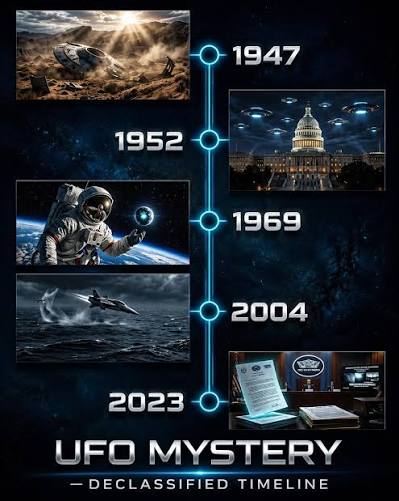
The modern UFO era is commonly traced to 1947, when pilot Kenneth Arnold reported seeing nine fast-moving objects near Mount Rainier in Washington State. Arnold described their movement as resembling “saucers skipping across water,” a phrase that eventually gave rise to the famous term “flying saucer.” The incident triggered widespread public fascination and a surge in reported sightings across the United States.
Today, investigators are revisiting these early reports with modern analytical tools, hoping to separate fact from fiction while identifying recurring characteristics that may connect historical and contemporary UAP events.
The Earliest Modern UAP Sightings
Although stories of strange objects in the sky have existed throughout recorded history, many researchers consider the late 1940s the beginning of the modern UAP era.
The Kenneth Arnold Incident
On June 24, 1947, Kenneth Arnold was flying his private aircraft near Mount Rainier when he observed a formation of unusual objects moving at high speed. His report received national attention and inspired thousands of similar accounts from witnesses across the country.
The sighting remains significant because it introduced many of the themes that continue to appear in UAP reports today:
- Unusual flight characteristics
- High speeds
- Lack of visible propulsion systems
- Multiple eyewitnesses
- Difficulty obtaining conventional explanations
The Roswell Incident
Shortly after Arnold’s sighting, another event captured worldwide attention. In July 1947, reports emerged of a mysterious crash near Roswell, New Mexico.
Although the U.S. military later stated the debris originated from a secret balloon project, the incident became one of the most debated UFO cases in history. It continues to influence public perceptions of government secrecy and extraterrestrial theories.
Government Investigations Begin
The surge in sightings prompted official investigations.
The U.S. Air Force launched Project Sign in 1948, followed by Project Grudge and later Project Blue Book. These programs examined thousands of reports submitted by military personnel, pilots, scientists, and civilians. Project Blue Book ultimately cataloged more than 12,000 sightings before ending in 1969. Most cases received conventional explanations, but hundreds remained unidentified.
Government investigators concluded that no evidence demonstrated extraterrestrial origins. However, the persistence of unexplained cases ensured that public interest never disappeared.
The Washington D.C. UFO Wave
One of the most famous early UAP events occurred in 1952.
During several nights in July, radar operators detected unusual objects near Washington National Airport. Pilots and observers also reported strange lights in the sky.
The incidents generated massive media coverage and prompted emergency government responses. Officials eventually attributed many observations to atmospheric conditions, including temperature inversions, but the event remains a landmark case in UFO history.
For modern investigators, the Washington sightings provide a valuable dataset because they involved both visual and radar observations.
The Search Beyond America
Researchers increasingly emphasize that UAP sightings are not uniquely American.
A recent scientific review noted that governments and researchers worldwide have documented unexplained aerial phenomena for decades. Historical investigations have occurred in Europe, Canada, Russia, China, and other regions.
This global perspective is encouraging investigators to compare early reports from different countries. By analyzing similarities and differences, researchers hope to identify patterns that transcend culture and geography.
Scientific Interest Grows
For many years, UFO research was considered taboo within mainstream science.
That attitude has begun to change.
Recent academic papers describe UAP as a legitimate subject of scientific inquiry, emphasizing the importance of collecting high-quality data and conducting rigorous investigations. Scientists increasingly argue that unexplained observations deserve examination regardless of their ultimate explanation.
Modern studies focus on:
- Sensor analysis
- Radar data
- Satellite observations
- Optical imaging
- Artificial intelligence-assisted detection
- Historical archives
Rather than assuming extraordinary explanations, researchers aim to systematically evaluate all possibilities.
Revisiting Mysterious 1950s Evidence
One of the most intriguing developments involves historical astronomical photographs.
Recent studies have reexamined images captured by the Palomar Observatory during the 1950s. Researchers identified thousands of unusual transient flashes appearing on photographic plates taken before satellites became common. Some investigators argue that these anomalies warrant further study because they do not fit easily into known categories.
Critics suggest photographic defects, environmental effects, or statistical coincidences may explain many of the observations. Nevertheless, the findings have reignited debate about historical evidence that was largely forgotten for decades.
The Rendlesham Forest Mystery
Although it occurred in 1980 rather than the earliest UAP era, the Rendlesham Forest incident demonstrates why investigators continue revisiting historical cases.
Military personnel stationed near RAF Bentwaters in England reported unusual lights and a triangular object in a nearby forest. Witness accounts, official documents, and recorded observations have kept the case alive for decades. Some researchers view it as one of the strongest historical UAP incidents, while skeptics point to misidentifications and memory distortions.
The case highlights the challenges investigators face when examining historical reports long after the events occurred.
Why Historical Cases Matter
Historical UAP investigations offer several advantages.
Long-Term Patterns
Researchers can examine whether specific characteristics repeatedly appear across decades.
Common themes include:
- Bright lights
- Sudden acceleration
- Silent movement
- Unusual maneuvers
- Radar confirmation
Improved Technology
Modern analytical tools allow investigators to revisit old evidence with greater precision than was possible when incidents originally occurred.
Better Context
Historical research helps distinguish genuinely unusual reports from cases influenced by cultural trends, media coverage, or technological developments.
What the Pentagon Says
Modern government investigations continue to analyze UAP reports.
Recent Pentagon assessments found no verified evidence linking reported phenomena to extraterrestrial technology. Most investigated cases were eventually attributed to ordinary objects, atmospheric effects, balloons, drones, or sensor anomalies. However, some incidents remain unresolved due to insufficient information.
Officials emphasize that unidentified does not automatically mean alien. Instead, unresolved cases often reflect limited data or incomplete observations.
Nevertheless, a small number of reports continue to resist easy explanation, fueling ongoing interest among researchers and the public.
The Rise of Modern UAP Science
Several scientific initiatives now seek to gather reliable data on aerial anomalies.
Projects involving ground-based observatories, advanced sensors, machine learning systems, and coordinated observation networks aim to improve data quality dramatically. Researchers argue that decades of anecdotal reports can finally be supplemented by objective measurements.
This shift marks an important evolution in the field.
Instead of relying primarily on witness testimony, investigators increasingly focus on measurable evidence.
Skepticism Remains Essential
Despite growing interest, skepticism continues to play a critical role.
Many famous UFO sightings have ultimately been explained by:
- Atmospheric phenomena
- Experimental aircraft
- Balloons
- Astronomical objects
- Camera artifacts
- Human perception errors
Scientists stress that extraordinary claims require extraordinary evidence. The existence of unexplained reports does not automatically support extraordinary conclusions.
At the same time, researchers argue that dismissing all sightings without investigation would be equally unscientific.
Public Fascination Endures
The enduring appeal of UAP mysteries reflects deeper questions about humanity’s place in the universe.
Whether the explanation involves unknown atmospheric phenomena, advanced technologies, sensor limitations, psychological factors, or something entirely unexpected, the mystery continues to inspire curiosity.
Each newly uncovered document, scientific study, or historical report adds another piece to a puzzle that remains incomplete.
The Road Ahead
As investigators revisit the earliest UAP sightings, they are combining historical research with cutting-edge science.
Archival records, declassified government files, astronomical photographs, military reports, and modern sensor data are all being analyzed together for the first time. This multidisciplinary approach may eventually reveal whether historical sightings share common causes—or whether some truly represent phenomena that remain beyond current understanding.
For now, the mystery remains unresolved.
What is clear, however, is that the search for answers is far from over. The earliest UAP sightings continue to challenge assumptions, inspire debate, and encourage researchers to look more closely at events that many once dismissed as impossible.
As new evidence emerges and old cases are reexamined, investigators hope that the truth behind these enduring mysteries may finally come into focus.
About the Author