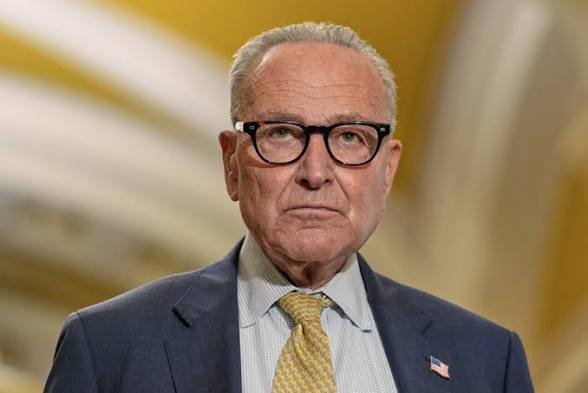
The Democratic Party is facing a growing ideological battle as the Democratic Socialists of America (DSA) gains influence, wins primary contests and pushes a platform that goes far beyond traditional Democratic policy. The latest controversy centers on Senate Minority Leader Chuck Schumer, who was pressed over whether the DSA’s call to abolish the U.S. Senate has a place inside the Democratic Party.
Schumer did not directly answer the question.
Instead, he emphasized that Democrats across the ideological spectrum would work together against President Donald Trump, reduce costs and challenge what he described as Republican corruption and chaos. His response has fueled a broader debate about whether the Democratic Party can continue operating as a “big tent” while accommodating a movement seeking major structural changes to the American political system.
The controversy has also attracted attention from conservative commentators, including David Asman, amid wider arguments about whether mainstream Democrats should distance themselves from the DSA or attempt to benefit from its growing grassroots energy.
DSA Civil War: Why the Democratic Party Is Under Pressure

The phrase “DSA civil war” captures a growing ideological conflict rather than an actual organizational war. At its center is a fundamental question: How far left can the Democratic Party move while remaining electorally competitive across the United States?
The DSA has become increasingly influential during the 2026 election cycle. The organization has backed candidates who challenge Democratic incumbents and has attracted younger voters frustrated with housing costs, healthcare expenses, wages and what they see as the failure of established political institutions.
Recent reporting has described the DSA as having more than 120,000 members and hundreds of chapters. Its growing campaign operation has allowed it to punch above its financial weight, relying heavily on volunteers and grassroots organizing.
That growth is creating an uncomfortable situation for Democratic leaders.
On one hand, the DSA can provide volunteers, enthusiasm and an energized voter base. On the other hand, some of its national proposals are dramatically different from the positions traditionally associated with the Democratic establishment.
Schumer Faces the Senate Question
The immediate controversy involving Chuck Schumer began with a simple question: Does the DSA’s proposal to abolish the Senate have a place within the Democratic Party?
Schumer was asked about the issue in July. Rather than endorse or reject the proposal, he focused on the broader Democratic coalition and its opposition to Trump.
That answer is politically significant.
Schumer is not merely another Democratic politician. As Senate Democratic leader, he represents the institutional Democratic Party in the very chamber that the DSA wants to abolish.
The DSA’s national platform calls for abolishing the Senate and replacing the current two-party structure with a more proportional political system. The proposal would dramatically alter how American government works.
The platform also discusses changes involving the presidency and Supreme Court, alongside major economic and social reforms.
For Schumer, directly embracing such proposals could alienate moderate and independent voters. Rejecting them too aggressively, however, could create tension with a movement that is becoming increasingly influential in Democratic primaries.
That is the political dilemma behind the Schumer controversy.
What Does the DSA Actually Want?
The Democratic Socialists of America is not simply another Democratic Party faction.
The organization is an independent political organization that has increasingly influenced Democratic candidates and elections. Its supporters generally advocate democratic-socialist economic policies, stronger labor protections and expanded public programs.
But its current national platform goes much further.
The DSA has called for structural changes including abolishing the Senate, expanding the House, implementing proportional representation and adopting ranked-choice voting.
The organization has also promoted policies involving healthcare, labor rights, policing, immigration, corporate ownership and military spending.
Megan Romer, a national co-chair of the DSA, recently confirmed several of the organization’s long-term positions during a television interview. Among the proposals she affirmed were abolishing the Senate, abolishing ICE, defunding the Pentagon and pursuing government ownership of large corporations.
Those positions have made the DSA impossible for mainstream Democrats to ignore.
Why Abolishing the Senate Is So Controversial
The Senate is one of the central institutions of the U.S. Constitution.
Every state receives two senators regardless of population. That means smaller states have considerably greater representation in the Senate than they would under a strictly population-based system.
DSA critics argue that abolishing the Senate would eliminate an important constitutional check and dramatically change the balance between large and small states.
Progressive politicians themselves have expressed reservations.
Rep. Alexandria Ocasio-Cortez, one of the most prominent progressive Democrats and a DSA member, pushed back on the proposal. She said she was working within the institutions that exist and described the issue as a constitutional question.
Rep. Ro Khanna has also rejected abolishing the Senate, saying his preference is to abolish the filibuster rather than eliminate the chamber itself.
That distinction matters.
It demonstrates that even politicians on the Democratic Party’s progressive wing do not necessarily support every element of the DSA platform.
AOC and Other Progressives Create a Complicated Picture
The DSA’s growing influence does not mean every progressive Democrat supports every DSA policy.
AOC’s position is particularly important because she has become one of the most recognizable progressive figures in the country.
Her reluctance to embrace Senate abolition illustrates the difference between progressive policy and institutional revolution.
There is a major difference between demanding Medicare for All, stronger unions or higher taxes on wealthy Americans and demanding the elimination of a constitutional institution.
That difference could become increasingly important as the 2026 midterm elections approach.
The DSA may be successful in influencing Democratic primaries, but general elections require candidates to appeal to voters well beyond the activist base.
David Asman and the “Kick Out” Debate
The controversy has also been amplified by conservative media commentators, including David Asman.
The underlying argument is straightforward: if the DSA is fundamentally opposed to major institutions of the American political system, should Democratic leaders continue treating the organization as part of the broader Democratic coalition?
That question is at the heart of the “kick out” argument.
Critics believe Democrats should establish clearer boundaries between the party establishment and organizations seeking to fundamentally restructure the American government.
Supporters of the DSA, however, argue that the organization’s growing electoral influence demonstrates that its ideas cannot simply be dismissed.
The debate therefore becomes bigger than Schumer.
It becomes a question about the future identity of the Democratic Party.
Why Schumer Is Unlikely to Simply Reject the DSA
There is a strategic reason Schumer may avoid directly attacking the DSA.
The Democratic Party needs energized voters.
It needs volunteers.
It needs young voters.
And it needs candidates capable of generating enthusiasm in an election environment where turnout can determine control of Congress.
The DSA has demonstrated that it can mobilize activists.
Recent primary victories have shown that established Democratic incumbents are not automatically safe from challenges backed by the socialist movement.
For Schumer, therefore, completely rejecting the DSA could create another problem: alienating voters who are increasingly important to Democratic electoral campaigns.
But embracing the movement too closely could create an equally serious problem.
Moderate voters could view the Democratic Party as moving too far left.
That is the balancing act.
The Mamdani Effect
Zohran Mamdani has become an important part of this national debate.
His rise in New York politics has demonstrated how socialist candidates can build a coalition around affordability, housing, public services and economic frustration.
The DSA’s influence has expanded partly because many younger voters believe traditional politics has failed to address the cost of living.
Housing prices, rents, healthcare expenses and student debt have become powerful political issues.
The DSA’s message connects those economic frustrations with a broader argument that America’s political institutions need fundamental change.
That message can be attractive to voters who feel that conventional politics has produced little improvement.
But it can also alarm voters who believe the organization is proposing changes that go too far.
Could the DSA Take Over the Democratic Party?
A complete takeover is far from guaranteed.
The Democratic Party is enormous and includes moderates, liberals, progressives and Democratic socialists.
The DSA remains a relatively small organization compared with the overall Democratic electorate.
Its influence, however, can be disproportionately large because primary elections are often decided by smaller and more politically engaged electorates.
A highly motivated activist organization can therefore influence candidate selection without controlling the entire party.
This is why the DSA’s victories have attracted so much attention.
The organization does not need to control every Democratic voter.
It only needs to influence enough primary elections to change the party’s candidate pool.
The Senate “Alert” for Democrats
The Senate issue represents a warning sign for Democratic strategists.
If mainstream Democrats cannot explain their relationship with the DSA, Republicans will have an opportunity to define that relationship for them.
Republican campaigns are likely to argue that Democratic leaders are unwilling to reject proposals they consider radical.
Democrats, meanwhile, are likely to emphasize that the party remains a broad coalition.
Schumer’s recent response reflects that strategy.
Rather than engage in an ideological argument about abolishing the Senate, he redirected the conversation toward defeating Trump and addressing economic concerns.
That may be politically practical, but it does not resolve the underlying ideological conflict.
The Constitutional Barrier
Even if the DSA suddenly gained enormous political influence, abolishing the Senate would not be simple.
The U.S. Constitution establishes the Senate as part of Congress. Major constitutional changes require an amendment process with extremely high political thresholds.
That means Senate abolition is not something a president or congressional majority could accomplish through ordinary legislation.
The same is true for many other structural proposals associated with the DSA.
As a result, these ideas should be understood primarily as long-term political goals rather than immediate legislative possibilities.
This distinction is important when analyzing claims about an imminent transformation of the American government.
Why the DSA Is Still Politically Important
The fact that some DSA proposals face enormous constitutional barriers does not make the movement irrelevant.
Political movements often influence policy without achieving their most ambitious goals.
The DSA’s importance lies partly in its ability to change the political conversation.
Issues that once seemed marginal can become mainstream discussion topics after activists organize around them.
The Democratic Party may ultimately reject Senate abolition while adopting some of the movement’s economic proposals.
That could mean stronger labor policies, expanded public services, healthcare reforms or different approaches to housing and taxation.
In other words, the DSA does not need to win every argument to influence American politics.
A Real Democratic “Civil War”?
Calling the situation a “civil war” is dramatic, but there is clearly an ideological struggle.
The Democratic Party is debating whether its future should be built around:
- A broad coalition appealing to moderates and progressives.
- A stronger economic-populist message.
- Greater cooperation with democratic-socialist activists.
- A more aggressive rejection of corporate influence.
- Or a return toward the political center.
These choices will become increasingly important during the 2026 midterms and the 2028 presidential cycle.
The DSA’s electoral performance will help determine how seriously Democratic leaders take the movement.
If DSA-backed candidates continue winning primaries, party leaders may have little choice but to engage with them.
If those candidates struggle in general elections, Democratic strategists may become more cautious.
What Happens Next?
The most important development will be whether DSA-backed candidates can turn primary victories into general-election wins.
Another major factor will be whether Democratic leaders develop a unified response to the organization’s more controversial proposals.
Schumer’s approach so far has been to emphasize unity against Republicans rather than publicly dividing Democrats over the DSA.
That strategy may keep the coalition together in the short term.
But eventually, voters may demand clearer answers.
Do Democratic leaders support abolishing the Senate?
Do they support replacing the current constitutional system?
How much influence should the DSA have over Democratic candidates?
And where should the party draw the line between progressive reform and revolutionary restructuring?
Those questions are unlikely to disappear.
Conclusion: DSA Civil War Could Shape the Democratic Future
The growing DSA influence has created a difficult political calculation for Democrats.
The movement provides energy, volunteers and a powerful economic message that resonates with many younger voters. At the same time, its national platform includes proposals that even prominent progressives such as AOC and Ro Khanna have questioned.
Chuck Schumer’s refusal to directly address whether Senate abolition belongs inside the Democratic Party illustrates the dilemma.
Reject the DSA, and Democrats risk alienating an energized part of their coalition.
Embrace it, and Republicans could use the movement’s most controversial proposals to portray the entire Democratic Party as extreme.
That is why the emerging DSA civil war is bigger than one interview or one dispute involving Schumer.
It is a battle over what the Democratic Party should become—and whether its future lies in traditional liberal politics, economic populism, democratic socialism, or some combination of all three.
As the 2026 election cycle develops, the answer could have major consequences for both parties and for the direction of American politics.
FAQs About the DSA Civil War
What is the DSA?
The Democratic Socialists of America is a large socialist political organization in
the United States that promotes democratic-socialist economic and political policies.
Why is the DSA causing controversy among Democrats?
The controversy comes from the organization’s increasingly ambitious platform, including proposals to abolish the Senate and make major changes to America’s political institutions.
Did Chuck Schumer support abolishing the Senate?
Schumer did not endorse abolishing the Senate when questioned about the DSA position. Instead, he emphasized Democratic unity and opposition to Trump.
Does AOC support abolishing the Senate?
AOC has expressed reservations about the proposal and said she works within existing institutions. She described Senate abolition as a constitutional question.
Who is David Asman?
David Asman is a television host and commentator associated with Fox News and Fox Business. He has frequently discussed the growth of socialism and its potential impact on American politics.
Can Congress abolish the Senate?
Not through ordinary legislation. Eliminating the Senate would require fundamental constitutional change and face extremely high legal and political barriers.
Is the DSA part of the Democratic Party?
The DSA is an independent organization rather than an official Democratic Party wing. However, it increasingly influences Democratic primary elections and supports candidates who run as Democrats.
Why is the DSA important for the 2026 elections?
DSA-backed candidates have already demonstrated an ability to challenge established Democratic politicians in primary elections, making the organization an increasingly important force in the 2026 political cycle.
Could the DSA take over the Democratic Party?
A complete takeover is unlikely to happen quickly. However, continued primary victories could give DSA-aligned candidates and activists greater influence over the Democratic Party’s policy direction.
What does the DSA controversy mean for Chuck Schumer?
Schumer faces a political balancing act. He must maintain a broad Democratic coalition while responding to a growing socialist movement whose platform includes proposals that many mainstream Democrats do not support.
Is there really a Democratic civil war?
“Civil war” is a political description rather than a literal conflict. It refers to the ideological struggle between different factions of the Democratic coalition over policy, strategy and the party’s future direction.
About the Author