Aliya Rahman Arrest : SOTU Standing, Capitol Charge, Omar Demands Probe

In a moment that has ignited nationwide debate over free speech, disability rights, and law enforcement conduct within the U.S. Capitol, Aliya Rahman—a disabled Minneapolis resident—was arrested during the 2026 State of the Union (SOTU) address after standing silently in the House gallery. The incident has since prompted Congresswoman Ilhan Omar to demand a federal investigation, drawing political fire from both sides of the aisle and raising serious questions about the treatment of guests within the Capitol, the enforcement of rules during historic addresses, and the boundaries of lawful protest in government spaces.
This article explores the full context of Rahman’s arrest, the Capitol charge she faces, the political backlash—including Omar’s call for a probe—and the broader implications for civil liberties and political expression in the United States.
Who Is Aliya Rahman?
Aliya Rahman, a 43-year-old software engineer and activist from Minneapolis, is a Bangladeshi-American U.S. citizen with a history of confronting federal enforcement practices. Her national visibility began in January 2026 when she was violently dragged from her car by Department of Homeland Security agents during an immigration enforcement action in Minneapolis—a moment that sparked public outrage and earned her attention as a critic of aggressive law enforcement tactics.
Rahman lives with autism and a traumatic brain injury, conditions that an attorney representing her highlighted during public discussions of her arrest.
After her January encounter with federal agents, Rahman was invited by Rep. Ilhan Omar to attend the 2026 State of the Union address as one of her guests—a symbolic gesture meant to bring attention to issues of law enforcement conduct and immigrant rights.
What Happened at the State of the Union?
During President Donald Trump’s 2026 State of the Union address, Rahman was seated in the House gallery. According to multiple reports:
Rahman stood up silently during portions of the speech, at a time when other attendees were also standing.
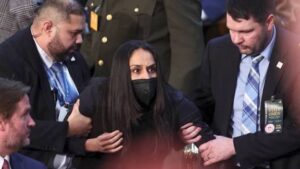
Capitol Police responded, ordering her to sit down. When she did not, officers began removing her from the gallery.
Rahman informed officers of pre-existing shoulder injuries sustained in the January ICE incident, but she was still aggressively handled.
She was taken to the George Washington University Hospital for medical attention and later booked at the Capitol Police headquarters.
Capitol Police charged her with “Unlawful Conduct” for allegedly refusing lawful orders and disrupting Congressional proceedings.
The charge of unlawful conduct carries a potential sentence of up to six months in prison and a fine of up to $500 under Washington, D.C. code.
In Rahman’s own words, shared during an interview after her arrest: “There are only two things you can do at the State of the Union—sit down and stand up. I was arrested for standing up.”
Rep. Ilhan Omar’s Response and Call for a Probe
Rep. Ilhan Omar (D-MN) issued a strong statement condemning the way Rahman was treated. She described the response from Capitol Police as “heavy-handed” and said it sends a chilling message about the state of democracy when guests are arrested for what she believed was peaceful behavior.
According to Omar’s press release:
“The heavy-handed response to a peaceful guest sends a chilling message about the state of our democracy. I am calling for a full explanation of why this arrest occurred.”
Omar reiterated her demand for a comprehensive investigation into the circumstances of the arrest—including the conduct of Capitol Police and whether Rahman’s disabilities were properly considered.
Capitol Police Position
While Omar and Rahman’s supporters argue the arrest was unjustified, the U.S. Capitol Police offered a different perspective. According to official statements:
SOTU guests are prohibited from “demonstrating” during the address.
Officers maintain that Rahman was repeatedly warned to sit and refused lawful orders before being removed.
They cited disruption of Congressional proceedings as the basis for the arrest.
Whether Rahman’s actions met the threshold for “demonstration” or unlawful conduct remains contested in public discourse.
Political and Social Backlash
Rahman’s arrest has generated widespread reaction across social and political spheres:
Support from Advocates and Civil Liberties Groups
Civil liberties advocates argue the arrest reflects over-policing and suppression of peaceful expression, especially toward individuals with disabilities.
Social media has amplified the incident, with many commenters describing it as an infringement on free speech and due process.
Criticism from Opponents
Some conservative commentators and law enforcement supporters point to the Capitol Police’s claims that Rahman disobeyed orders as justification for the actions taken.
Questions have been raised about whether rules were applied fairly and uniformly during the address.
Broader Political Tensions
The incident comes at a time of heightened political polarization in the U.S., particularly over immigration policy and law enforcement practices—issues Rahman’s own history underscores.
Key Issues Highlighted by the Incident
1. Free Speech vs. Capitol Enforcement Rules
The arrest raises essential questions about how rules governing decorum during Congressional addresses intersect with individuals’ rights to express disagreement or discomfort with political rhetoric.
2. Disability Accommodations
Rahman reported that officers continued to handle her roughly even after she disclosed her medical conditions, raising concerns about law enforcement sensitivity to disability needs.
3. Treatment of SOTU Guests
Traditionally, guests of members of Congress attend the State of the Union as observers. This incident prompts debate about what constitutes acceptable behavior and who gets to decide.
4. Political Symbolism
For many supporters of Rahman and Rep. Omar, the arrest represents broader concerns about governmental accountability, the treatment of marginalized communities, and political retaliation.
FAQ – Frequently Asked Questions
Q: Why was Aliya Rahman arrested at the State of the Union?
A: She was arrested by Capitol Police on charges of “Unlawful Conduct” for allegedly refusing to obey orders to sit down after standing silently during President Trump’s address.
Q: Who is Aliya Rahman?
A: Rahman is a disabled U.S. citizen and software engineer from Minneapolis, previously injured during an encounter with federal immigration agents in January 2026.
Q: What charge does she face?
A: Rahman faces unlawful conduct and disruption of Congress, a misdemeanor under D.C. code, carrying potential fines and up to six months in jail.
Q: Did Rep. Ilhan Omar support Rahman?
A: Yes. Omar condemned the arrest, calling for a full investigation into how the situation was handled by authorities.
Q: Was Rahman injured during the arrest?
A: Reports indicate she was taken to a hospital after the incident and had prior injuries from a January enforcement encounter.
Q: Are protests allowed at the State of the Union?
A: Official Capitol rules prohibit demonstrations during the address; however, interpretations of what constitutes a protest can vary.
Q: What’s next for Rahman?
A: As of now, the situation is under public scrutiny, and legal proceedings or investigations may unfold depending on Capitol Police actions and Omar’s probe.
Conclusion
The arrest of Aliya Rahman at the 2026 State of the Union address has become a flashpoint in national discussions about civil liberties, governmental authority, and the right to peaceful expression—even within the walls of the U.S. Capitol. With Rep. Ilhan Omar demanding a formal investigation and advocates on both sides deeply divided over the facts and interpretations of the incident, the fallout is likely to continue reverberating through political discourse in the coming weeks and months.
Whether this episode ultimately changes how rules are applied during historic national addresses or reshapes conversations about activism, disability rights, and law enforcement conduct remains to be seen.
How useful was this post?
Click on a star to rate it!
Average rating 0 / 5. Vote count: 0
No votes so far! Be the first to rate this post.
About the Author

usa5911.com
Administrator
Hi, I’m Gurdeep Singh, a professional content writer from India with over 3 years of experience in the field. I specialize in covering U.S. politics, delivering timely and engaging content tailored specifically for an American audience. Along with my dedicated team, we track and report on all the latest political trends, news, and in-depth analysis shaping the United States today. Our goal is to provide clear, factual, and compelling content that keeps readers informed and engaged with the ever-changing political landscape.