Tucker Carlson : CIA texts claim, foreign agent probe, MAGA media war
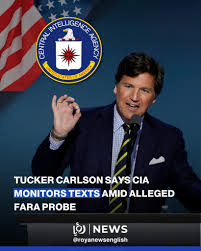
The American media and political landscape erupted into controversy after commentator Tucker Carlson claimed that the Central Intelligence Agency had accessed his private messages and was preparing a criminal referral accusing him of acting as a foreign agent.
Carlson’s allegation triggered an intense debate about government surveillance, national security, and political influence inside the conservative media ecosystem often associated with the MAGA movement.
The claim has not been confirmed by U.S. intelligence agencies, but the story quickly evolved into a major political flashpoint—fueling accusations, counter-attacks, and a growing “MAGA media war” among right-wing commentators.
This article explains the controversy, the legal implications, the political reaction, and what it means for American media and national security.
The Origin of Tucker Carlson’s CIA Texts Claim

The controversy began when Tucker Carlson released a video on social media claiming that U.S. intelligence agencies had been reviewing his communications.
According to Carlson, the CIA allegedly accessed his text messages and prepared a potential criminal referral to the United States Department of Justice.
Carlson suggested the investigation relates to his communications with foreign officials—particularly individuals connected to Iran—before the outbreak of a major regional conflict.
He argued that:
His conversations were part of legitimate journalism
He never acted on behalf of any foreign government
The potential case would be legally “ludicrous”
Carlson also framed the situation as a warning about government overreach.
In his statement, he said discovering intelligence agencies reading his texts could mean they were trying “to frame him for a crime.”
The Foreign Agent Law at the Center of the Storm
The controversy centers on the Foreign Agents Registration Act (FARA).
FARA requires individuals who act on behalf of foreign governments or political entities to register with the U.S. government and disclose their activities.
Key aspects of the law include:
Mandatory disclosure for lobbying or political advocacy
Registration requirements for agents of foreign principals
Criminal penalties for failure to comply
Critics of Carlson claim that communicating with foreign officials could raise questions under the law.
However, Carlson argues that journalists routinely speak with foreign sources and that doing so does not make someone a foreign agent.
Legal experts say the difference usually depends on whether the person is advocating on behalf of a foreign government or receiving compensation from it.
Iran Communications and the Geopolitical Context
Reports suggest the alleged investigation may relate to Carlson’s communications with Iranian figures before the start of a regional war involving Iran and Israel.
Carlson has been openly critical of U.S. and Israeli military actions in the Middle East, and he has conducted controversial interviews with international political figures.
Supporters say such communication is normal journalism.
Critics argue that Carlson’s messaging sometimes aligns with narratives promoted by foreign governments.
This tension lies at the heart of the current controversy.
Intelligence Surveillance Claims
Carlson’s accusations also revived long-running debates about whether U.S. intelligence agencies spy on American citizens.
He argued that intelligence services monitor Americans more frequently than the public realizes.
Historically, U.S. intelligence agencies are legally restricted from directly targeting American citizens without proper authorization.
However, communications involving foreign targets can sometimes capture conversations involving Americans.
This is known as incidental collection.
Past controversies—such as the disclosures by Edward Snowden—have fueled public distrust of intelligence surveillance programs.
Carlson cited those broader debates while framing his claims.
MAGA Media War Erupts
The story quickly escalated into a political conflict inside the conservative movement.
Several pro-Trump commentators attacked Carlson’s claims or accused him of promoting narratives favorable to foreign adversaries.
Among the most vocal critics was activist Laura Loomer, who criticized Carlson and said the issue should be investigated.
The dispute reflects a broader struggle among right-wing media figures over:
loyalty to Donald Trump
foreign policy toward Iran
the future leadership of the MAGA media ecosystem
Carlson, once one of the most influential voices in conservative broadcasting, now operates largely through independent media platforms after leaving Fox News in 2023.
That independence has made him both more influential and more controversial.
Why the Allegations Are Politically Explosive
The Carlson controversy touches on multiple sensitive issues in American politics.
1. Intelligence Agency Power
If Carlson’s claims were proven true, it would raise major concerns about government surveillance and press freedom.
However, intelligence agencies have not confirmed his allegations.
2. Journalism vs Foreign Influence
Journalists frequently communicate with foreign officials.
But if someone is perceived to be advocating for foreign interests, legal and political questions arise.
3. Internal Conservative Rivalries
The dispute highlights divisions inside the MAGA movement over foreign policy and media power.
Carlson has increasingly taken positions that differ from traditional Republican hawks.
Carlson’s Defense
Carlson has strongly denied any wrongdoing.
He insists that:
he has never taken money from foreign governments
he speaks to global figures as part of journalism
the allegations are politically motivated
He also argues that wartime environments often lead governments to become more authoritarian.
Carlson warned that dissenting voices can be treated as threats during geopolitical crises.
The Silence from U.S. Authorities
One notable aspect of the controversy is the lack of official confirmation.
Neither the CIA nor the Department of Justice has publicly verified Carlson’s claims.
Without official confirmation, analysts say the story remains largely based on Carlson’s own statements.
Still, the allegation itself has generated massive online attention.
Historical Pattern of Intelligence Claims
This is not the first time Carlson has accused U.S. intelligence agencies of monitoring him.
In 2021, he claimed the National Security Agency was spying on him.
However, a review reportedly found no evidence that the agency had targeted him directly.
Instead, his name may have appeared in communications involving other people who were under surveillance.
The earlier controversy makes the new claims even more polarizing.
The Media Impact
The story quickly became one of the most discussed political controversies online.
Key reasons include:
Carlson’s massive social media audience
rising geopolitical tensions with Iran
internal conflicts within conservative media
For many supporters, Carlson is a whistleblower exposing intelligence overreach.
For critics, the allegations are another example of conspiracy-style politics dominating modern media discourse.
What Happens Next?
Several possible outcomes could follow:
1. No Investigation
If authorities confirm there is no criminal case, the controversy could fade quickly.
2. Legal Inquiry
If evidence emerges suggesting FARA violations, it could become a high-profile legal battle.
3. Political Fallout
Regardless of legal outcomes, the dispute may reshape alliances within conservative media.
Broader Implications for U.S. Politics
The Carlson controversy reflects deeper structural tensions in American politics:
distrust of intelligence agencies
polarized media ecosystems
rising geopolitical conflict
These forces increasingly collide in an environment where political commentary and journalism overlap.
Carlson’s case may become a test of how far media figures can engage with foreign actors without facing political backlash.
Conclusion
The controversy surrounding Tucker Carlson’s CIA texts claim has ignited one of the most dramatic media and political battles of the year.
At its core, the debate touches on three powerful themes:
the limits of intelligence surveillance
the responsibilities of journalists engaging with foreign sources
internal power struggles within conservative media.
Whether Carlson’s claims prove accurate or not, the episode highlights how quickly modern political narratives can escalate into full-scale information wars.
As investigations and responses unfold, the story will likely remain a defining flashpoint in the ongoing clash between media, politics, and national security.
FAQs
What did Tucker Carlson claim about the CIA?
Tucker Carlson alleged that the CIA accessed his private text messages and may be preparing a criminal referral accusing him of acting as an unregistered foreign agent.
What is the Foreign Agents Registration Act?
The Foreign Agents Registration Act (FARA) is a U.S. law requiring individuals working on behalf of foreign governments to register and disclose their activities.
Has the CIA confirmed Carlson’s claims?
No. As of now, neither the CIA nor the U.S. Department of Justice has confirmed Carlson’s allegations.
Why are Carlson’s communications with Iran controversial?
Some critics believe talking to Iranian officials could raise concerns about foreign influence, while Carlson says such contacts are normal for journalists.
Has Carlson accused intelligence agencies before?
Yes. In 2021 he alleged the NSA was spying on him, but an internal review reportedly found no evidence that he was directly targeted.
How useful was this post?
Click on a star to rate it!
Average rating 0 / 5. Vote count: 0
No votes so far! Be the first to rate this post.
About the Author

usa5911.com
Administrator
Hi, I’m Gurdeep Singh, a professional content writer from India with over 3 years of experience in the field. I specialize in covering U.S. politics, delivering timely and engaging content tailored specifically for an American audience. Along with my dedicated team, we track and report on all the latest political trends, news, and in-depth analysis shaping the United States today. Our goal is to provide clear, factual, and compelling content that keeps readers informed and engaged with the ever-changing political landscape.