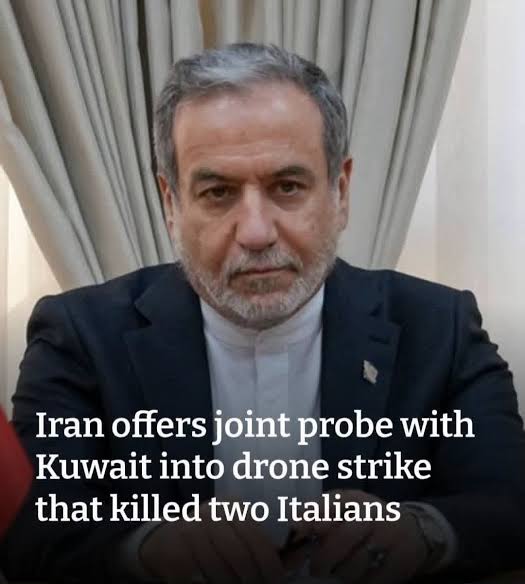
Iran has strongly denied responsibility for a deadly drone attack in Kuwait that killed two Italian nationals and injured other personnel. The incident has increased tensions across the Middle East, raising fresh concerns about regional security and the possibility of further military escalation.
Iranian Foreign Minister Abbas Araghchi described the incident as suspicious and questioned the accusations directed at Tehran. He also suggested that the attack could be part of an attempt to expand the ongoing conflict and draw additional countries into the confrontation.
The attack took place on Thursday, November 26, 2026, at a strategically important facility in Kuwait. Kuwaiti authorities initially reported injuries and material damage after several hostile drones entered the country’s airspace. Italy later confirmed that two of its citizens had died from their injuries.
Both Kuwait and Italy blamed Iran for the incident. However, Tehran rejected the accusations and offered to cooperate with Kuwait and Italy through a joint investigation.
The disagreement has created another diplomatic challenge for countries already dealing with a wider regional conflict involving Iran, the United States and Israel.
According to reports published on November 26 and 27, the central question remains unresolved: who was responsible for the drone attack, and what evidence will establish its origin?
Reuters+2
What Happened in the Kuwait Drone Attack?
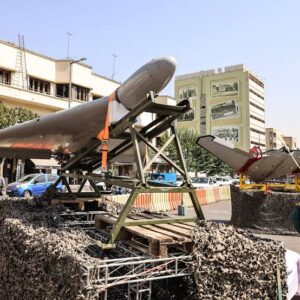
The incident occurred on Thursday when several drones reportedly entered Kuwaiti airspace and targeted a vital facility.
Kuwait’s military said its forces detected and countered hostile unmanned aircraft. However, debris from the incident caused damage and injuries at a military-related location.
The initial reports indicated that four people had been injured. Those affected included two Italian nationals, a Kuwaiti military officer and a Pakistani national.
The situation became more serious when the two Italian nationals later died from their injuries.
Italian Foreign Minister Antonio Tajani confirmed the deaths while addressing the incident. He explained that the victims were technicians employed by Rheinmetall Italia, the Italian subsidiary of German defence manufacturer Rheinmetall.
The technicians were working at an air-defence surveillance station in Kuwait.
Their work involved detection antennas associated with the Skyguard air-defence system used by Kuwait’s military.
The attack therefore affected more than an ordinary military installation. It also involved foreign defence personnel supporting Kuwait’s security infrastructure.
Kuwaiti authorities described the incident as a serious violation of the country’s security. Italy also expressed concern and indicated that it would raise the matter directly with Iranian representatives.
The deaths have added an international dimension to an already sensitive security situation.
Reuters+2
Abbas Araghchi Calls the Attack Suspicious
Iranian Foreign Minister Abbas Araghchi rejected accusations that Tehran was responsible for the Kuwait drone attack.
Following the incident, Araghchi contacted his Kuwaiti counterpart, Sheikh Jarrah Jaber Al-Ahmad Al-Sabah. He also spoke with Italian Foreign Minister Antonio Tajani.
During these diplomatic conversations, the Iranian foreign minister expressed condolences over the deaths of the Italian citizens.
However, he firmly denied Iranian involvement.
Araghchi also described the incident as suspicious. In a public statement shared on social media, he suggested that the attack looked like a prearranged attempt to create conditions for further conflict.
His comments reflected Tehran’s position that the accusations could be politically motivated.
Iran has also offered to cooperate with Kuwait and Italy in investigating the incident. According to the Iranian Foreign Ministry, the proposal aims to establish the attack’s origin and determine the circumstances behind it.
This offer is important because the competing claims have created uncertainty about responsibility.
A joint investigation could potentially examine radar information, recovered drone components, debris and other technical evidence.
However, cooperation would require both sides to agree on the investigation’s structure and the methods used to evaluate the evidence.
For now, Iran maintains that it had no role in the attack.
Anadolu Agency+2
Iran Accuses the United States and Israel of Possible False-Flag Operations
Iran’s denial has gone beyond rejecting responsibility.
Senior Iranian military spokesperson Abolfazl Shekarchi accused the United States and Israel of involvement in what Tehran described as possible false-flag activities.
A false-flag operation generally refers to an action designed to make another country or group appear responsible.
Iranian officials suggested that the Kuwait incident could be intended to damage Tehran’s relationships with neighbouring Gulf countries.
They also warned that such an incident could encourage additional military involvement from countries that might otherwise remain outside the conflict.
However, these allegations have not been independently established.
Iranian state-linked media also reported claims suggesting that Ukrainian operatives could be involved in the wider regional drone situation. Some Iranian commentators have raised questions about Ukraine’s growing cooperation with Gulf countries on drone defence.
Nevertheless, there is no independently verified evidence establishing that Ukraine, the United States or Israel organised the Kuwait attack.
These accusations should therefore be treated as claims rather than confirmed facts.
The situation highlights a major problem in modern conflicts: identifying the origin of a drone does not automatically establish who launched it or who ordered the operation.
Investigators must distinguish between the manufacturer, operator, launch location and the organisation responsible for the attack.
That distinction could become particularly important if the investigation identifies a drone design associated with Iran.
Euronews+2
Kuwait and Italy Blame Iran for the Attack
While Tehran has rejected responsibility, Kuwait and Italy have taken a different position.
Kuwaiti authorities described the incident as an Iranian attack and condemned the damage caused to the country’s vital facility.
The Kuwaiti government also stressed that protecting national sovereignty and the safety of residents remained a priority.
Italy has also expressed serious concern because the two people killed were Italian citizens working on defence equipment.
Foreign Minister Antonio Tajani said the incident involved Iranian drones targeting military facilities in Kuwait. He indicated that Italy would lodge a formal complaint with Iran’s embassy.
Italy’s position is particularly important because the country has personnel and defence-related interests in the Gulf region.
The deaths have also increased pressure on European governments to respond to security threats affecting their citizens abroad.
However, Iran’s rejection of responsibility means the diplomatic dispute is far from settled.
The two governments have presented their assessment of the incident, while Tehran continues to demand an investigation.
The difference between these positions could make diplomatic discussions more difficult.
Kuwait Summons the Iranian Ambassador
The diplomatic situation became more serious on Friday, November 27.
Kuwait’s Foreign Ministry announced that it had summoned Iranian Ambassador Mohammad Totonji.
The ambassador was handed a formal note of protest concerning what Kuwait described as continued Iranian attacks against the country.
The protest specifically referred to Thursday’s drone attack, which killed two Italian nationals.
This diplomatic step demonstrates that Kuwait considers the incident a serious threat to its national security.
Summoning an ambassador does not automatically mean that diplomatic relations will be suspended. However, it communicates strong dissatisfaction and places additional pressure on the country receiving the protest.
Tehran’s response and willingness to cooperate with an investigation could influence what happens next.
Arab News+1
Why Were Italian Technicians Working in Kuwait?
The involvement of Italian technicians has attracted international attention.
The two victims were employees of Rheinmetall Italia, which operates as the Italian subsidiary of German defence company Rheinmetall.
They were reportedly maintaining detection antennas connected to Kuwait’s Skyguard air-defence system.
Such systems help military forces monitor and respond to aerial threats.
Their work was therefore connected to Kuwait’s wider efforts to strengthen its air-defence capabilities.
The presence of foreign technical specialists also illustrates how Gulf countries depend on international defence partnerships.
These partnerships involve equipment, maintenance, training and technical support.
However, foreign personnel working near military installations can face serious risks when regional conflicts intensify.
The Kuwait incident demonstrates how attacks involving military infrastructure can affect international employees who are not directly participating in combat operations.
Italy has a responsibility to address the deaths of its citizens, while Kuwait faces pressure to strengthen protection around strategic facilities.
The incident could also lead defence contractors and governments to reconsider security arrangements for personnel working in the region.
The Wider Iran Conflict Is Increasing Regional Instability
The Kuwait drone attack cannot be understood separately from the broader conflict involving Iran, Israel and the United States.
The regional confrontation began on February 28, 2026, following US and Israeli military strikes against Iran.
Since then, the conflict has expanded beyond the immediate battlefield.
Iran has launched attacks against Israel and Gulf countries hosting American military installations. Tehran has argued that its operations target military facilities connected to attacks against Iran.
Meanwhile, Gulf governments have repeatedly expressed concern about the security of their territory and critical infrastructure.
Kuwait is particularly sensitive because of its strategic location and its relationship with the United States.
The country also plays an important role in regional energy security and international military cooperation.
Drone attacks present a difficult challenge for governments because relatively inexpensive unmanned aircraft can threaten expensive military equipment and infrastructure.
They can also create uncertainty when interception attempts result in falling debris.
As a result, Gulf countries have increasingly focused on improving surveillance, interception systems and coordination between defence forces.
The latest incident has renewed concerns that the conflict could spread further across the region.
Al Jazeera+2
Kuwait’s Strategic Importance in the Gulf
Kuwait occupies an important position in the Persian Gulf.
Its geographical location places it close to Iraq, Saudi Arabia and Iran. It also has significant connections to international energy markets and regional security arrangements.
The country has maintained close defence cooperation with the United States for many years.
This relationship makes Kuwait strategically important during periods of confrontation between Washington and Tehran.
Iran has repeatedly warned neighbouring governments against allowing their territory to be used for military operations against the Islamic Republic.
At the same time, Gulf countries argue that their sovereignty and security must be respected.
This creates a difficult situation.
Kuwait must protect its territory while maintaining diplomatic and economic relationships with neighbouring countries.
An attack on a military facility can therefore have consequences beyond the immediate physical damage.
It can affect diplomatic relations, defence cooperation, regional trade and confidence among international partners.
The latest incident could increase pressure on Kuwait to strengthen its security measures.
However, the country must also consider the risks of allowing the confrontation to expand further.
Could the Incident Draw Europe Deeper Into the Conflict?
The deaths of two Italian nationals have given the Kuwait incident a wider European dimension.
Italy is a European Union member and an important NATO country.
Although the victims were civilian defence technicians rather than soldiers, their deaths have created political pressure on the Italian government.
Foreign Minister Tajani has indicated that Italy will formally raise the matter with Tehran.
The Italian government must balance several priorities.
First, it must seek accountability for the deaths of its citizens.
Second, it must protect Italian personnel and interests across the Middle East.
Third, it must avoid actions that could unnecessarily increase the risk of a wider regional confrontation.
Iran appears concerned that the attack could encourage European countries to become more directly involved in the conflict.
Araghchi’s suspicious-incident comments reflect this concern.
However, Italy has not established that Tehran was responsible through an independently published investigation.
The next diplomatic steps will depend partly on whether Kuwait and Iran can agree on a credible process to determine what happened.
European governments are also likely to monitor the investigation closely because the incident raises questions about the safety of their nationals working in Gulf countries.
The Role of Drones in Modern Middle East Conflicts
Drones have become a major part of modern military operations.
They can conduct surveillance, gather intelligence and attack targets without requiring a pilot to enter dangerous airspace.
Their relatively low cost also makes them attractive to governments and armed groups.
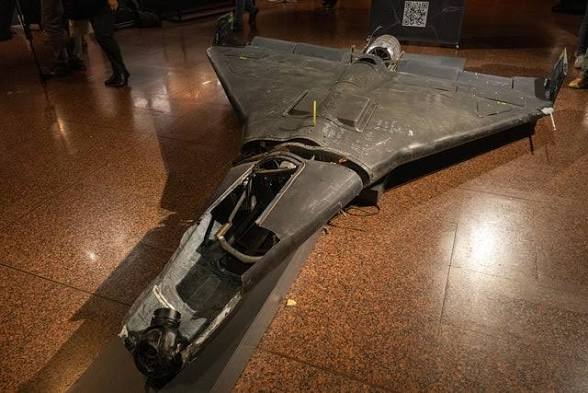
Iran has developed a significant domestic drone industry and has used unmanned aircraft in several regional operations.
Its drone technology has also become an important subject in international security discussions.
However, the presence of Iranian-designed components does not automatically prove that Iran launched a particular attack.
Military investigators must examine several factors.
These include:
The drone’s physical design and recovered components.
Radar information showing its flight path.
The location from which it may have been launched.
Communication signals and available electronic data.
Evidence connecting the operators to a military or non-state organisation.
Such information could help investigators determine whether the Kuwait attack involved Iranian forces, another armed group or a different actor.
Without reliable technical evidence, competing political accusations could make the situation more difficult to resolve.
This is why an independent investigation would be important.
What Evidence Could Establish Responsibility?
Determining responsibility for a drone attack requires more than identifying the type of aircraft involved.
Investigators generally need to establish how the drone entered the airspace, where it originated and who controlled it.
Radar records could provide information about its direction and flight path.
Recovered debris could help identify its manufacturer, model and technical configuration.
Electronic intelligence might also provide clues about communication systems or operational control.
Investigators could compare this information with known military equipment and previously documented drone operations.
Statements from witnesses and military personnel could provide additional context.
However, no single piece of evidence necessarily proves who ordered an attack.
A drone could be manufactured in one country, operated by a group in another country and launched from a third location.
This distinction is especially relevant in the Middle East, where several armed organisations operate across national borders.
Iran’s offer to cooperate with Kuwait and Italy could create an opportunity to examine these questions.
Nevertheless, the credibility of any investigation will depend on transparency, access to evidence and agreement between the participating governments.
Until that process produces reliable findings, responsibility remains disputed.
Regional Countries Condemn the Kuwait Drone Attack
The incident has also triggered reactions from other Middle Eastern governments.
Saudi Arabia, Bahrain, Qatar and the United Arab Emirates condemned the attack, expressing concern about the consequences for regional security.
These reactions demonstrate that the incident is not being viewed as an isolated security event.
Gulf countries have faced repeated threats involving missiles and drones during the wider conflict.
Their governments are concerned that further attacks could damage critical infrastructure and increase the possibility of direct military confrontation.
The Gulf Cooperation Council also has an important role in coordinating regional security discussions.
Its members have a shared interest in protecting important facilities, energy infrastructure and international shipping routes.
The latest incident could encourage additional cooperation on air defence and intelligence sharing.
However, regional governments must also consider diplomatic options.
A wider confrontation could create serious economic and security consequences for the entire Gulf region.
What Does Iran’s Denial Mean for Regional Diplomacy?
Iran’s denial creates another challenge for diplomatic efforts aimed at preventing further escalation.
Tehran is attempting to separate itself from the attack while presenting its willingness to cooperate with Kuwait and Italy.
The proposed joint investigation could help reduce uncertainty if all parties agree to participate.
However, diplomatic cooperation will not automatically resolve the disagreement.
Kuwait has already protested to Iran, while Italy is seeking accountability for the deaths of its citizens.
These positions suggest that the diplomatic consequences will continue even if the investigation moves forward.
There is also a broader question about trust.
Gulf governments have repeatedly expressed concerns about Iranian military activities in the region. Iran, meanwhile, argues that neighbouring countries should not allow their territory to be used against it.
Both sides face pressure to protect their security interests.
The challenge is to prevent these competing concerns from creating another cycle of military retaliation.
For now, Iran’s proposal for an investigation represents a possible diplomatic opening.
Whether Kuwait accepts the proposal and what form the investigation takes will be important developments to watch.
Could the Kuwait Attack Lead to Further Military Escalation?
The possibility of further escalation remains a major concern.
Kuwait has described the attack as a serious violation of its sovereignty. Italy has also demanded a response after losing two citizens.
If investigators establish that Iran was directly responsible, pressure for diplomatic or security measures against Tehran could increase.
However, if the evidence points towards another actor, the political situation could change considerably.
There are several possible developments to watch.
First, diplomatic protests could intensify. Kuwait may continue demanding explanations and guarantees concerning its security.
Second, military surveillance could increase. Gulf countries may strengthen their air-defence networks and monitoring systems.
Third, international investigations could become important. Italy and Kuwait may seek technical evidence to establish responsibility.
Fourth, regional negotiations could face additional pressure. The incident could complicate attempts to reduce tensions between Iran and its neighbours.
At this stage, there is no confirmed evidence that the incident will automatically lead to a new military confrontation.
However, the deaths of two Italian technicians have made the situation considerably more serious.
What Happens Next?
The coming days could be important for determining the diplomatic and security consequences of the Kuwait drone attack.
The first major development to watch is whether Kuwait responds positively to Iran’s offer of a joint investigation.
A credible investigation could help establish the circumstances surrounding the attack.
It could also provide an opportunity for the countries involved to prevent further misunderstandings.
Another important issue is the response from Italy.
The Italian government is likely to continue seeking explanations about the deaths of its citizens and the circumstances in which the technicians were working.
Meanwhile, Kuwait will need to consider additional measures to protect military facilities and foreign personnel.
Iran will also face pressure to provide evidence supporting its claims that it was not involved.
The wider international community will be watching these developments because the incident has implications for regional security and European interests.
The central issue remains whether the attack was carried out by Iranian forces, another armed group or a different actor.
Until reliable evidence establishes responsibility, the competing claims will remain unresolved.
Conclusion: Iran’s Denial Adds Another Layer of Uncertainty
The Iran-Kuwait drone attack has created a serious diplomatic dispute at a time when the Middle East is already experiencing significant instability.
Kuwait and Italy have blamed Tehran for the incident, which killed two Italian defence technicians and injured other personnel.
Iran, however, has rejected responsibility.
Foreign Minister Abbas Araghchi has described the incident as suspicious and offered to cooperate with Kuwait and Italy in a joint investigation.
Iranian military officials have also raised false-flag allegations involving the United States and Israel, although these claims have not been independently verified.
Kuwait’s decision to summon the Iranian ambassador demonstrates the seriousness of the diplomatic dispute.
The priority now should be establishing the facts through reliable technical evidence and preventing further escalation.
Ultimately, the investigation’s findings could influence relations between Iran, Kuwait, Italy and other countries concerned about Gulf security.
Frequently Asked Questions (FAQs)
1. Why did Iran deny the Kuwait drone attack?
Iran denied responsibility for the November 26, 2026, drone attack. Iranian officials said their armed forces had not conducted the alleged operation and questioned the accusations made by Kuwait and Italy.
2. What did Abbas Araghchi say about the Kuwait attack?
Iranian Foreign Minister Abbas Araghchi described the incident as suspicious and suggested it could be an attempt to provoke further conflict. He also offered to cooperate with Kuwait and Italy in a joint investigation.
3. How many people died in the Kuwait drone attack?
Two Italian nationals died from injuries sustained during the November 26 attack. Two other people, a Kuwaiti military officer and a Pakistani national, were also reported injured.
4. Who were the Italian nationals killed in Kuwait?
The two victims were technicians employed by Rheinmetall Italia. They were working on detection antennas associated with Kuwait’s Skyguard air-defence system.
5. Did Kuwait blame Iran for the drone attack?
Yes. Kuwaiti authorities attributed the attack to Iran and condemned it as a serious violation of the country’s security. Kuwait subsequently summoned the Iranian ambassador and handed him a formal note of protest.
6. What is Iran’s false-flag allegation?
Iranian officials suggested that the attack could have been organised by other actors to make Tehran appear responsible and increase regional tensions. Iran raised allegations involving the United States and Israel, but has not provided independently verified evidence establishing these claims.
7. Did Iran offer an investigation into the attack?
Yes. Abbas Araghchi offered to cooperate with Kuwait and Italy in a joint investigation to determine the origin and circumstances of the incident.
8. Why is Kuwait important in the Iran conflict?
Kuwait has a strategic location in the Persian Gulf and maintains important defence and security relationships with the United States. It is also connected to regional energy markets and international shipping routes.
9. Could the Kuwait drone attack increase tensions between Iran and Gulf countries?
Yes. The incident could increase diplomatic tensions and encourage Gulf countries to strengthen their air-defence capabilities. However, the extent of any escalation will depend on the investigation and subsequent government responses.
10. Has Iran’s responsibility for the attack been independently confirmed?
As of November 27, 2026, responsibility remains disputed. Kuwait and Italy have blamed Iran, while Tehran denies involvement. A complete independent investigation is needed to establish the facts.
About the Author