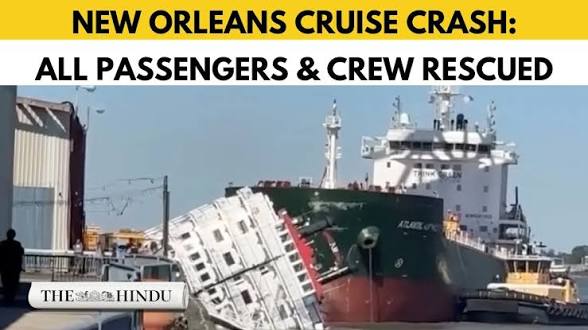
A terrifying maritime accident unfolded in New Orleans on November 13, 2026, when a large asphalt tanker slammed into a docked passenger riverboat on the Mississippi River. The collision caused the cruise vessel to roll onto its side and partially sink, triggering an emergency rescue operation involving local authorities, firefighters, police officers, and the United States Coast Guard.
The incident involved the American Heritage, a paddlewheel riverboat operated by American Cruise Lines, and the much larger tanker Atlantic Asphalt. Approximately 129 passengers were aboard the riverboat, alongside crew members, when the collision occurred.
Although the accident created a dangerous situation, officials confirmed that everyone aboard the cruise vessel was accounted for. Thirty-two people were transported to hospitals with non-critical injuries. No fatalities or critical injuries were initially reported.
The dramatic rescue quickly attracted national attention. Authorities praised the coordinated emergency response, while investigators began examining why the tanker struck the stationary passenger vessel.
What Happened in the New Orleans Cruise Crash?
The New Orleans cruise crash happened shortly after 12:30 p.m. local time on Friday, November 13, 2026.
According to the Port of New Orleans, the Atlantic Asphalt tanker struck the American Heritage near the Port of New Orleans Place terminal.
The passenger riverboat had arrived approximately two hours earlier. It was docked and preparing to allow passengers to disembark when the tanker approached and collided with it.
The impact was powerful enough to push the smaller vessel toward the dock and cause it to roll onto its side.
Passengers suddenly faced an extremely dangerous situation. Some people were still aboard the riverboat, while others had already started leaving.
As the vessel began taking on water, passengers and crew members attempted to reach safety. Several people entered the Mississippi River, while emergency responders and nearby boat operators rushed to help.
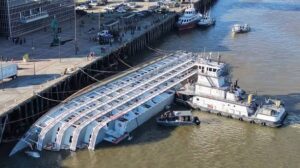
Videos and photographs from the scene showed the American Heritage lying on its side near the riverbank. Emergency personnel could also be seen assisting passengers wearing life jackets.
The incident prompted a major rescue operation along the New Orleans waterfront.
American Heritage: The Cruise Ship Involved in the Collision
The American Heritage is a passenger riverboat operated by American Cruise Lines.
The vessel is designed for Mississippi River cruises and features a traditional paddlewheel-inspired appearance. It offers passengers an opportunity to explore historic river communities while enjoying accommodation, dining, and sightseeing.
The ship was built in 2015 and can accommodate approximately 150 passengers.
At the time of the accident, the American Heritage was completing an eight-day Mississippi River journey.
Its itinerary included destinations in Louisiana and Mississippi, with stops associated with the historic Mississippi River corridor.
The collision happened as the vessel was docked in New Orleans.
This detail is particularly important because passengers were not expecting an emergency. Many were preparing to leave the ship after completing their cruise.
Instead, they suddenly found themselves dealing with a serious maritime accident.
The vessel’s position near the dock also became important during the rescue operation. Emergency personnel and nearby boats were able to assist people attempting to escape the damaged riverboat.
Atlantic Asphalt Tanker: What We Know About the Other Vessel
The second vessel involved in the accident was the Atlantic Asphalt.
Unlike the American Heritage, which was designed to carry tourists, the Atlantic Asphalt is a commercial tanker used to transport asphalt and bitumen.
These materials are commonly associated with road construction, roofing, and industrial applications.
The tanker is approximately 520 feet long, making it substantially larger than the passenger riverboat.
Its size and weight made the collision particularly dangerous.
Available shipping information identified the vessel as registered under the Marshall Islands flag. Reports also linked its ownership to Nave Shipping SA, a Liberia-registered company associated with China State Shipbuilding Corporation.
Thome Ship Management was also identified as the vessel’s management company.
Following the accident, the tanker remained under the attention of maritime authorities.
Its crew was reported safe and accounted for. The vessel was subsequently separated from the damaged cruise ship and moved away from the immediate collision area.
Investigators are examining the circumstances surrounding its movement before the collision.
Approximately 130 Passengers Were Aboard the Riverboat
One of the biggest concerns following the New Orleans cruise crash was the number of people aboard the American Heritage.
Port officials initially reported approximately 129 passengers, in addition to crew members.
The total number of people aboard the passenger vessel was therefore higher than 130.
Early reports described a major rescue effort as authorities worked to establish whether anyone remained missing.
New Orleans Mayor Helena Moreno later confirmed that everyone aboard had been accounted for.
This announcement brought considerable relief to families, emergency workers, and the wider community.
The incident could have resulted in a much greater tragedy, particularly because the collision caused the riverboat to overturn and partially submerge.
Officials reported that 32 people were transported to local hospitals.
None of the reported injuries was initially classified as critical.
Subsequent reporting indicated that eight people remained hospitalized on Saturday as medical teams continued providing treatment.
The tanker crew was also reported safe.
The successful rescue demonstrated the importance of emergency coordination during major maritime accidents.
How Emergency Responders Rescued Passengers
The rescue operation involved several local, state, and federal agencies.
The Port of New Orleans Harbor Police, New Orleans Fire Department, New Orleans Police Department, and United States Coast Guard responded to the collision.
Emergency medical personnel also arrived to provide assistance.
Nearby private vessels played an important role in the rescue.
Some boat operators voluntarily helped people escape from the water while emergency teams worked around the damaged riverboat.
Firefighters and police officers used available equipment, including ladders, to help passengers reach safety.
People who were rescued were taken to designated areas near the Port of New Orleans administration building.
Medical personnel assessed passengers and arranged hospital transportation when necessary.
The response was especially challenging because the riverboat was lying on its side, creating additional difficulties for anyone attempting to escape.
The Mississippi River also presented risks because of its depth, temperature, and commercial vessel traffic.
Passengers wearing life jackets had an important safety advantage.
Local officials praised the coordinated efforts of professional responders and private boat operators.
Mayor Helena Moreno described the successful outcome as a miracle on the Mississippi.
Her comments reflected the seriousness of the accident and the relief that no one had lost their life.
Did the Tanker Lose Steering Control?
One of the most important questions surrounding the New Orleans cruise crash concerns the cause of the collision.
Initial statements from officials suggested that the Atlantic Asphalt may have experienced a steering problem.
During a news conference, Coast Guard representatives indicated that investigators were examining a possible loss of steering.
However, authorities had not established the exact reason for the collision.
A steering failure could potentially prevent a vessel from following its intended course. On a busy commercial waterway such as the Mississippi River, even a short period of lost control can create serious consequences.
Large tankers require careful navigation because of their size, momentum, and stopping distance.
They also operate in waterways where commercial traffic, passenger vessels, tugboats, and port infrastructure must share limited space.
However, investigators must examine several possibilities before reaching a conclusion.
These may include mechanical problems, steering-system failures, human error, navigation decisions, communication issues, and other operational factors.
It would be premature to assign responsibility before the investigation is complete.
The National Transportation Safety Board is examining the incident alongside other authorities.
NTSB Investigation: What Happens Next?
The National Transportation Safety Board has begun investigating the collision.
The agency is responsible for examining major transportation accidents and identifying their underlying causes.
Its investigation will help establish what happened before the Atlantic Asphalt struck the American Heritage.
Investigators are expected to examine the vessels’ movements, available video footage, navigation records, communications, and equipment.
A particularly important development was the recovery of the tanker’s voyage data recorder.
This device can provide valuable information about a vessel’s operation before an accident.
Depending on the available data, investigators may examine navigation information, heading, speed, and other recorded details.
Witness interviews will also help investigators reconstruct the incident.
The NTSB has indicated that a preliminary report is expected within approximately 30 days.
However, a complete investigation could take considerably longer. Reports suggest that a final investigation may require between 18 and 24 months.
The preliminary findings may provide an early understanding of the collision, but they should not be confused with a final determination of responsibility.
Mississippi River Temporarily Closed After the Accident
The collision also disrupted commercial and passenger traffic along the Mississippi River.
Following the accident, the Coast Guard closed a section of the waterway to allow rescue teams to operate safely.
The restricted area covered several miles near the Port of New Orleans.
The closure affected vessels waiting to travel through the area.
The Regional Transit Authority also suspended its cross-river ferry service during the emergency response.
These restrictions were necessary because rescue boats, emergency vessels, and investigators needed sufficient space to operate.
The Mississippi River is one of the most important commercial transportation routes in the United States.
It supports the movement of agricultural products, industrial materials, fuel, and other cargo.
Consequently, even a temporary closure can create logistical challenges.
Authorities later began reopening the waterway under safety restrictions.
Reports indicated that one-way traffic and a designated safety zone were introduced while officials continued managing the situation.
The restrictions allowed maritime operations to resume while protecting the damaged cruise ship and emergency crews.
Port of New Orleans Files Lawsuit After Tanker Collision
The financial consequences of the accident quickly became another major development.
The Port of New Orleans filed a lawsuit against the Atlantic Asphalt and companies associated with its ownership and management.
The legal action seeks compensation for damage caused by the collision.
According to reports, the port is claiming more than $1 million in damage to terminal property.
The lawsuit names Nave Shipping SA and Thome Ship Management, alongside the tanker.
The port alleges that the tanker and its operators failed to take appropriate steps to avoid striking the stationary passenger vessel.
These allegations are part of the legal proceedings and have not been established as final findings of fault.
The lawsuit seeks compensation for expenses associated with repairs, cleanup, inspections, and other damage-related costs.
A federal judge also authorized steps allowing authorities to take control of the tanker.
The legal process could become more complicated as investigators determine the cause of the collision and assess the full extent of the damage.
Additional claims may also emerge as the recovery operation continues.
Why Recovering the American Heritage Could Take Weeks
The American Heritage suffered extensive damage when it rolled onto its side.
The vessel remained in a difficult position along the riverfront after the accident.
Recovering a large passenger riverboat is a complicated operation.
Salvage teams must first assess the vessel’s structural condition and determine whether it can be safely moved.
They must also consider remaining fuel, possible environmental hazards, water entering the vessel, and the stability of the surrounding area.
Moving the riverboat too quickly could create additional risks.
The Coast Guard and other authorities must therefore coordinate the recovery process.
Reports indicated that removing the American Heritage could take weeks.
The operation may require specialized equipment, tugboats, pumps, and other salvage resources.
Officials must also consider the effect of the damaged vessel on nearby port infrastructure and river traffic.
Environmental protection is another priority.
If fuel or other materials escape from the vessel, they could create additional problems for the Mississippi River.
For these reasons, the recovery process is expected to proceed carefully.
What the Crash Means for American Cruise Lines
The accident has placed American Cruise Lines under considerable attention.
The company operates passenger vessels on several major American waterways, including the Mississippi River.
Following the collision, the company confirmed that its guests and crew had been evacuated.
It also expressed appreciation for the actions of the captain, crew members, and emergency responders.
The company’s immediate priority is assisting affected passengers and cooperating with authorities.
The incident could also raise questions about passenger safety, emergency procedures, and port operations.
However, the available information does not establish that the cruise line caused the collision.
The American Heritage was docked when the tanker struck it.
Investigators must determine the circumstances of the incident before conclusions can be reached.
The accident may nevertheless encourage wider discussions about protecting passenger vessels in busy commercial ports.
Could the New Orleans Cruise Crash Have Been Worse?
The New Orleans cruise crash could have resulted in a significantly greater loss of life.
The American Heritage was carrying more than 100 passengers, along with crew members.
The collision caused the vessel to overturn and partially sink.
People were forced to escape from a damaged ship into the Mississippi River.
Cold water, heavy vessels, and the risk of becoming trapped can make maritime emergencies particularly dangerous.
The fact that everyone was accounted for is therefore especially significant.
The response also highlighted the importance of life jackets, trained crew members, nearby rescue vessels, and coordinated emergency services.
The incident demonstrates that maritime accidents can develop rapidly, even when a passenger vessel is safely docked.
It also highlights why commercial waterways need effective navigation systems and strong safety procedures.
What Happens Next in the Mississippi River Tanker Investigation?
Several important developments are expected in the coming days and weeks.
First, investigators will continue reviewing the Atlantic Asphalt’s navigation and steering systems.
They will also examine the voyage data recorder and interview people who witnessed the collision.
Second, salvage teams will assess the condition of the American Heritage and develop a recovery plan.
Third, the Port of New Orleans lawsuit may move forward as the parties address the damage claims.
Authorities will also continue monitoring the waterway and enforcing any safety restrictions around the damaged vessel.
The NTSB’s preliminary findings should provide additional information about the sequence of events.
However, a final explanation may take many months.
Until then, questions about the tanker’s steering, navigation, and operational condition remain under investigation.
Conclusion: New Orleans Cruise Crash Ends Without Fatalities
The New Orleans cruise crash was a frightening maritime accident that could have ended in tragedy.
On November 13, 2026, the Atlantic Asphalt tanker struck the docked American Heritage riverboat, causing the passenger vessel to roll onto its side and partially sink.
Approximately 129 passengers and additional crew members were aboard.
Authorities confirmed that everyone was accounted for, while 32 people were transported to hospitals with non-critical injuries.
The emergency response involved local authorities, firefighters, police officers, the Coast Guard, and nearby private vessels.
Although the immediate rescue operation was successful, important questions remain unanswered.
Investigators are examining a possible steering failure, while the Port of New Orleans is pursuing compensation for property damage.
The recovery of the American Heritage and the NTSB investigation will remain important developments in the coming weeks.
For now, the most significant outcome is that the accident resulted in no reported fatalities.
The incident serves as a powerful reminder of the risks associated with commercial maritime traffic and the importance of strong passenger safety procedures.
Frequently Asked Questions (FAQs)
1. What happened in the New Orleans cruise crash?
A large tanker called Atlantic Asphalt struck the docked American Heritage passenger riverboat on November 13, 2026. The impact caused the cruise vessel to roll onto its side and partially sink in the Mississippi River.
2. How many passengers were aboard the American Heritage?
Approximately 129 passengers were aboard the American Heritage, alongside crew members. The total number of people aboard was higher than 130.
3. Did anyone die in the New Orleans cruise crash?
No fatalities were reported. Officials confirmed that everyone aboard the passenger vessel was accounted for following the rescue operation.
4. How many people were injured?
Thirty-two people were transported to local hospitals with non-critical injuries. Subsequent reports indicated that eight people remained hospitalized on Saturday.
5. Which tanker hit the New Orleans riverboat?
The tanker involved was the Atlantic Asphalt, a commercial vessel used to transport asphalt and bitumen.
6. What caused the Atlantic Asphalt to crash?
The exact cause remains under investigation. Officials initially suggested that the tanker may have experienced a loss of steering control.
7. What happened to the American Heritage cruise ship?
The American Heritage rolled onto its side and partially submerged after the collision. Salvage teams are assessing the vessel and planning its recovery.
8. Is the Mississippi River open after the collision?
Authorities began reopening the affected section under safety restrictions. Vessel movements were managed through designated safety zones and traffic controls.
9. Is the NTSB investigating the New Orleans cruise crash?
Yes. The National Transportation Safety Board is investigating the collision, examining evidence, interviewing witnesses, and reviewing the tanker’s voyage data recorder.
10. Has the Port of New Orleans filed a lawsuit?
Yes. The port filed a lawsuit seeking more than $1 million in compensation for damage associated with the collision. The legal claims are separate from the ongoing safety investigation.
11. How long will it take to remove the damaged riverboat?
The recovery could take several weeks. Salvage teams must assess the vessel’s stability, structural damage, remaining fuel, and environmental risks before moving it.
12. Which company operates the American Heritage?
American Cruise Lines operates the American Heritage, a passenger riverboat that offers cruises along the Mississippi River.
About the Author