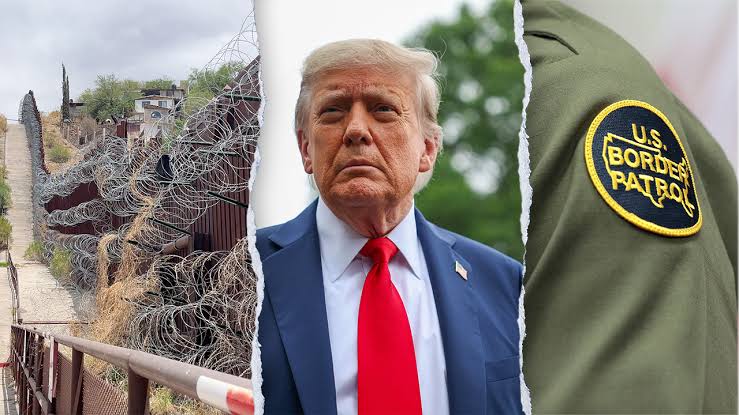
President Donald Trump has issued a fresh warning to Mexico over a growing migrant caravan moving north through the country toward the United States. The president threatened to immediately double tariffs on Mexican goods unless Mexican authorities stop the migrants from reaching the US border.
The warning marks another escalation in Trump’s aggressive immigration strategy. It also places additional pressure on Mexican President Claudia Sheinbaum, whose government faces the difficult task of managing migration while protecting its economic relationship with Washington.
The latest confrontation comes just days after Democrats secured major victories in the November 2026 midterm elections. According to reports, more than 1,000 migrants began travelling north from southern Mexico, raising fresh questions about border security and immigration enforcement.
Trump has made his position clear: Mexico must stop the migrant movement or face potentially significant economic consequences.
However, Sheinbaum has pushed back against the president’s claims. She argues that no migrant caravan has reached the US border since Trump returned to the White House in January 2025.
The disagreement highlights growing tensions between the neighbouring countries at a particularly sensitive moment for trade negotiations and regional security.
Trump Threatens Mexico With Immediate Tariff Increases
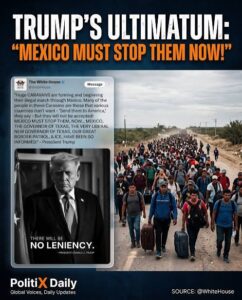
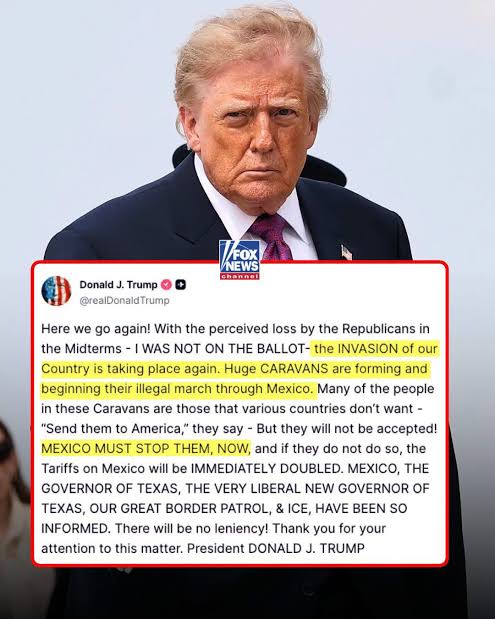
Trump delivered his warning through a post on Truth Social on Thursday, November 12, 2026.
The president claimed that large migrant caravans were forming and beginning their journey through Mexico toward the United States.
He also connected the renewed migration movement to the Republican Party’s losses in the recent midterm elections.
Trump suggested that the election results had encouraged migrants to believe that American immigration policies could become more relaxed.
In his message, the president demanded immediate action from Mexico.
He warned that tariffs on Mexican imports would be doubled if the country failed to stop the caravans.
Trump also mentioned Texas officials, Border Patrol and Immigration and Customs Enforcement (ICE), indicating that his administration was preparing to maintain a firm approach to border security.
However, the president did not provide a specific deadline for Mexico to comply. He also did not identify exactly which existing tariff rates or imported products would be affected by the threatened increase.
Nevertheless, the announcement sent a clear political message.
Trump intends to use America’s economic influence as leverage in his effort to control migration.
Migrant Caravan Moves North From Southern Mexico
The latest controversy follows the formation of a migrant caravan in southern Mexico.
According to Reuters reporting, approximately 1,500 migrants, many from Central America, departed from Tapachula in the state of Chiapas on Tuesday, November 10.
Tapachula is located near Mexico’s border with Guatemala and has long served as an important stopping point for migrants travelling north.
Many people in the group hope to reach Mexico City before deciding their next steps.
Some migrants reportedly believe that recent Democratic victories in the United States could eventually create new opportunities for entering and working in America.
However, election results do not automatically change immigration laws or border enforcement policies.
The journey also presents significant challenges.
Migrants must travel long distances, deal with transportation difficulties and navigate complicated immigration procedures. Some also face threats from criminal organisations operating along migration routes.
Furthermore, reaching northern Mexico does not guarantee entry into the United States.
The current caravan has therefore become a major political issue even though it remains far from the American border.
Claudia Sheinbaum Pushes Back Against Trump’s Claims
Mexican President Claudia Sheinbaum has responded firmly to Trump’s warning.
During her Thursday news conference, Sheinbaum said that no migrant caravan had reached the United States border since Trump returned to office in January 2025.
Her comments directly challenged the president’s description of the situation.
She also explained that a group of approximately 600 migrants travelling through Chiapas had largely dispersed after receiving information about the difficulties of reaching the United States.
Additionally, Mexican authorities were communicating with another group of several hundred Honduran migrants.
Officials were encouraging members of that group to return to their home country.
Sheinbaum also rejected the suggestion that Mexico would use widespread force to break up the caravans.
Instead, she indicated that authorities would continue using their experience to manage migrant movements and explain the limited possibilities of crossing into the United States.
Her response suggests that Mexico wants to avoid unnecessary confrontation while continuing to cooperate on migration management.
At the same time, the Mexican government does not appear willing to accept Trump’s demands without considering its own legal and humanitarian responsibilities.
Why Trump Is Linking Immigration to Tariffs
Trump’s latest warning reflects a broader strategy that combines immigration enforcement with international trade policy.
For the president, tariffs are not simply economic measures. They are also a negotiating tool.
By threatening higher duties on Mexican imports, Trump hopes to encourage Mexico to increase its efforts to control migration before migrants reach the American border.
This approach is consistent with his previous dealings with Mexico.
During his presidency, Trump repeatedly threatened economic consequences to pressure neighbouring countries into addressing American concerns about illegal immigration.
The strategy creates significant pressure because Mexico and the United States maintain deeply connected economies.
American businesses depend on Mexican manufacturing, agricultural products and industrial supplies. Similarly, Mexican companies rely heavily on access to American consumers.
Consequently, a sudden increase in tariffs could affect businesses and consumers on both sides of the border.
Higher import costs could also create additional pressure on American households already concerned about affordability.
For Mexico, the threat creates another economic challenge during ongoing trade negotiations.
US-Mexico Trade Relationship Faces Fresh Uncertainty
The tariff warning arrives at an important moment for economic relations between Washington and Mexico City.
The two governments are negotiating trade arrangements following Trump’s decision not to extend the existing United States-Mexico-Canada Agreement on its previous terms.
The USMCA remains central to economic cooperation across North America.
It supports a wide range of industries, including automobile manufacturing, agriculture, electronics, transportation and industrial production.
The United States and Mexico are also discussing several existing tariff disputes.
These include duties affecting trucks, steel, aluminum and Mexican agricultural products.
According to reporting by the Associated Press, Mexico is seeking reductions in several American tariffs while both countries prepare for the agreement’s review.
Therefore, Trump’s latest warning could complicate an already sensitive negotiating process.
If Washington follows through on the threat, Mexican exporters could face additional uncertainty.
American companies that import Mexican products could also encounter higher expenses.
Ultimately, the economic consequences could extend well beyond immigration policy.
Democrats’ Midterm Victory Adds Political Pressure
The latest migrant caravan has also become part of America’s domestic political debate.
Democrats achieved significant victories in the November 2026 midterm elections, gaining control of both chambers of Congress.
The results represent a major political setback for Republicans.
Democrats also won the Texas governorship, with Gina Hinojosa defeating Republican incumbent Greg Abbott.
This political change is particularly important because Texas shares an extensive border with Mexico.
Trump has already referred to the incoming Democratic governor in his warning about border security.
He indicated that the new administration in Texas would need to maintain strong border protection.
However, the election does not automatically change federal immigration laws.
Immigration enforcement remains a federal responsibility, although state governments can influence border-related policies through cooperation, legislation and legal challenges.
Some migrants travelling through Mexico reportedly expressed hope that Democratic victories might eventually create more favourable immigration opportunities.
Nevertheless, American immigration rules remain in place.
The political transition could influence future debates, but it does not provide migrants with an automatic pathway into the United States.
Trump Administration Signals Tough Border Enforcement
The Trump administration has indicated that it intends to maintain strict border security.
Following the president’s tariff warning, Homeland Security Secretary Markwayne Mullin also issued a firm message.
He said the administration would use available resources to secure the border and prevent the migrant caravan from entering the country.
This statement reinforces the administration’s position that preventing unauthorised crossings remains a priority.
Border Patrol and ICE are expected to remain important parts of the federal immigration enforcement system.
However, the situation involves more than simply stopping a group of people at the border.
Authorities must also consider asylum applications, immigration procedures, international agreements and humanitarian responsibilities.
The distinction between migrants travelling through Mexico and people actually attempting to cross into the United States is also important.
At present, the caravan is moving through southern Mexico.
It has not reached the US border.
That distinction is central to understanding the disagreement between Trump and Sheinbaum.
Humanitarian Concerns Surround the Migrant Caravan
Although the political debate focuses heavily on border security, the migrants themselves face difficult circumstances.
Many people travelling in caravans come from countries experiencing economic hardship, insecurity and limited employment opportunities.
Some are travelling with family members, including children.
Others hope to find better jobs and improve their living conditions.
Organising into groups can provide certain safety advantages.
Travelling together may reduce individual transportation costs and make it easier for migrants to obtain food, water and temporary assistance.
However, large journeys through Mexico can expose vulnerable people to additional risks.
These include criminal activity, dangerous weather, illness and exploitation.
Mexican authorities therefore face a complicated responsibility.
They must enforce immigration rules while also considering the safety and basic rights of people travelling through the country.
Sheinbaum’s rejection of a force-based response reflects this challenge.
Her government appears interested in managing the groups through communication, migration procedures and possible returns to migrants’ countries of origin.
The situation demonstrates why migration remains a difficult issue for governments throughout the region.
Could Trump Actually Double Tariffs on Mexico?
One of the biggest questions following Trump’s announcement concerns whether the threatened tariff increase will become reality.
The president has clearly stated his intention to impose higher tariffs if Mexico fails to stop the migrant caravans.
However, his announcement does not automatically mean that every Mexican product will immediately face double duties.
Several details remain unclear.
First, Trump has not specified which tariff rates would be doubled.
Second, he has not identified all affected products.
Third, the president has not announced a detailed implementation schedule.
These details matter because the economic relationship between the two countries involves different tariff arrangements.
Some products qualify for preferential treatment under the USMCA, while others face separate duties.
A new tariff measure could therefore require additional government decisions and legal procedures.
Businesses will also be watching closely for clarification from the White House and relevant trade authorities.
For now, the threat has created uncertainty rather than a fully defined new tariff policy.
What Happens If Mexico Refuses Trump’s Demand?
If Mexico does not meet Trump’s expectations, relations between the two countries could become more complicated.
The president has indicated that economic pressure is one possible response.
A decision to increase tariffs could create tension in several important areas.
Trade negotiations: Higher tariffs could make discussions over North American trade arrangements more difficult.
Business confidence: Companies operating across the US-Mexico border may delay investment decisions while waiting for clarity.
Consumer prices: Importers could pass some additional costs to American consumers.
Diplomatic relations: A public disagreement over migration could weaken cooperation between Washington and Mexico City.
Border enforcement: Both governments may face additional pressure to demonstrate that they are taking the situation seriously.
However, a complete breakdown in cooperation is not inevitable.
The United States and Mexico share important interests in trade, security and migration management.
Both governments have strong economic and political reasons to maintain communication.
Sheinbaum may continue pursuing a diplomatic approach while resisting demands that she considers excessive.
Similarly, Trump could use the tariff threat as leverage in negotiations rather than immediately implementing the full increase.
Why Mexico’s Cooperation Matters to US Border Security
Mexico plays a crucial role in managing migration across North America.
Its geographical position makes the country an important transit route for people travelling from Central America and other regions toward the United States.
Mexican authorities can influence migration movements through immigration enforcement, transportation checks, humanitarian assistance and cooperation with regional governments.
The country has previously increased efforts to manage migrant movements in response to American pressure.
According to recent reporting, Mexican officials have already intervened in several migrant movements in southern Mexico.
These actions demonstrate that Mexico is not ignoring the issue.
However, stopping every migrant from travelling north presents practical and legal challenges.
Authorities must manage a large territory and multiple migration routes.
Furthermore, migrants may change their routes or travel independently when organised caravans become difficult to maintain.
This means that migration enforcement requires continuous coordination rather than a single operation.
For Washington, cooperation with Mexico remains important because American border security is influenced by developments far beyond the physical border itself.
Political Implications for Trump’s Immigration Agenda
The confrontation could also influence Trump’s broader political strategy.
Immigration was one of the central issues of his presidential campaign.
His administration has repeatedly presented stricter enforcement as an important achievement.
However, the recent midterm results have created new political challenges for Republicans.
Trump has acknowledged concerns about the political consequences of aggressive deportation policies.
He recently indicated that his administration’s approach had been too tough in certain circumstances and expressed openness to working with Democrats on immigration.
Nevertheless, the latest warning to Mexico suggests that border enforcement will remain a major priority.
The appointment of Stephen Miller, a key architect of Trump’s immigration policies, as White House chief of staff has also raised questions about the administration’s future direction.
Miller’s influence could reinforce the president’s preference for strict immigration measures.
At the same time, the Democratic-controlled Congress may challenge several aspects of the administration’s agenda.
This could produce a difficult political environment in which immigration policy becomes an even bigger source of disagreement.
What Comes Next for Trump and Mexico?
The immediate focus will be on how Mexico responds to Trump’s tariff threat and whether the migrant caravan continues travelling north.
Mexican officials have indicated that they are communicating with migrants and exploring ways to manage the situation without resorting to widespread repression.
Meanwhile, the Trump administration has reiterated its commitment to preventing unauthorised border crossings.
Several developments will be important to watch.
First, observers will want to know whether the caravan continues toward Mexico City or disperses.
Second, Washington may provide additional details about the proposed tariff increases.
Third, Sheinbaum’s government will need to balance American pressure with domestic political and humanitarian considerations.
Finally, ongoing trade negotiations could become more complicated if the immigration dispute escalates.
The next few days could therefore be important for both countries.
However, there is currently no confirmed agreement or publicly announced deadline resolving the dispute.
Conclusion: Trump’s Mexico Ultimatum Raises Stakes Over Migration and Trade
Donald Trump’s latest warning has placed Mexico under renewed pressure to stop migrant caravans travelling north toward the United States.
By threatening to double tariffs, the president has connected immigration enforcement directly to the economic relationship between the neighbouring countries.
The development comes at a politically sensitive time following major Democratic victories in the November 2026 midterm elections.
Mexican President Claudia Sheinbaum has challenged Trump’s claims, arguing that no migrant caravan has reached the US border since January 2025.
She has also rejected the use of widespread force against migrants.
For now, the situation remains unresolved.
The caravan’s progress, Mexico’s response and Washington’s next economic moves will determine whether the latest confrontation becomes another negotiating dispute or develops into a larger diplomatic and trade conflict.
One thing is clear: Trump is once again using America’s economic influence to pursue his border security objectives, while Mexico is attempting to protect its sovereignty, economy and approach to migration management.
Frequently Asked Questions (FAQs)
1. Why did Trump threaten Mexico with higher tariffs?
Trump threatened to double tariffs on Mexican goods unless Mexico stopped migrant caravans travelling north toward the United States. He wants Mexico to increase its efforts to prevent migrants from reaching the American border.
2. When did Trump issue the Mexico tariff warning?
Trump issued the warning on Thursday, November 12, 2026, through a post on his Truth Social platform.
3. How many migrants are travelling in the latest caravan?
Reuters reported that approximately 1,500 migrants, many from Central America, departed from Tapachula in southern Mexico on November 10, 2026.
4. What did Claudia Sheinbaum say about Trump’s warning?
Mexican President Claudia Sheinbaum challenged Trump’s claims, saying no migrant caravan had reached the US border since January 2025. She also said Mexican authorities were managing migrant groups without widespread repression.
5. Will Mexico face immediate double tariffs?
Trump threatened to immediately double tariffs if Mexico failed to stop the caravans. However, he did not provide specific implementation details or identify all affected products.
6. Where did the migrant caravan begin its journey?
The main reported migrant caravan departed from Tapachula, in Mexico’s southern state of Chiapas, near the Guatemalan border.
7. Did the US midterm elections influence the migrant caravan?
Some migrants reportedly expressed hope that Democratic victories could create more favourable immigration opportunities. However, the election results did not automatically change US immigration laws.
8. Could Trump’s tariff threat affect American consumers?
Yes. Higher tariffs could increase import costs for American businesses. Some companies may pass those additional expenses to consumers through higher prices.
9. What is the USMCA?
The United States-Mexico-Canada Agreement is a major North American trade agreement governing economic relations between the three countries. It covers industries including manufacturing, agriculture and automotive production.
10. What happens next in the US-Mexico immigration dispute?
The next developments will depend on Mexico’s response, the migrant caravan’s progress and whether the Trump administration provides further details about its proposed tariff increases.
About the Author