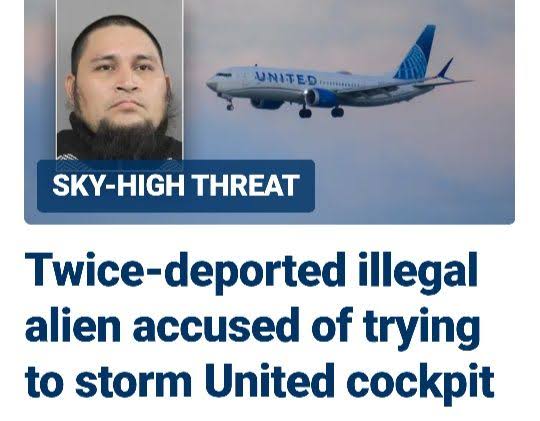
Commercial aviation security was pushed to its absolute limits during a terrifying mid-air incident that quickly escalated into a national security emergency. A routine domestic flight transformed into a high-stakes nightmare when a passenger—subsequently identified by federal authorities as a twice-deported individual—began acting erratically, claimed to possess an explosive device, and aggressively attempted to breach the aircraft’s cockpit.
The episode, which triggered a Level 4 hijack alert—the most severe threat classification in commercial aviation—has reignited intense public and political debates regarding border enforcement, immigration custody releases, and airline safety protocols. While the aircraft ultimately landed safely and the suspect was swiftly apprehended by local law enforcement, the chilling details emerging from the flight deck and the Department of Homeland Security (DHS) have left passengers, lawmakers, and security experts demanding urgent answers.
Anatomy of a Crisis: Inside United Airlines Flight 2174

The alarming sequence of events unfolded aboard United Airlines Flight 2174, a Boeing 737 Max 9 carrying 46 passengers and six crew members. The aircraft had departed cleanly from Newark Liberty International Airport (EWR) in New Jersey, bound for Louis Armstrong New Orleans International Airport (MSY).
For the majority of the journey, the flight proceeded without incident. However, as the aircraft crossed into the final stages of its evening route over the American South, chaos erupted in the cabin.
According to reports from the Jefferson Parish Sheriff’s Office and aviation authorities, a male passenger—later identified as 34-year-old Honduran national Rony Alexander Gomez-Alberto—underwent a sudden and radical behavioral shift.Witnesses and flight crew logs noted that Gomez-Alberto began acting erratically and irrationally. In a bizarre transformation, he reportedly changed into all-black clothing before standing up and creating a disturbance in the aisle.
Moving toward the front of the aircraft, the suspect made a terrifying declaration to the flight crew: he claimed that he was carrying a bomb inside his backpack and demanded access to the front of the plane. Witnesses stated that Gomez-Alberto lunged toward the flight deck door, attempting to force his way into the cockpit while the aircraft was cruising at high altitude.
The Level 4 Hijack Alert and Cabin Subdual
In commercial aviation, a Level 4 security threat represents an actual or attempted breach of the flight deck.Recognizing the catastrophic potential of an intrusion while airborne, the flight crew immediately initiated emergency protocols.
The pilotspilots inside the reinforced cockpit issued a formal hijack alert to air traffic control, signaling an active emergency.Meanwhile, quick-thinking flight attendants and able-bodied passengers in the cabin took immediate action. Displaying immense composure under extreme pressure, the crew intercepted Gomez-Alberto before he could compromise the cockpit door.
Working collaboratively, personnel subdued the disruptive passenger and restrained him safely at the rear of the aircraft for the remainder of the flight.
Despite the high-stress environment, the flight deck crew maintained control of the aircraft, executing a calm and prioritized descent. United Airlines Flight 2174 touched down safely on schedule in New Orleans, where a heavily armed contingent of local law enforcement officers, federal agents, and emergency responders swarmed the tarmac to meet the aircraft at the gate.
Suspect Profile: Immigration History and Prior Deportations
As federal investigators took over the inquiry, disclosures from the Department of Homeland Security (DHS) and Immigration and Customs Enforcement (ICE) revealed a complex and controversial immigration history surrounding the suspect.
Authorities identified the man as Rony Alexander Gomez-Alberto, a 34-year-old citizen of Honduras. According to federal immigration records, Gomez-Alberto had been apprehended and formally removed from the United States on multiple prior occasions:
2011 & 2014 Apprehensions: U.S. Border Patrol agents intercepted Gomez-Alberto near the southern border—specifically near El Indio, Texas, in 2011, and near Columbus, New Mexico, in 2014. On both occasions, he was processed and successfully deported back to Honduras.
2019 Re-entry and 2020 Release: Federal records show that Gomez-Alberto crossed into the United States illegally a third time, getting arrested by Border Patrol near San Ysidro, California, in 2019. However, following immigration court proceedings in 2020, an immigration judge issued an order ending the proceedings, resulting in his release from immigration custody into the interior of the country.
The revelation that a twice-deported individual with a history of unauthorized border entries was able to move freely within the United States—and ultimately board a commercial airliner—immediately sparked fierce political and public scrutiny regarding vetting procedures and enforcement loopholes.
Legal Charges and Federal Investigations
Following his removal from the aircraft in Louisiana, Gomez-Alberto was transferred to local custody and booked into the Jefferson Parish Correctional Center.
Local prosecutors and the Jefferson Parish Sheriff’s Office filed severe state charges against him, including:
Terrorizing
Communicating false information of planned arson (a statute commonly utilized by Louisiana prosecutors in false bomb threat scenarios)
Disorderly conduct
Simultaneously, federal agencies stepped in to evaluate additional charges. The Federal Aviation Administration (FAA) and the FBI launched parallel investigations into the mid-air disturbance. Legal experts note that federal statutes criminalizing interference with flight crews, conveying false information concerning the safety of civil aircraft, and attempting to breach a flight deck carry substantial federal prison sentences upon conviction.
Furthermore, Immigration and Customs Enforcement (ICE) acted swiftly in the wake of the arrest, lodging an official immigration detainer against Gomez-Alberto on Tuesday, ensuring that he will be transferred to federal immigration custody for deportation proceedings once local criminal prosecution concludes.
Political and Public Safety Repercussions
The incident has instantly ignited a national firestorm across media platforms and congressional offices. Critics of current immigration policies have pointed to the case as evidence of systemic failures in tracking individuals who re-enter the country after deportation. Security analysts and political commentators have questioned how an individual with multiple immigration violations managed to navigate domestic travel identification protocols without triggering red flags prior to boarding.
Conversely, aviation security advocates have praised the rapid and disciplined response of the United Airlines cabin crew and flight deck officers. Security experts emphasize that the incident highlights why modern commercial aircraft feature hardened, reinforced cockpit doors designed specifically to withstand physical breaches and prevent unauthorized access during emergencies.
No explosive devices were ultimately found inside the aircraft or among the suspect’s belongings following a thorough sweep by bomb-sniffing K-9 units and law enforcement officers in New Orleans. Nevertheless, the psychological toll on the 46 passengers and six crew members who lived through the harrowing mid-air ordeal remains profound.
As federal prosecutors prepare their case and congressional committees review the security breakdowns that allowed the suspect onto a commercial jetliner, the Newark-to-New Orleans flight will undoubtedly serve as a watershed moment in discussions surrounding both national border security and the safeguarding of America’s skies.
Frequently Asked Questions (FAQs)
1. What happened on the United Airlines flight from Newark to New Orleans?
A passenger aboard United Airlines Flight 2174 began acting erratically, claimed to have a bomb in his backpack, and attempted to force his way into the aircraft’s cockpit, triggering a Level 4 hijack alert. The flight crew and passengers subdued him, and the plane landed safely in New Orleans.
2. Who is the suspect accused of the bomb threat?
Federal authorities identified the suspect as Rony Alexander Gomez-Alberto, a 34-year-old citizen of Honduras.
3. Was the suspect legally in the United States?
No. According to the Department of Homeland Security (DHS), Gomez-Alberto was an undocumented immigrant who had been formally deported from the United States twice (in 2011 and 2014), re-entered illegally in 2019, and was subsequently released from immigration custody following an immigration judge’s order in 2020.
4. Was an actual bomb found on the plane?
No. Following the plane’s safe landing and the suspect’s arrest, law enforcement searched the aircraft and confirmed that no explosive device was found.
5. What charges does the suspect face?
Gomez-Alberto was booked into the Jefferson Parish Correctional Center in Louisiana on state charges including terrorizing and communicating false information of planned arson. He also faces potential federal charges for interfering with a flight crew, and ICE has lodged an immigration detainer against him.
6. How many people were on board the aircraft?
The flight, operated with a Boeing 737 Max 9 aircraft, carried 46 passengers and six crew members. No injuries were reported during the incident.
About the Author