New York City is mourning a devastating tragedy after the death toll rises in Brooklyn following the catastrophic collapse of a three-story residential and commercial building in the Flatbush neighborhood. Emergency officials confirmed on Thursday morning, November 12, 2026, that at least eight people have died and 17 others were injured after the structure gave way on Wednesday afternoon, sending tons of brick, timber, and debris crashing into an adjacent excavation pit.
What began as an urgent afternoon rescue mission quickly transformed into a painstaking overnight recovery operation.Hundreds of firefighters, paramedics, structural engineers, and K-9 search teams converged on Flatbush Avenue as dusk fell on Wednesday, working through the night under floodlights to locate residents trapped beneath the unstable wreckage.By Thursday morning, authorities announced that additional victims had been recovered from the debris and two others succumbed to their injuries at area hospitals, pushing the fatality count from two to eight.
As investigators from the New York City Department of Buildings (DOB) and the Brooklyn District Attorney’s Office launch a full-scale inquiry into whether neighboring construction work triggered the disaster, the Flatbush community is left grappling with profound grief, displaced families, and urgent questions about urban construction safety.
What Happened in Flatbush: Timeline of the Brooklyn Building Collapse
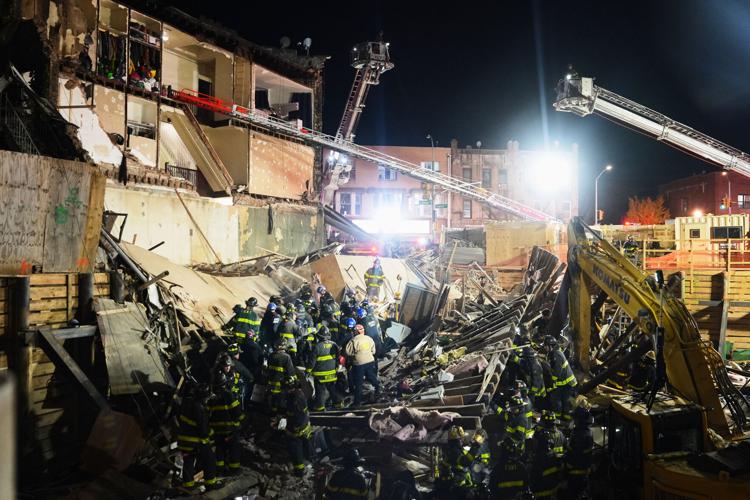
The disaster unfolded shortly before 4:00 p.m. EST on Wednesday, November 11, 2026, in the heart of Flatbush, a densely populated and vibrant neighborhood in central Brooklyn. According to the New York City Police Department (NYPD) and the Fire Department of New York (FDNY), a three-story building located at 1321 Flatbush Avenue—near the intersection of Bedford Avenue and Clarendon Road—suffered a total structural failure.
Witnesses described hearing a deafening roar followed by a massive plume of gray dust that blanketedblanketed the busy commercial corridor. Within seconds, the entire three-story structure collapsed inward and sideways, spilling into an adjacent lot where a single-story building had recently been demolished and excavated for a new construction project.
The sheer force of the collapse also sheared off the exterior wall of the neighboring building at 1323 Flatbush Avenue.Aerial footage and photographs from the scene revealed a haunting cross-section of daily life: exposed bedrooms, stairwells, furniture, and closets still hanging with clothes, left completely open to the elements after the shared wall was torn away.
Key Moments in the Emergency Response
Wednesday, 4:00 p.m. EST: First 911 calls flood emergency dispatchers reporting a major building collapse on Flatbush Avenue with multiple people trapped inside.
Wednesday, 4:15 p.m. EST: FDNY deploys a massive technical rescue response, eventually scaling up to roughly 250 firefighters and Emergency Medical Services (EMS) personnel.
Wednesday, 6:15 p.m. – 6:30 p.m. EST: In a dramatic moment captured by news cameras, firefighters pull a dust-covered woman—later identified by her husband at the scene as his pregnant wife—alive from a narrow tunnel dug into the rubble. A toddler is also rescued from the debris.
Wednesday, 8:00 p.m. EST: New York City Mayor Zohran Mamdani and FDNY Commissioner Lillian Bonsignore hold a press briefing confirming two fatalities and 19 total injuries, including four patients in critical condition and seven children.
Thursday, Morning (Nov. 12): Officials update the casualty figures as the death toll rises in Brooklyn to at least eight confirmed dead, after four more bodies are recovered from the wreckage and two hospitalized victims pass away.
Inside the Grueling Overnight Search and Rescue Operation
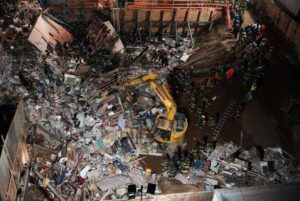
Conducting search and rescue operations in a collapsed masonry building requires extreme precision. Because heavy machinery can cause unstable voids to shift and crush survivors underneath, FDNY rescue teams had to dismantle the rubble pile largely by hand.
“This has been an incredibly challenging and fast-moving situation, with precarious wreckage to navigate and dangerous voids beneath the surface,” Mayor Zohran Mamdani said during his evening briefing at the scene. “This type of rescue is exactly what the FDNY trains for.”
FDNY Commissioner Lillian Bonsignore emphasized the peril facing first responders as they tunneled beneath hanging slabs of concrete and splintered floor joists. “The units are performing dangerous and heroic work,” Bonsignore told reporters. “Every move is choreographed.”
To locate signs of life beneath the debris, emergency crews utilized a multi-layered approach:
Specialized K-9 Search Teams: Periodically throughout the night, commanders ordered complete silence across the block—halting generators and power tools—so trained search-and-rescue dogs could canvass the debris pile for human scent and faint cries for help.
Thermal Imaging and Aerial Drones: FDNY drone units hovered above the collapsed footprint, providing live aerial mapping and thermal imaging to identify structural weak points and heat signatures.
Trenching and Shoring: Urban Search and Rescue (USAR) specialists installed temporary wooden and hydraulic shoring to stabilize the exposed walls of 1323 Flatbush Avenue before firefighters crawled into confined spaces below.
One firefighter suffered minor injuries during the grueling operation and was treated by medics at the scene. Meanwhile,ambulances transported the 17 injured civilians to nearby trauma centers, including Kings County Hospital, Maimonides Medical Center, and SUNY Downstate Health Sciences University.
Harrowing Stories of Survival Amid the Rubble
Behind the official statistics are heartbreaking stories of families caught inside their homes without warning. Because the collapse occurred around 4:00 p.m., many children had just returned home from school, explaining why seven of the injured victims were minors.
Anderson Velez, a resident of the collapsed building, recounted the terrifying phone call he received while at work when the structure gave way. His wife and their two young children, ages 7 and 2, were inside the apartment at the time.
“She called me when the building collapsed while she was inside with rubble on top of her,” Velez told reporters near the police barricade. “She was screaming for someone to help get my son out, and then the call cut off.” After agonizing hours waiting outside the cordon, Velez received the news that firefighters had successfully pulled his wife and both children from the wreckage alive.
Elsewhere along the perimeter, New York City Public Advocate Jumaane Williams comforted a distraught man who broke down in tears upon learning that his pregnant wife had been rescued from the debris pile and loaded into an ambulance.Williams also confirmed witnessing emergency crews carry a young toddler out of the rubble to safety.
For the families of the eight victims who did not survive, however, the wait ended in devastation. City officials have withheld the names of the deceased pending formal identification by the Office of Chief Medical Examiner and notification of next of kin.
Investigation Underway: Did Adjacent Construction Cause the Collapse?
As rescue operations gradually transition toward debris removal and structural stabilization, intense scrutiny has turned to the active construction site directly next door.
According to witnesses, aerial imagery, and municipal property records, the collapsed building at 1321 Flatbush Avenue stood directly on the edge of a lot where a one-story structure had previously been torn down. Crews had been actively excavating the lot to prepare foundations for a new development. When 1321 Flatbush Avenue failed, its bricks, flooring, and facade tumbled directly into the open excavation pit.
Structural engineering experts note that excavation work immediately adjacent to older, load-bearing masonry rowhouses is one of the highest-risk activities in urban construction. In New York City, many three- and four-story mixed-use buildings constructed in the early 20th century sit on shallow rubble-stone or brick foundations. If an adjacent excavation digs below the footing level of an existing building without proper underpinning, soil retention, or shoring, the earth supporting the neighboring wall can shift—causing sudden, catastrophic foundation failure.
Multi-Agency Probe Launched
To determine exactly what went wrong, multiple city and state agencies have opened parallel investigations:
Reporters attempted to reach the property owner, architect, and general contractor listed in city filings for the adjacent construction project, though none had issued public statements by Thursday morning. DOB Commissioner and structural inspectors remained on site throughout the night to evaluate surrounding properties along Flatbush Avenue and ensure no additional structures are at risk of secondary collapse.
Community Impact, Street Closures, and Emergency Aid
The tragedy has paralyzed a major artery of central Brooklyn and displaced dozens of neighbors whose homes were either destroyed or rendered uninhabitable by structural damage.
Traffic Disruptions and Street Closures
The NYPD established a wide safety perimeter around the collapse zone, closing Flatbush Avenue in both directions between Clarendon Road and Bedford Avenue. Commuters, local businesses, and MTA bus routes serving the Flatbush junction face significant delays and detours as heavy cranes and emergency vehicles occupy the roadway. Drivers are strongly urged to avoid the area until DOB engineers clear the surrounding block.
Support for Displaced Residents
Because neighboring buildings—including the heavily damaged 1323 Flatbush Avenue—had to be evacuated immediately due to exposed walls and compromised utilities, New York City Emergency Management (NYCEM) and the American Red Cross moved swiftly to establish a reception and assistance center.
Displaced residents can access emergency shelter, food, clothing, mental health counseling, and financial assistance at the Flatbush YMCA, located at 1401 Flatbush Avenue. By Thursday morning, the Red Cross had already registered multiple households—including adults and young children—for emergency housing placement.
New York Governor Kathy Hochul also pledged full state support to assist city agencies and affected families. “My administration has reached out and offered its full support as authorities investigate what happened,” Hochul stated.
A Troubling Pattern of NYC Building Collapses
As the death toll rises in Brooklyn, housing advocates and urban safety experts are raising alarms over recurring structural failures across New York City’s aging building stock.
The Flatbush tragedy comes just months after a high-profile structural incident in Manhattan in July 2026, when two load-bearing columns buckled inside a building, forcing emergency evacuations. It also echoes past fatal collapses tied to adjacent construction and renovation work across the five boroughs, including the 2023 partial collapse of a residential building in the Bronx and a deadly parking garage collapse in Lower Manhattan that prompted citywide inspection reforms.
While New York City enforces some of the strictest building codes in the United States—requiring specialized monitoring for excavations near existing structures—critics argue that enforcement often lags behind the rapid pace of urban redevelopment. Under current DOB rules, contractors excavating near neighboring foundations must file Support of Excavation (SOE) plans and install vibration and optical monitors to detect even millimeter-level shifts in adjacent walls.Investigators will examine whether those safeguards were properly designed, approved, and maintained at the Flatbush Avenue site.
What Happens Next in Flatbush?
Over the coming days, emergency operations at 1321 Flatbush Avenue will shift from urgent rescue to careful forensic deconstruction. Structural engineers must stabilize the sheared facade of 1323 Flatbush Avenue before heavy equipment can safely clear the remaining debris from the excavation pit.
Simultaneously, the Brooklyn District Attorney’s Office and the Department of Buildings will subpoena construction records, soil engineering reports, and inspection histories. If investigators uncover evidence that contractors cut corners on shoring or ignored structural warning signs, the property owners and builders could face severe civil penalties and criminal prosecution.
For the residents of Flatbush, however, legal accountability will take months or years—while the loss of eight neighbors leaves an immediate, indelible scar on the community.
Frequently Asked Questions (FAQs)
1. What is the latest death toll in the Brooklyn building collapse?
As of Thursday morning, November 12, 2026, officials confirmed that at least eight people have died and 17 others were injured in the Brooklyn building collapse. Two victims were pronounced dead at the scene on Wednesday, while four more bodies were later recovered from the rubble and two victims died at local hospitals.
2. Where exactly did the Brooklyn building collapse happen?
The collapse occurred at 1321 Flatbush Avenue (near Bedford Avenue and Clarendon Road) in the Flatbushneighborhood of Brooklyn, New York. The collapse also tore off the side wall of the adjacent building at 1323 Flatbush Avenue.
3. What caused the building in Brooklyn to collapse?
The official cause remains under investigation by the New York City Department of Buildings (DOB) and the Brooklyn District Attorney’s Office. However, authorities noted that the collapsed three-story building stood directly next to an active construction lot where a one-story structure had been demolished and the ground was being excavated.
4. Were children among the victims of the Flatbush collapse?
Yes. According to FDNY Commissioner Lillian Bonsignore, seven of the injured patients were children. First responders also rescued a toddler and two young children (ages 2 and 7) from the debris pile.
5. Which streets are closed due to the Brooklyn collapse?
The NYPD has closed Flatbush Avenue between Clarendon Road and Bedford Avenue to all vehicular traffic while emergency crews, structural engineers, and heavy equipment operate at the site.
6. Where can displaced residents get help after the Brooklyn building collapse?
New York City Emergency Management (NYCEM) and the American Red Cross have opened a reception and assistance center at the Flatbush YMCA (1401 Flatbush Avenue) to provide shelter, food, and emergency services for displaced families.
About the Author