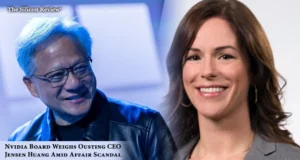
Silicon Valley is witnessing one of the most dramatic governance crises in modern corporate history. For more than three decades, Jensen Huang has served as the undisputed face, architect, and visionary force behind Nvidia. He transformed the company from a modest graphics card startup into a multi-trillion-dollar artificial intelligence colossus. Today,however, that legendary tenure hangs by a thread. In an astonishing turn of events, Nvidia weighs ousting CEO over affairs that have triggered national security alarms, wiped hundreds of billions of dollars off the company’s market value,and ignited a fierce battle inside the boardroom.
What initially began as a closely guarded corporate probe into a single personal relationship has rapidly spiraled into a full-blown crisis of leadership. Reports confirm that Nvidia’s board of directors has convened emergency discussions to determine whether Huang can remain at the helm. The tipping point arrived when explosive reporting revealed not just one, but two extramarital relationships involving the 63-year-old chief executive. While the first entanglement raised severe geopolitical concerns regarding Chinese intelligence and export controls, the second involved a high-ranking subordinate within Nvidia itself. Together, these revelations have forced independent directors to confront an unthinkable question: must Nvidia fire the co-founder who built its empire?
Inside the Boardroom: Why Nvidia Weighs Ousting CEO Over Affairs
For years, Nvidia’s board operated largely in lockstep with Huang. Under his guidance, the chipmaker captured roughly 90 percent of the artificial intelligence accelerator market, generating unprecedented returns for shareholders. Just days before the ouster reports surfaced, the board issued a carefully worded public statement expressing confidence in Huang and his leadership team while announcing an internal review. That united front crumbled within 72 hours.
The sudden shift in sentiment underscores how dramatically the risk calculus has changed for Nvidia’s 11-member board,of which 10 directors are classified as independent. Under Nvidia’s corporate bylaws, the board holds the authority to remove any company officer—including the chief executive—with or without cause via a simple majority vote. As details of Huang’s personal conduct spilled across the front pages of major financial newspapers, directors faced mounting pressure from institutional investors, regulatory bodies, and legal advisors to take decisive action.
To manage the fallout, Nvidia retained the prominent New York law firm Wachtell, Lipton, Rosen & Katz to lead an independent investigation. Simultaneously, reports emerged that directors had begun consulting with an outside executive search firm to identify potential interim and permanent replacements. When a board engages succession headhunters while investigating its sitting chief executive, it signals that a formal vote on removal is no longer a theoretical exercise—it is an active contingency plan.
The First Scandal: Alice Huang, Megaspeed, and Espionage Allegations
The crisis first broke into public view following investigative reports detailing Huang’s extramarital relationship with Alice Huang, a Chinese businesswoman also known as Huang Le. AliceAlice Huang held a senior executive role and later became a controlling figure at Megaspeed International, a Singapore-based cloud computing company that rapidly emerged as one of Nvidia’s largest customers in Southeast Asia.
The business ties between Nvidia and Megaspeed were substantial. Shortly after key corporate restructuring at Megaspeed, the firm became an official Nvidia Cloud Partner. Between mid-2024 and early 2026, Megaspeed and its Malaysian affiliate purchased more than $4.8 billion worth of advanced Nvidia-powered server infrastructure. However,those massive shipments quickly drew the attention of United States national security officials.
American intelligence agencies and the Commerce Department began investigating whether Megaspeed was acting as a front to divert restricted, top-tier AI processors into mainland China in violation of strict U.S. export control laws. As the probe deepened, intelligence officials reportedly concluded that Alice Huang had been recruited by China’s Ministry of State Security to act as an intelligence asset. The Commerce Department subsequently handed the case over to the Department of Justice’s National Security Division, which launched a criminal inquiry.
In an internal memo sent to Nvidia employees on November 8, 2026, Jensen Huang acknowledged that he had been unfaithful to his wife and took “full responsibility” for his personal failings, asking colleagues to respect his family’s privacy. However, he did not name the individuals involved or address the espionage allegations. Beijing’s Ministry of Foreign Affairs fiercely rejected the claims, calling the espionage narrative “entirely baseless” and a smear campaign.Megaspeed similarly denied wrongdoing, stating it is cooperating with U.S. Bureau of Industry and Security inspections and conducting an independent audit of its hardware inventory.
The Second Revelation: Kimberly Powell and Corporate Governance Breaches
While the Alice Huang controversy created a geopolitical firestorm, many corporate governance experts note that the second revelation is what truly sealed the board’s pivot toward ouster. Just as directors were attempting to contain the national security fallout, The New York Times published a report revealing that Jensen Huang had also engaged in an extramarital affair with Kimberly Powell, Nvidia’s Vice President of Healthcare.
Powell, 48, has been a prominent figure at Nvidia since joining the company in 2008 and has led its healthcare division since 2017. Crucially, she reported directly to Jensen Huang. According to multiple former and current employees cited in media reports, rumors of the relationship had circulated internally for some time. The situation escalated during Nvidia’s flagship GTC developer conference in San Jose, California, in March 2026, when bystanders reportedly captured video footage of Huang and Powell being overtly affectionate at a local hotel.
Even more troubling for corporate governance attorneys was the aftermath of that incident. Reports indicate that Huang’s personal security team approached the bystander who filmed the encounter and arranged for them to sign a non-disclosure agreement. Both Huang and Powell are married to other people.
From a strict corporate compliance standpoint, an undisclosed romantic relationship between a chief executive and a direct subordinate represents a textbook violation of workplace conduct policies. Nvidia’s internal code of conduct explicitly instructs employees to avoid conflicts of interest arising from personal relationships. Furthermore, deploying company-linked security personnel to secure NDAs over a chief executive’s personal behavior raises severe questions about the misuse of corporate resources and potential cover-ups.
Historical Precedents in Corporate America
Nvidia’s board does not have to look far to find clear precedents for how major corporations handle executive misconduct involving subordinates:
Intel (2018): Chief Executive Officer Brian Krzanich was forced to resign after an investigation revealed he had engaged in a past consensual relationship with an Intel employee, violating the company’s non-fraternization policy.
McDonald’s (2019): The board fired CEO Steve Easterbrook after determining he had violated company policy by engaging in a consensual relationship with an employee. The board later sued Easterbrook to claw back tens of millions of dollars in severance after discovering additional undisclosed relationships and evidence destruction.
Texas Instruments (2018): CEO Brian Crutcher stepped down after less than two months in the top job due to violations of the company’s code of conduct regarding personal behavior.
In each of these cases, boards concluded that allowing a chief executive to remain after violating internal conduct rules destroys accountability across the entire organization. If a CEO is exempt from conflict-of-interest standards, human resources and compliance departments lose all credibility.
Wall Street Reacts: Billions Wiped Out in Days
Financial markets responded to the leadership turmoil with immediate, punishing volatility. As news broke that Nvidia weighs ousting CEO over affairs, the company’s stock tumbled roughly 7 to 8 percent in premarket and after-hours trading. Over the span of a single week following the initial disclosures, Nvidia shed between $300 billion and $600 billion in market capitalization.
The selloff rippled across global technology exchanges. Semiconductor suppliers in Taiwan, South Korea, and Japan experienced sharp declines, while major cloud service providers and AI software firms saw nervous trading. Investors were forced to price in an unprecedented risk factor: the sudden removal of the leader widely considered indispensable to Nvidia’s technological dominance.
Adding to the financial pressure, shareholders wasted no time turning to the courts. A federal class-action securities lawsuit was filed in California against Nvidia and Huang, alleging that the company misled investors by failing to disclose the CEO’s relationship with an individual suspected of foreign intelligence ties. Legal analysts expect additional derivative lawsuits accusing the board of failing in its fiduciary duty of oversight if directors do not demonstrate rigorous,independent corrective action.
Geopolitical Fallout in Washington and Beijing
Beyond Wall Street and Silicon Valley, the scandal has ignited intense political debate in Washington, D.C. For the past two years, Jensen Huang had cultivated a remarkably close working relationship with President Donald Trump. Huang frequently advised the White House on artificial intelligence policy, accompanied the President on high-profile diplomatic trips—including a state visit to Beijing in May 2026—and received the National Medal of Science in October 2026.
Despite intelligence briefings regarding Alice Huang that reportedly reached senior officials months earlier, President Trump publicly defended the Nvidia chief, describing him as an “honorable guy” who had done an “incredible job” and stating that Huang had no idea the woman was suspected of espionage. The White House also indicated it would not intervene in the Nvidia board’s internal governance decision.
However, congressional leaders have taken a far more aggressive stance. The Republican chairs of three powerful House panels—the Foreign Affairs Committee, the Select Committee on the Chinese Communist Party, and the Intelligence Committee—formally demanded that Huang appear for a closed-door briefing on November 18, 2026. Lawmakers want answers regarding whether sensitive technical roadmaps, export control lobbying strategies, or supply chain data were compromised during his interactions with Megaspeed executives.
Meanwhile, high-level clashes have reportedly erupted within the administration itself over whether to immediately place Megaspeed on the U.S. Commerce Department’s Entity List, a move that would completely cut the firm off from American technology.
The Succession Dilemma: Who Could Replace Jensen Huang?
The single greatest obstacle complicating the board’s decision is Nvidia’s notorious lack of a formal succession plan.Unlike traditional Fortune 500 corporations that groom a clear heir apparent, Huang designed Nvidia around a remarkably flat organizational structure. He has roughly 60 senior executives reporting directly to him and has publicly stated in the past that he does not believe in conventional succession planning.
Nvidia’s own regulatory filings explicitly warn investors that the company is “highly dependent on the services of our longstanding executive team”. Removing Huang abruptly carries the risk of strategic paralysis at a moment when rivals like AMD, Broadcom, and custom silicon teams at Google and Amazon are fighting aggressively for AI data center market share.
If the board proceeds with removing Huang—or negotiates a face-saving resignation—several internal and external candidates are being weighed to steady the ship:
Even if Huang is ousted from the corner office, he will remain a formidable presence. As Nvidia’s largest individual shareholder, holding approximately 3.56 percent of the company’s stock—worth over $150 billion even after the recent selloff—Huang retains massive financial clout. In a surprising show of Silicon Valley solidarity, tech leaders such as Elon Musk publicly praised Huang, with Musk remarking on social media that it would be an “honour” to hire him if Nvidia lets him go.
What Happens Next for Nvidia and the AI Industry?
The outcome of the board’s emergency deliberations will reverberate far beyond Santa Clara, California. Nvidia sits at the very center of the global artificial intelligence infrastructure buildout. Sovereign nations, hyperscale cloud providers, and enterprise software giants rely on predictable multi-year product roadmaps—spanning the Blackwell and upcoming Vera Rubin chip architectures—to plan hundreds of billions of dollars in capital expenditures.
Analysts at leading research firms warn that without Huang’s relentless deal-making and personal diplomacy, Nvidia could see a temporary slowdown in massive bilateral AI infrastructure agreements. Conversely, governance experts argue that keeping a compromised CEO in place poses an even greater long-term threat: endless regulatory probes, shareholder litigation, and distracted leadership.
Whether the board opts for an immediate termination, a negotiated transition to a non-executive advisory role, or a strict probationary arrangement pending the Wachtell Lipton investigation, the aura of invincibility surrounding Jensen Huang has permanently shattered. For a company built on calculating probabilities at lightning speed, Nvidia now faces the hardest calculation in its 33-year history.
Frequently Asked Questions (FAQs)
1. Why is Nvidia’s board considering ousting CEO Jensen Huang?
Nvidia’s board of directors is weighing Jensen Huang’s removal following revelations of two separate extramarital affairs.The first involved Alice Huang, a former executive at Singapore-based Megaspeed whom U.S. intelligence officials suspect of acting as a Chinese intelligence asset and helping divert restricted AI chips to China. The second involved Kimberly Powell, Nvidia’s Vice President of Healthcare, who reported directly to Huang—a violation of corporate conflict-of-interest standards.
2. Has Jensen Huang officially been fired by Nvidia?
As of November 12, 2026, Nvidia has not announced a final decision to remove Jensen Huang. However, the board has met to discuss his future, retained the law firm Wachtell, Lipton, Rosen & Katz to conduct an independent investigation, and reportedly engaged an outside search firm to evaluate potential replacements.
3. Who are the two women linked to the Jensen Huang scandal?
The two women identified in major media reports are Alice Huang (also known as Huang Le), a businesswoman formerly associated with Singaporean cloud company Megaspeed International, and Kimberly Powell, Nvidia’s longtime Vice President of Healthcare.
4. Did Jensen Huang admit to the affairs?
Yes. On November 8, 2026, Jensen Huang sent an internal memo to Nvidia employees acknowledging that he had been unfaithful to his wife, apologizing to his family, and taking full responsibility for his personal actions. However, he did not name the individuals involved or comment on the allegations of espionage or workplace policy violations.
5. How has the scandal affected Nvidia’s stock price?
Nvidia’s stock has experienced severe volatility, plunging roughly 7 to 8 percent in after-hours and premarket trading following news of the board’s ouster discussions. Across the week of disclosures, the chipmaker lost hundreds of billions of dollars in market capitalization, and shareholders filed a federal class-action lawsuit alleging they were misled about the risks surrounding the CEO.
6. Who could replace Jensen Huang if he steps down or is removed?
Because Nvidia does not have a formally designated successor, the board would likely appoint an interim leader while conducting a broader search. Internal contenders mentioned by analysts include Chief Financial Officer Colette Kressand Vice President of Hyperscale and High-Performance Computing Ian Buck, alongside potential external semiconductor executives.
7. Does Nvidia’s board have the legal authority to fire its co-founder?
Yes. Under Nvidia’s corporate bylaws, the board of directors can remove any company officer—including the CEO—with or without cause through a majority vote. Ten of Nvidia’s 11 board members are independent directors.
About the Author