Anna Paulina Luna Sounds Off: ‘Socialism 101 Is Rules For Thee, Not For Me’

The American political landscape is no stranger to fiery rhetoric, but Representative Anna Paulina Luna once again grabbed national attention after declaring, “Socialism 101 is rules for thee, not for me.” The statement quickly spread across social media and conservative news platforms, becoming another flashpoint in the ongoing ideological battle between conservatives and progressives.
Luna’s comments came during a period of heightened political tension in Washington, where debates over election legislation, government spending, and the role of federal power continue to dominate headlines. The Florida Republican has become one of the most outspoken conservative voices in Congress, frequently criticizing progressive policies while defending limited government and constitutional principles.
The viral quote has resonated with supporters who argue that socialist policies often create unequal standards for political elites. Critics, however, argue that Luna’s characterization oversimplifies complex policy debates and unfairly labels mainstream Democratic proposals.
This article examines what Luna said, why the quote went viral, the political context surrounding her remarks, reactions from both sides of the aisle, and what the controversy reveals about the increasingly polarized state of American politics.
Who Is Anna Paulina Luna?
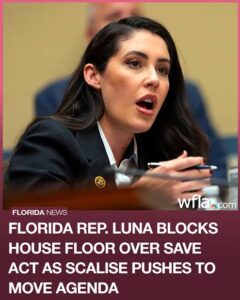
Anna Paulina Luna represents Florida in the U.S. House of Representatives and has emerged as one of the Republican Party’s rising conservative figures.
She has built a national profile through her outspoken positions on issues including:
- Border security
- Election integrity
- Government accountability
- Military affairs
- Government spending
- Free speech
Luna regularly appears on television and podcasts discussing conservative priorities and has become closely associated with the MAGA movement.
Recently, she has also played a prominent role in congressional disputes over Republican legislative strategy, particularly surrounding voter identification legislation and the SAVE America Act.
What Did Luna Mean by “Rules for Thee, Not for Me”?
The phrase “rules for thee, not for me” has become a common political slogan used by critics who believe government officials or influential figures impose standards on ordinary citizens that they do not follow themselves.
When Luna connected this phrase with socialism, she argued that socialist systems often:
- Expand government authority
- Increase regulation
- Centralize political power
- Allow elites to operate under different standards
Supporters interpreted her statement as criticism of what they view as hypocrisy among political leaders.
Opponents countered that the statement was political messaging rather than an objective description of socialist policies.
Why the Statement Went Viral
Several factors helped Luna’s remarks spread rapidly across social media.
Simple Messaging
Short political slogans often gain traction because they are easy to remember and share.
Existing Political Divide
The quote reinforced existing conservative arguments about government overreach and political hypocrisy.
Social Media Amplification
Supporters circulated video clips and graphics featuring Luna’s statement across platforms, leading to significant engagement.
Timing
The comments arrived during intense congressional battles over election legislation and broader ideological disputes, giving them additional visibility.
Political Context Behind the Comments
Luna’s statement did not occur in isolation.
Congress has recently experienced significant internal disagreements over Republican legislative priorities.
Luna has been among House conservatives pushing aggressively for stronger election integrity legislation while criticizing Senate leadership for not moving quickly enough on voter identification proposals.
These disputes contributed to procedural battles that delayed House business before the July Fourth recess.
Against this backdrop, Luna’s criticism of socialism fits within a broader conservative narrative emphasizing limited government and skepticism toward expanded federal authority.
Conservative Response
Many conservative commentators praised Luna’s remarks.
Supporters argued that her statement reflected concerns about:
- Government mandates
- Higher taxes
- Bureaucratic expansion
- Unequal treatment by political elites
Some also pointed to examples where politicians have been accused of failing to follow restrictions they imposed on the public as evidence supporting Luna’s criticism.
For many conservatives, the phrase encapsulated frustrations with perceived government hypocrisy.
Progressive Response
Progressive politicians and commentators viewed the statement differently.
Critics argued that:
- The United States does not practice socialism in the traditional sense.
- Many Democratic proposals involve regulated capitalism rather than government ownership.
- The quote relies on political branding more than policy analysis.
Others accused Luna of using emotionally charged language designed to energize conservative voters rather than foster bipartisan discussion.
What Is Socialism?
Socialism generally refers to economic systems where the government owns or controls major industries or plays a significant role in managing economic activity.
Modern political debates often use the word more broadly.
Some conservatives apply the label to:
- Expanded government programs
- Universal healthcare proposals
- Higher taxes
- Increased regulation
Many Democrats reject that characterization, arguing their policies are better described as social democratic reforms within a capitalist economy.
Because definitions vary, debates over socialism often become debates over terminology as much as policy.
The Role of Political Messaging
Political communication increasingly relies on memorable slogans.
Statements like Luna’s are designed to:
- Capture media attention
- Mobilize supporters
- Frame policy debates
- Generate online discussion
Whether one agrees or disagrees with the message, short phrases often influence public conversation more effectively than lengthy policy explanations.
Social Media’s Influence
Platforms such as X, Facebook, Instagram, and TikTok have transformed political communication.
A brief comment from a member of Congress can quickly become:
- Viral clips
- Memes
- News headlines
- Television discussions
This environment rewards concise, emotionally engaging messaging.
Luna’s statement demonstrates how political branding now extends far beyond traditional speeches.
Election-Year Implications
As election campaigns intensify, ideological messaging is expected to become even more prominent.
Republicans continue emphasizing:
- Smaller government
- Border security
- Fiscal restraint
- Election integrity
Democrats generally focus on:
- Healthcare
- Worker protections
- Climate initiatives
- Social programs
Luna’s comments align with broader Republican efforts to portray Democratic policies as excessive government expansion.
Critics Say the Debate Oversimplifies Policy
Political scientists frequently note that terms like “socialism” are often used rhetorically rather than academically.
Complex policy proposals may include elements of:
- Free-market economics
- Government regulation
- Public-private partnerships
Reducing these debates to single labels can sometimes obscure important policy details.
However, campaign messaging often prioritizes clarity and emotional appeal over nuance.
Why Political Language Matters
Words shape public understanding.
Terms such as:
- Freedom
- Democracy
- Socialism
- Capitalism
carry powerful emotional and historical associations.
Politicians carefully choose language that reinforces their broader political identity and appeals to their core supporters.
Luna’s quote illustrates how a single phrase can become a defining political message.
Public Reaction
Online reactions reflected America’s deep political polarization.
Supporters praised Luna for “telling the truth” about government hypocrisy.
Critics accused her of promoting divisive rhetoric and oversimplifying economic systems.
The sharply contrasting responses underscore how political messages are increasingly interpreted through partisan perspectives rather than shared factual frameworks.
Looking Ahead
Anna Paulina Luna remains one of the Republican Party’s most visible conservative voices.
Whether discussing election legislation, government accountability, or broader ideological issues, she continues to attract significant national attention.
As Congress debates major legislation and the political climate intensifies, remarks like “Socialism 101 is rules for thee, not for me” are likely to remain part of broader campaign messaging and ideological disputes.
Conclusion
Anna Paulina Luna’s statement that “Socialism 101 is rules for thee, not for me” has become another example of how modern political messaging shapes national conversations. Supporters see it as a pointed critique of government hypocrisy, while critics argue it oversimplifies complex policy debates. Regardless of perspective, the remark highlights the growing importance of concise, memorable rhetoric in today’s media environment.
With congressional battles continuing and election campaigns gathering momentum, ideological messaging from both parties will likely remain central to American political discourse.
Frequently Asked Questions
What did Anna Paulina Luna say?
She stated, “Socialism 101 is rules for thee, not for me,” criticizing what she described as hypocrisy within socialist or progressive political approaches.
Why did the quote become viral?
Its concise wording, strong political message, and widespread sharing on social media helped it gain national attention.
What political party does Anna Paulina Luna belong to?
She is a Republican representing Florida in the U.S. House of Representatives.
Did everyone agree with Luna’s statement?
No. Supporters praised the comment as a criticism of government hypocrisy, while opponents argued it misrepresented socialist ideas and oversimplified policy debates.
Why is socialism frequently debated in American politics?
The term is often used differently by various political groups, making it a recurring point of disagreement over government spending, regulation, healthcare, taxation, and the role of the federal government.
Representative Anna Paulina Luna’s remarks also reflect a broader communications strategy embraced by many Republicans in recent years. Rather than focusing solely on technical policy language, conservative lawmakers increasingly use short, memorable phrases that resonate with voters and are easily shared on social media.
Luna has consistently argued that Americans are concerned about government expansion, rising national debt, and what many conservatives view as unequal enforcement of laws and regulations. Her “Rules for thee, not for me” comment fits neatly into that messaging framework, presenting a simple argument that supporters believe captures their frustrations with political elites.
Republican strategists often emphasize that voters respond more strongly to values-based messaging than lengthy legislative explanations. As a result, statements like Luna’s can become powerful campaign tools, especially when they spark national conversations.
The Broader Debate Over Government Power
Although Luna specifically referenced socialism, the broader discussion centers on the proper role of government in American society.
Conservatives generally argue that:
- Smaller government promotes economic growth.
- Lower taxes encourage investment and job creation.
- Individual freedom should take priority over expanded regulation.
- Government bureaucracy often creates inefficiency.
Meanwhile, many progressives argue that government has an essential role in:
- Protecting workers.
- Expanding access to healthcare.
- Supporting education.
- Addressing income inequality.
- Regulating large corporations.
These differing philosophies explain why debates over the size and scope of government remain among the most contentious issues in U.S. politics.
Critics Call for More Nuanced Discussion
Political analysts from across the ideological spectrum often caution against reducing complex economic systems to slogans.
Many note that modern economies—including that of the United States—combine elements of both capitalism and government intervention. Public services such as Social Security, Medicare, public schools, and infrastructure are funded by government while private businesses continue to drive much of the economy.
Because of this mixed system, experts argue that terms like “socialism” and “capitalism” are frequently used in political rhetoric rather than as precise economic descriptions.
Luna’s supporters, however, maintain that her comment was intended as a critique of perceived government hypocrisy rather than an academic definition of socialism.
The Role of Media in Amplifying Political Quotes
Traditional media and social media now work together to amplify political statements.
A comment made during a press conference, television interview, or social media post can quickly spread across multiple platforms, reaching millions of people within hours.
News organizations often report on viral remarks because they generate significant public interest, while social media users create clips, memes, and commentary that extend the conversation even further.
This cycle has fundamentally changed political communication. Members of Congress now know that a single sentence can dominate headlines and shape public debate.
How Supporters Interpreted the Message
Many of Luna’s supporters argued that her statement reflected concerns they have expressed for years.
Common themes included:
- Government officials applying different standards to themselves than to ordinary citizens.
- Increased regulation affecting businesses and families.
- Concerns about expanding federal authority.
- Calls for greater government accountability and transparency.
For these voters, Luna’s remarks reinforced their belief that elected officials should be held to the same rules as the public.
How Opponents Responded
Those who disagreed with Luna argued that the statement oversimplified a wide range of policy proposals.
Critics contended that:
- Democratic policies generally operate within a capitalist framework.
- Expanding certain public programs does not necessarily constitute socialism.
- Political slogans can contribute to increased polarization by reducing complex issues to simple talking points.
Some commentators also urged lawmakers to focus on detailed policy discussions rather than rhetorical exchanges.
What This Means for Future Elections
Political messaging is expected to become even more prominent as election campaigns intensify.
Candidates from both parties will continue using memorable phrases to distinguish themselves and motivate supporters. Viral moments often translate into increased fundraising, media coverage, and online engagement, making concise messaging an important part of modern campaigning.
Whether voters ultimately prioritize rhetoric or policy specifics remains to be seen, but Luna’s comment illustrates how a single statement can shape the political conversation far beyond the halls of Congress.
Final Thoughts
Anna Paulina Luna’s remark, “Socialism 101 is rules for thee, not for me,” has become one of the latest examples of how concise political messaging can dominate public discourse. Supporters view it as a sharp criticism of government hypocrisy, while opponents see it as an oversimplification of complex ideological debates.
As discussions over government spending, regulation, and individual freedoms continue, comments like Luna’s are likely to remain central to America’s political landscape. Regardless of where one stands politically, the episode highlights the growing influence of social media, viral messaging, and ideological branding in shaping modern political debate.
Additional FAQs
Why did Anna Paulina Luna criticize socialism?
Luna argued that socialist-style governance can create unequal standards, where political leaders impose rules on the public that they do not always follow themselves.
Is Anna Paulina Luna active on social media?
Yes. Luna regularly shares updates, policy positions, and commentary through her official social media accounts, where many of her statements gain significant attention.
Why do political quotes often go viral?
Short, memorable statements are easy to share on platforms like X, Facebook, Instagram, and TikTok. They often spark debate and receive extensive media coverage.
Has Luna made similar remarks before?
Yes. Luna is known for outspoken criticism of progressive policies, federal government expansion, and what she describes as political hypocrisy.
What is the main takeaway from this controversy?
The controversy demonstrates how political rhetoric can rapidly shape public discussion, highlighting deep ideological divisions while underscoring the importance of clear and engaging communication in modern politics.
How useful was this post?
Click on a star to rate it!
Average rating 0 / 5. Vote count: 0
No votes so far! Be the first to rate this post.
About the Author

usa5911.com
Administrator
Hi, I’m Gurdeep Singh, a professional content writer from India with over 3 years of experience in the field. I specialize in covering U.S. politics, delivering timely and engaging content tailored specifically for an American audience. Along with my dedicated team, we track and report on all the latest political trends, news, and in-depth analysis shaping the United States today. Our goal is to provide clear, factual, and compelling content that keeps readers informed and engaged with the ever-changing political landscape.