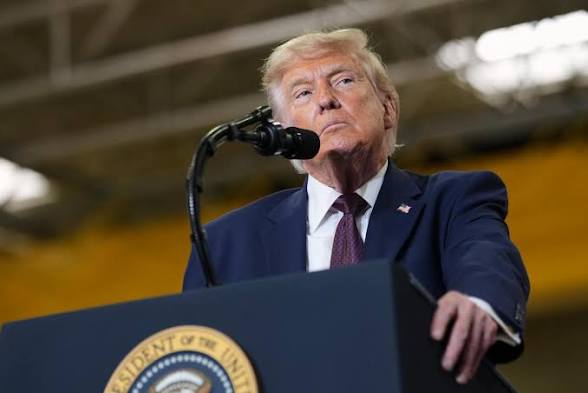
President Donald Trump has launched a new offensive against major oil companies, accusing them of failing to pass lower crude oil prices on to American consumers. In a strongly worded statement, Trump announced that he had instructed the Department of Justice (DOJ) to immediately investigate what he described as possible gasoline price gouging.
The announcement quickly became one of the day’s biggest economic stories, with investors, motorists, and energy analysts closely watching how the administration’s latest move could affect fuel prices and the broader energy market.
According to Trump, crude oil prices have fallen sharply in recent weeks following easing geopolitical tensions and improving stability in the Middle East. However, gasoline prices at service stations have not declined at the same pace, prompting concerns that consumers may be paying more than necessary.
Why Trump Ordered the DOJ Investigation
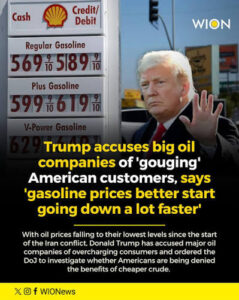
Trump made his position clear in a Truth Social post, arguing that major oil companies are benefiting from lower wholesale oil costs while failing to reduce prices at the pump.
He stated that crude oil prices are “dropping like a rock,” yet motorists are not seeing comparable savings when filling their vehicles. The president argued that Americans are being unfairly charged and instructed the Justice Department to examine whether companies are engaging in anti-competitive pricing practices.
The White House has not yet released additional details regarding the scope of the investigation or whether any specific companies have been identified.
Falling Oil Prices Spark New Debate
The investigation comes after global oil markets experienced a dramatic decline.
Several developments contributed to the drop in crude prices, including:
- Reduced geopolitical tensions.
- Improved diplomatic progress involving Iran.
- Expectations of more stable shipping through the Strait of Hormuz.
- Increased confidence in global energy supplies.
These developments pushed benchmark crude oil prices significantly lower over the past several weeks.
Despite that decline, retail gasoline prices have decreased much more slowly.
This gap between wholesale oil costs and retail gasoline prices has become the central issue behind Trump’s latest action.
The Numbers Behind Trump’s Complaint
Recent market data illustrates why the administration believes further scrutiny is necessary.
Among the key figures:
- Crude oil prices have fallen by roughly 40% from their spring highs.
- Since May, oil prices have dropped by more than 20%.
- Average U.S. gasoline prices have declined, but by a much smaller percentage.
- National average gasoline prices remain close to $3.90 per gallon.
Trump argues that consumers should already be seeing substantially lower prices at the pump if oil companies were fully passing along reduced costs.
Could Oil Companies Actually Be Price Gouging?
Energy economists caution that the answer is more complicated.
Gasoline prices do not always move in perfect sync with crude oil prices because several additional costs influence what consumers ultimately pay.
These include:
1. Refining Costs
Crude oil must first be processed into gasoline.
If refineries face higher operating expenses or limited production capacity, pump prices may remain elevated even as crude becomes cheaper.
2. Transportation Expenses
Fuel must be shipped from refineries to regional markets.
Transportation, storage, insurance, and distribution costs all affect final retail prices.
3. Existing Inventory
Many gasoline stations sell fuel that was purchased weeks earlier at higher wholesale prices.
Retailers generally wait until newer, cheaper supplies arrive before lowering prices significantly.
This delay is often described by economists as the “rockets and feathers” phenomenon—prices rise quickly when crude becomes more expensive but tend to fall more gradually when crude prices decline.
Historical Precedent
Trump is not the first president to challenge the oil industry over gasoline prices.
Previous administrations from both political parties have launched investigations or called for federal scrutiny during periods of elevated fuel costs.
Historically:
- Investigations have occasionally uncovered isolated cases of local market manipulation.
- Large-scale nationwide price-fixing has been much harder to prove.
- Most experts attribute pricing differences to market dynamics rather than widespread collusion.
Nevertheless, public frustration over gasoline prices often places significant political pressure on elected leaders.
Political Timing Matters
The announcement also arrives during an important political period.
Fuel prices remain one of the most visible indicators of inflation for American households.
As millions of drivers continue to feel the impact of higher transportation costs, the administration appears eager to demonstrate that it is taking aggressive action to protect consumers.
Political analysts note that gasoline prices often influence voter sentiment because they directly affect household budgets and commuting expenses.
What Could the DOJ Investigation Involve?
Although details remain limited, the Department of Justice could examine several areas, including:
- Potential anti-competitive conduct.
- Market manipulation.
- Possible collusion among fuel suppliers.
- Consumer pricing practices.
- Compliance with federal antitrust laws.
If investigators discover evidence of unlawful conduct, the DOJ could pursue civil or criminal enforcement actions depending on the findings.
However, experts caution that investigations of this nature often require extensive economic analysis and may take months before any conclusions are reached.
About the Author