Major Setback: US-Iran Talks DELAYED As Switzerland Confirms Last-Minute Postponement
The latest effort to advance diplomatic engagement between the United States and Iran has encountered an unexpected obstacle after Switzerland confirmed that high-level talks planned at the Bürgenstock resort have been postponed. The announcement came only hours before negotiators were expected to begin discussions, raising fresh questions about the future of the diplomatic process and the stability of a recently announced framework agreement.
Although Swiss officials emphasized that preparations at the venue continue and expressed readiness to host the meeting whenever both sides agree on a new date, the delay highlights the fragile nature of negotiations involving two longtime geopolitical rivals. The postponement has also fueled speculation about the political and security challenges that continue to shape relations between Washington and Tehran.
For observers of Middle East affairs, the development is significant because the talks were expected to mark the first major step toward implementing commitments contained in a preliminary diplomatic framework. Instead, uncertainty has returned just as many hoped momentum was beginning to build.
Switzerland Announces Last-Minute Postponement
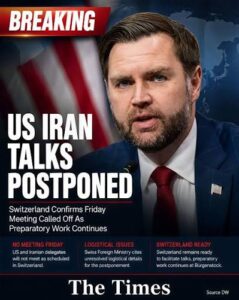
Swiss authorities confirmed that the scheduled meeting would not proceed as planned. The Swiss Federal Department of Foreign Affairs stated that while the negotiations have been postponed, Switzerland remains prepared to facilitate discussions whenever the participating parties are ready.
Officials also noted that logistical preparations at the Bürgenstock resort are continuing despite the delay. No revised timetable has yet been announced, leaving diplomats and analysts waiting for further updates from Washington and Tehran.
The announcement surprised many observers because only a day earlier Swiss officials had indicated that preparations for the meeting were moving forward and that mediators remained engaged with both governments.
Why Were the US-Iran Talks Delayed?
While neither government has provided a detailed public explanation, several factors appear to have contributed to the postponement.
One important development was the White House’s confirmation that U.S. Vice President JD Vance would no longer travel to Switzerland for the planned discussions. Officials described the situation as involving unresolved logistical issues and emphasized that negotiations had not been fully finalized.
Meanwhile, Iranian officials had already expressed uncertainty about participating. Reports indicated that Tehran wanted clearer evidence that Washington was implementing previously discussed commitments before moving ahead with the next stage of negotiations.
These developments suggest that the postponement reflects both practical scheduling concerns and deeper diplomatic differences that remain unresolved.
A Fragile Diplomatic Process
The delayed meeting was expected to focus on implementing a preliminary framework aimed at reducing tensions and establishing a roadmap for future negotiations.
Diplomats hoped the discussions would create mechanisms for monitoring commitments, improving communication, and addressing difficult issues that continue to divide both governments.
Instead, the postponement demonstrates how quickly diplomatic momentum can slow when political disagreements, regional security concerns, or logistical complications emerge.
Experts note that negotiations between Washington and Tehran have historically experienced repeated interruptions, with progress often depending on confidence-building measures before more contentious topics can be addressed.
Regional Tensions Continue to Influence Diplomacy
The broader regional environment has also complicated diplomatic efforts.
Recent instability involving Israel and Hezbollah has added uncertainty to an already sensitive negotiating process. Reports indicate that renewed violence in Lebanon contributed to concerns surrounding the planned meeting and may have influenced decisions by both delegations regarding travel and participation.
Diplomatic analysts frequently point out that negotiations involving the United States and Iran rarely occur in isolation. Events elsewhere in the Middle East often affect the political atmosphere surrounding talks, making sustained progress more difficult.
As a result, even relatively minor regional developments can reshape the timing and priorities of high-level diplomatic meetings.
How useful was this post?
Click on a star to rate it!
Average rating 0 / 5. Vote count: 0
No votes so far! Be the first to rate this post.
About the Author

usa5911.com
Administrator
Hi, I’m Gurdeep Singh, a professional content writer from India with over 3 years of experience in the field. I specialize in covering U.S. politics, delivering timely and engaging content tailored specifically for an American audience. Along with my dedicated team, we track and report on all the latest political trends, news, and in-depth analysis shaping the United States today. Our goal is to provide clear, factual, and compelling content that keeps readers informed and engaged with the ever-changing political landscape.