Idaho Air Show Crash: Emergency Response, Pilot Safety Fears, America Reacts
The Idaho air show crash has become one of the most talked-about aviation incidents in America this week after two U.S. Navy EA-18G Growler jets collided mid-air during the Gunfighter Skies Air Show at Mountain Home Air Force Base in Idaho. The dramatic accident unfolded in front of stunned spectators, triggering a massive emergency response and raising new concerns about pilot safety during military demonstrations.
Videos circulating online captured the terrifying moment the aircraft appeared to strike one another before spiraling downward in flames. Seconds later, four parachutes opened in the sky, confirming that all crew members had successfully ejected before impact. Authorities later confirmed that the pilots survived and were in stable condition.
The incident quickly dominated social media, national news broadcasts, and aviation forums, with Americans reacting to both the danger of the crash and the remarkable survival of the crew members.
What Happened During the Idaho Air Show Crash?
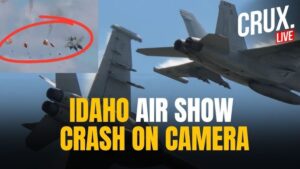
The collision occurred during the second day of the Gunfighter Skies Air Show near Mountain Home Air Force Base, located roughly 50 miles southeast of Boise, Idaho. The show featured military aircraft demonstrations, parachute jumps, and aerial maneuvers designed to showcase aviation capabilities and honor American military aviation history.
According to officials, the two aircraft involved were Navy EA-18G Growler electronic warfare jets assigned to Electronic Attack Squadron 129. The planes were performing a close-formation aerial routine when they collided in mid-air.
Witness footage showed the jets appearing to touch while maneuvering at high speed. The aircraft then spun together before crew members ejected moments ahead of a fiery crash. Thick black smoke rose from the crash site as emergency teams rushed into action.
The military base immediately initiated lockdown procedures, while organizers canceled the remainder of the event.
Emergency Response Teams Reacted Within Minutes
One major reason the Idaho air show crash did not become a far greater tragedy was the speed and coordination of the emergency response.
Military fire crews, emergency medical teams, local law enforcement, and regional support agencies quickly secured the area after the collision. Officials praised the professionalism of emergency responders, noting that their rapid actions helped protect both spectators and aircrew members.
Col. David Gunter, commander of the 366th Fighter Wing, publicly thanked response teams and emphasized that public safety remained the top priority throughout the incident.
Authorities also closed nearby highways and restricted access around the crash scene while investigators began gathering evidence. Idaho transportation officials warned that some road closures could continue for several days due to the ongoing investigation.
Medical teams evaluated all four crew members after they landed safely via parachute. Reports later confirmed the pilots were stable and no civilian injuries were reported on the ground.
Pilot Safety Fears Return After Dramatic Collision
Although the successful ejections prevented fatalities, the Idaho air show crash has reignited national discussions about pilot safety and the risks associated with military aerial demonstrations.
Air show flying requires extreme precision, particularly during close-formation maneuvers where aircraft operate within very narrow margins. Aviation experts noted that pilots participating in these demonstrations are among the most highly trained aviators in the world, yet even minor miscalculations can have devastating consequences.
Former aviation safety officials explained that mid-air collisions are especially dangerous because pilots often have little or no time to escape. In this case, experts described the crew’s successful ejection as extraordinary.
The incident has also renewed scrutiny over whether military air shows should continue involving high-risk tactical maneuvers in front of large crowds.
Many aviation enthusiasts defended the performances, arguing that air shows play an important role in public engagement and military recruitment. Others questioned whether the entertainment value justifies the danger to pilots and spectators.
America Reacts Across Social Media
The Idaho air show crash rapidly became a trending topic online as dramatic footage spread across social media platforms.
Thousands of Americans expressed relief that all four crew members survived. Others described the footage as terrifying and emotional, especially after witnessing the aircraft collide before exploding near the ground.
Several eyewitnesses posted firsthand accounts online, describing moments of confusion followed by panic as emergency sirens sounded across the airfield. Videos showing the parachutes opening above the falling jets were widely shared and viewed millions of times.
Military supporters praised the pilots’ training and calm response under extreme pressure. Others highlighted the professionalism of emergency personnel who managed the crisis in real time.
At the same time, online debate intensified regarding military demonstrations, aircraft maintenance, and operational safety standards.
Investigation Into the Idaho Air Show Crash Begins
Federal and military investigators are now working to determine exactly what caused the collision.
The Navy confirmed that a formal investigation is underway. Officials are expected to examine flight paths, pilot communications, weather conditions, aircraft systems, and performance data from both jets.
Experts believe investigators may have an advantage compared to many aviation disasters because all four crew members survived and can provide firsthand testimony.
Weather conditions at the time reportedly included strong wind gusts reaching nearly 29 mph, though visibility remained good.
Investigators are expected to evaluate whether weather conditions contributed to the accident or whether the collision resulted from operational or mechanical issues.
The EA-18G Growler: One of America’s Most Advanced Military Jets
The aircraft involved in the Idaho air show crash were EA-18G Growlers, electronic warfare aircraft derived from the F/A-18 Super Hornet platform.
These jets are designed for electronic attack missions, radar disruption, and battlefield communications interference. The Growler plays a major role in modern U.S. military operations and is considered one of the most sophisticated electronic warfare systems in the world.
Because of the aircraft’s advanced systems and tactical importance, the crash also raised questions about operational readiness and fleet safety.
Military aviation analysts noted that demonstration teams undergo extensive preparation before public performances, making the collision particularly shocking within the aviation community.
Idaho Air Show History Includes Previous Incidents
The Gunfighter Skies event had only recently returned after years of absence. According to reports, the last major show at Mountain Home Air Force Base occurred in 2018 and also ended in tragedy when a hang glider pilot died during a performance.
The base has also experienced previous aviation accidents over the years, including a 2003 Thunderbird crash in which the pilot ejected safely moments before impact.
Despite these incidents, aviation organizations note that air show safety has improved significantly in recent decades. Industry leaders reported there were no air show deaths in 2024 or 2025, reflecting broader efforts to strengthen safety standards.
Still, the Idaho air show crash serves as a reminder that high-performance military aviation always carries risk.
Military Air Shows Remain Popular Despite Risks
Even after the Idaho air show crash, military air shows remain highly popular across the United States.
Events featuring the Thunderbirds, Blue Angels, and Navy demonstration teams routinely attract hundreds of thousands of spectators. Supporters argue these shows inspire patriotism, educate the public about military aviation, and honor service members.
However, critics point to accidents like the Idaho collision as evidence that even elite pilots face enormous dangers during public performances.
The balance between entertainment, military outreach, and operational safety is likely to become part of a broader national conversation following this incident.
Why the Successful Ejection Was So Remarkable
One of the most discussed aspects of the Idaho air show crash was the survival of all four crew members.
Aviation experts explained that many mid-air collisions leave pilots with almost no opportunity to escape. In this case, the aircraft appeared to remain partially connected long enough for the crews to eject before impact.
Witnesses described seeing four parachutes deploy moments before the fireball erupted below.
The successful escape highlighted the effectiveness of modern military ejection systems and pilot training programs.
For many Americans watching online, the parachutes became a symbol of survival amid what could have been a catastrophic disaster.
Public Safety Concerns Continue After Idaho Air Show Crash
Even though no spectators were injured, the crash has sparked broader concerns about crowd safety at aviation events.
Military officials and air show organizers will likely review spectator distance requirements, emergency evacuation procedures, and flight safety protocols following the incident.
Experts say protecting crowds is always a major concern because high-speed aircraft accidents can create debris fields, fires, and secondary hazards.
Fortunately, the jets crashed away from the main viewing areas, preventing civilian casualties.
Conclusion
The Idaho air show crash shocked America with dramatic footage of two Navy jets colliding mid-air during a public demonstration. While the survival of all four crew members brought relief, the incident also reignited serious questions about pilot safety, emergency preparedness, and the risks of military air shows.
Investigators now face the task of determining what caused the collision and whether changes are needed to prevent similar accidents in the future.
For now, many Americans remain focused on one remarkable outcome: against overwhelming odds, every crew member survived.
FAQs
What happened in the Idaho air show crash?
Two Navy EA-18G Growler jets collided mid-air during the Gunfighter Skies Air Show at Mountain Home Air Force Base in Idaho.
Did the pilots survive the Idaho air show crash?
Yes. All four crew members successfully ejected and survived the crash. Officials reported they were in stable condition.
What caused the Idaho air show crash?
The exact cause is still under investigation. Authorities are examining flight data, weather conditions, aircraft systems, and pilot communications.
What aircraft were involved in the Idaho crash?
The aircraft involved were U.S. Navy EA-18G Growler electronic warfare jets.
Was anyone on the ground injured?
No civilian injuries were reported after the crash.
Why are military air shows considered risky?
Military air shows involve high-speed aerial maneuvers with very little room for error. Even experienced pilots face significant risks during close-formation performances.
Was the Idaho air show canceled after the crash?
Yes. Officials canceled the remainder of the Gunfighter Skies Air Show following the incident.
How useful was this post?
Click on a star to rate it!
Average rating 0 / 5. Vote count: 0
No votes so far! Be the first to rate this post.
About the Author

usa5911.com
Administrator
Hi, I’m Gurdeep Singh, a professional content writer from India with over 3 years of experience in the field. I specialize in covering U.S. politics, delivering timely and engaging content tailored specifically for an American audience. Along with my dedicated team, we track and report on all the latest political trends, news, and in-depth analysis shaping the United States today. Our goal is to provide clear, factual, and compelling content that keeps readers informed and engaged with the ever-changing political landscape.