Trump vs GOP Erupts: Indiana Republicans Block His Map Push
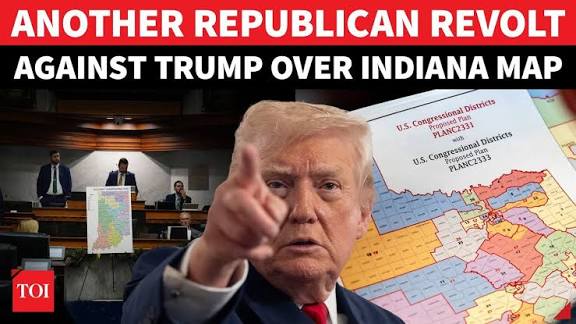
Indiana’s Republican-led Senate has decisively rejected the redrawn congressional map sought by the White House, which it would have supported. Today we will discuss about Trump vs GOP Erupts: Indiana Republicans Block His Map Push
Trump vs GOP Erupts: Indiana Republicans Block His Map Push
In an extraordinary political rupture that has sent shockwaves across the Republican Party, Indiana legislators delivered a stunning rebuke to President Donald Trump by blocking his push for a new congressional map. The episode, unfolding in December 2025, has quickly become a symbol of internal GOP tension, exposing deep fissures between national party leadership and state-level lawmakers.
For years, redistricting battles have shaped the balance of power in Congress. But this clash in Indiana stands out because it wasn’t Democrats resisting a Republican map—it was Republicans turning against their own president. The result: a moment that may redefine intra-party dynamics, influence the 2026 midterms, and signal the limits of Trump’s authority within the GOP.
This in-depth, 2000-word analysis explores the political drama in full: what triggered the dispute, why Indiana Republicans stood their ground, how Trump reacted, and what this eruption means for the future of Republican politics.
Trump’s Map Push: A High-Stakes Strategy

As the 2026 midterm elections approach, the political stakes could not be higher. Republicans hold a narrow majority in the U.S. House, and Trump’s strategy for securing a long-term grip on Congress involves mid-decade redistricting—a controversial move aimed at expanding GOP advantages in states where the party controls both the governorship and legislature.
Indiana, with its firm Republican supermajority, was a key target. Trump and his advisers pushed aggressively for a new congressional map that would:
Break up heavily Democratic Indianapolis
Strengthen GOP margins in swing districts
Potentially give Republicans control of all nine U.S. House seats in the state
The proposed map would have diluted Democratic voting power by slicing urban communities into multiple districts dominated by Republican rural voters. The plan was framed as a strategic necessity—an opportunity to lock in additional seats during a critical national election cycle.
Trump publicly pressured lawmakers, warned them about consequences of defiance, and suggested that failure to pass the map would help Democrats gain ground nationally.
But Indiana Republicans did something unexpected: they said no.
Inside the State Senate Showdown
On December 11, the Indiana Senate convened to vote on the Trump-backed redistricting plan. The numbers suggested an easy victory: Republicans hold a supermajority, meaning they could pass the map without a single Democratic vote.
Instead, twenty-one Republican senators joined with Democrats to reject the proposal.
The final vote: 31–19 against the map.
The defeat wasn’t merely procedural—it was a direct challenge to Trump’s political influence. Many lawmakers framed their votes as an act of principle, not rebellion, citing concerns over fairness, local autonomy, and the pressure campaign waged by national GOP figures.
A Speech That Defined the Moment
One Republican senator delivered remarks that quickly became symbolic of the revolt. He said:
“I am a Christian first, then an American, then a conservative, then a Republican— in that order.”
The message was unmistakable: loyalty to values and state constituents came before loyalty to the president or national party.
The Pressure Campaign: Threats, Intimidation, and Backlash
Trump and his allies launched a full-scale blitz to secure the map’s passage. Lobbyists, national Republicans, and high-profile figures reportedly contacted Indiana legislators in the days leading up to the vote.
The tactics included:
Intense social-media pressure
Personal threats and hostile messages
Warnings of primary challenges
Accusations of disloyalty
Rhetoric suggesting lawmakers were helping Democrats
Some lawmakers and their families even experienced swatting incidents—dangerous hoax emergency calls meant to intimidate through police intervention. The atmosphere surrounding the vote grew increasingly tense and personal.
Rather than breaking the senators’ resolve, these actions appeared to harden it. Several legislators stated that the pressure campaign felt “out of line with Indiana values”, and many resented the idea of Washington attempting to dictate state policy.
Why Indiana Republicans Rejected Trump’s Plan
The surprising rejection came down to a combination of political, ethical, and strategic factors.
1. Defense of Local Autonomy
Indiana has long prided itself on a political culture that resists external interference. Lawmakers argued that the redistricting process should be defined by state needs—not national political calculations.
The sentiment was simple:
“We govern Indiana, not Washington.”
Many felt that Trump’s involvement violated that principle.
2. Backlash Against Mid-Decade Redistricting
Mid-cycle map changes are often criticized as naked partisan manipulation. Local voters and activists expressed significant concern that Indiana was being used as a pawn for national electoral engineering.
Public testimony poured in opposing the map. Citizens argued that:
Fair representation was being undermined
Communities were being torn apart
The proposal ignored demographic coherence
Lawmakers reported receiving hundreds of calls urging them to stand firm.
3. Fear of Electoral Blowback
Some Republican senators feared that openly embracing an aggressively partisan map could hurt their own political futures. With many facing re-election in 2026, aligning themselves with Trump’s pressure campaign was seen as risky.
4. Ethical and Moral Concerns
A number of GOP lawmakers indicated discomfort with the idea of manufacturing political advantage through extreme gerrymandering.
To them, the map was not merely strategic—it was a distortion of democratic principles.
Trump’s Reaction: Fury and Retaliation
The rejection sparked an immediate and explosive response.
Trump:
Attacked Indiana Republicans in posts and speeches
Accused them of betraying the party
Suggested federal funding consequences
Promised to back primary challengers against the “disloyal”
Claimed Democrats were “celebrating thanks to Republican weakness”
He singled out specific state leaders, calling them obstacles to GOP success. In Trump’s framing, rejecting the map was equivalent to empowering Democratic victories nationwide.
His supporters echoed his outrage, accusing the Indiana Senate of sabotaging the party at a critical moment. But the lawmakers who voted against the map appeared largely unmoved.
A Rare Act of Defiance in the Trump Era
The Indiana revolt stands as one of the clearest examples of formal Republican resistance to Trump since he returned to power.
Unlike isolated congressional criticisms, this was:
An organized, majority-backed decision
A direct rejection of Trump’s political strategy
A refusal to carry out a plan he personally championed
The act demonstrated that even in states where Trump is deeply popular, his influence has limits.
National Political Implications
The consequences of Indiana’s decision will ripple far beyond state borders.
1. The Limits of Trump’s Control
For years, Trump has been the gravitational center of the GOP. Indiana’s vote shows that his dominance is not absolute—not even in conservative states with supermajority Republican legislatures.
If other states take cues from Indiana, Trump’s ability to shape the national electoral map may weaken heading into 2026.
2. A Deepening GOP Identity Crisis
The Republican Party continues to grapple with defining its post-2020s identity. The Indiana revolt highlights a widening divide:
Trump-aligned Republicans prioritize aggressive party advantage and loyalty to the president.
Traditional Republicans emphasize federalism, state independence, institutional norms, and local accountability.
This split may become more significant as policy fights intensify.
3. Democratic Strategic Opportunities
Democrats seized on Indiana’s outcome as evidence that bipartisan resistance to gerrymandering is possible—even in red states. Though they remain structurally disadvantaged in many states, the Indiana result gives reform advocates new momentum.
4. A Changed Battlefield for the 2026 Midterms
Trump’s map would likely have eliminated two Democratic seats. Without it, Republicans must now fight harder to expand or even maintain their House majority.
Indiana’s decision reshapes the national congressional math and raises uncertainties about GOP control in 2026.
A Clash About More Than Maps
At its core, this conflict was not just about redistricting—it was about the nature of Republican governance.
Indiana’s GOP lawmakers made clear that:
Not every state will accept national directives
Not every Republican will yield to Trump’s demands
Integrity of democratic institutions still matters to some factions within the party
The eruption exposes the tension between Trump’s centralized, personality-driven political leadership and the locally rooted conservatism that many state Republicans still embrace.
Conclusion: A Critical Turning Point
“Trump vs GOP Erupts” is more than a dramatic headline—it is a moment that may define the next phase of Republican politics.
Indiana Republicans:
Defied direct presidential pressure
Rejected a map designed to cement GOP power
Asserted their independence
Exposed a growing divide inside the party
Trump, in turn, responded with familiar force, framing the vote as betrayal and threatening political retribution. But his pressure failed to alter the outcome—and may have strengthened the resolve of dissenters.
Whether this moment becomes a broader movement or remains an isolated act of defiance, it reveals a profound truth:
The Republican Party is no longer a monolith. Its future will be shaped by how it navigates the tensions between Trump’s influence and the resurgence of independent conservative leadership at the state level.
Indiana has drawn a new line—and the rest of the nation is watching.
How useful was this post?
Click on a star to rate it!
Average rating 0 / 5. Vote count: 0
No votes so far! Be the first to rate this post.
About the Author

usa5911.com
Administrator
Hi, I’m Gurdeep Singh, a professional content writer from India with over 3 years of experience in the field. I specialize in covering U.S. politics, delivering timely and engaging content tailored specifically for an American audience. Along with my dedicated team, we track and report on all the latest political trends, news, and in-depth analysis shaping the United States today. Our goal is to provide clear, factual, and compelling content that keeps readers informed and engaged with the ever-changing political landscape.