Trump State of the Union : record length, economy claims, Iran warning
You said
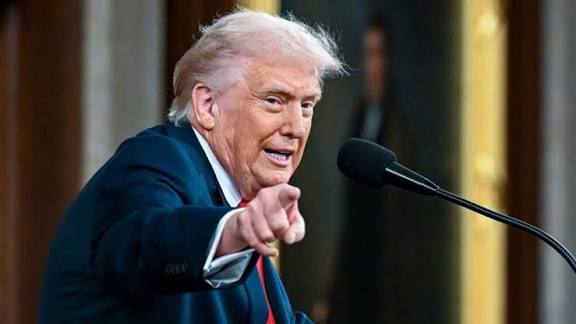
On February 24, 2026, U.S. President Donald Trump presented what became the longest State of the Union address in U.S. history, speaking for nearly 1 hour and 48 minutes before a joint session of the United States Congress. The marathon speech touched on a wide range of topics — from economic claims to immigration, foreign policy, and a pointed warning to Iran. While Trump’s supporters applauded his vision, critics argued much of his rhetoric was misleading or exaggerated.
This article breaks down the key elements of that address, analyzes Trump’s economic claims, explores the record-breaking length of the speech, examines his messaging on Iran, and explains how different audiences reacted. It also answers the most frequently asked questions about the address’s substance and implications.
The Record-Breaking Length of the Address
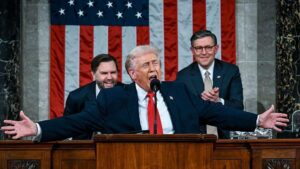
Trump’s 2026 State of the Union stands out first for its sheer duration. At 1 hour and 48 minutes, it surpassed all previous addresses in U.S. history — even beating President Bill Clinton’s 2000 speech by about 20 minutes.
The length was not merely a result of extended policy discussion. It also reflected frequent applause, partisan interruptions, and drawn-out storytelling — strategies that both amplified his message and highlighted the deep polarization inside the chamber.
Why Length Matters
A longer State of the Union can serve several purposes:
Greater airtime for policy priorities
More opportunities to appeal directly to voters
Room to reframe controversies or push new initiatives
A spectacle that reinforces political identity
However, critics noted that much of the extra time was spent on recurring themes and applause lines rather than actionable legislative proposals.
Trump’s Economy Claims
A central theme of Trump’s address was his administration’s economic performance. He depicted the nation as entering a new “golden age” of prosperity — with rising jobs, investment, and growth.
But independent fact-checkers disputed many of these claims, highlighting discrepancies between Trump’s rhetoric and economic data.
Key Economic Claims vs. Reality
Claim: The U.S. inherited a “stagnant” economy.
Fact: The economy before Trump’s return was not stagnant, though inflation concerns existed. GDP growth in 2024 was modest but positive.
Claim: Incomes are “roaring like never before.”
Fact: After-tax real income growth in 2025 was relatively low compared to historical performance.
Claim: Tariff revenues are “saving the country.”
Fact: Most economists agree that tariffs are ultimately paid by U.S. businesses and consumers, not foreign nations.
Experts also noted that employment figures and inflation metrics had complexities that Trump’s oversimplified statements glossed over.
The Broader Economic Context
A comprehensive analysis suggests that while some economic indicators improved, others (like consumer affordability and wage growth) lagged behind expectations, leading critics to question the narrative of unequivocal success.
Immigration, Domestic Policy, and Partisan Divide
Trump also used the address to reaffirm his hard-line stance on immigration and border security. He highlighted enforcement actions and called for stricter legislative measures, including tighter voter identification laws. These proposals drew sharp criticism from Democrats, who argued they would harm immigrant communities and civil rights.
The partisan divide was visible in the chamber itself: several Democratic lawmakers staged protests inside the Capitol, and some chose to attend a separate “People’s State of the Union” rally outside.
These tensions underscored the broader political landscape in the U.S. — where messaging to different voter blocs shapes how presidential speeches are interpreted.
Trump’s Iran Warning
Perhaps the most consequential foreign policy moment of the speech was Trump’s stern warning to Iran.
What Trump Said
Trump portrayed Iran as a threat that should never be allowed to develop nuclear weapons, declaring that the U.S. would not “allow the world’s number one sponsor of terror — which they are, by far — to have nuclear weapons.” He also hinted that military options remained on the table while expressing a preference for diplomacy.
He referenced alleged Iranian missile development and claimed past U.S. and allied strikes had “obliterated” parts of Tehran’s nuclear program — framing the policy as both deterrent and pressure.
The International Response
Iran’s Foreign Ministry vehemently denied many of Trump’s assertions, calling them “big lies.” Tehran challenged claims about nuclear ambitions, missile capabilities, and alleged protest deaths, and accused the U.S. of misinformation.
These sharp verbal exchanges highlight an ongoing diplomatic standoff — with negotiations in Geneva occurring amid rising tensions.
Public and Political Reactions
The State of the Union gave Trump a valued chance to speak directly to the American people and showcase his policy agenda. Supporters cheered his portrayal of U.S. strength and rallied around his assertive tone.
Critics, however, seized on several issues:
Key Criticisms
Misleading economic claims: Fact-checker groups highlighted distortions or omissions.
Foreign policy rhetoric: Analysts warned that Trump’s strong language on Iran and other foreign issues could escalate tensions.
Domestic focus gaps: Observers noted that pressing issues such as affordability, healthcare access, and climate change received comparatively little attention.
These debates are not merely academic; they shape how voters see the presidency and influence midterm election strategies for both parties.
What Comes Next
After the speech, Trump and congressional leaders face a series of political and legislative battles:
Midterm elections: Trump’s messaging is seen as a rallying cry to boost GOP turnout.
Budget negotiations: Ongoing talks over government funding, including for border security, remain contentious.
Foreign policy challenges: U.S.–Iran relations and global security issues will continue to garner attention.
The State of the Union, while symbolic, often sets the stage for political conflict and cooperation over the ensuing months.
FAQs (Frequently Asked Questions)
Q1: Why was Trump’s 2026 State of the Union address historically significant?
A: It set a new record for the longest State of the Union speech — lasting approximately 1 hour and 48 minutes — surpassing all previous presidents in U.S. history.
Q2: What were Trump’s main economic claims in the speech?
A: Trump highlighted job growth, income increases, rising investment, and tariff revenues — though many of these claims were contested by independent fact-checkers.
Q3: How did Iran react to Trump’s warning?
A: Iran accused the U.S. of spreading “big lies,” denying many of the claims about its nuclear program and protest casualties.
Q4: Did anyone protest during the address?
A: Yes, several Democratic lawmakers either protested inside the chamber or participated in an alternate rally outside the Capitol.
Q5: What issues were not addressed in detail?
A: Critics noted that topics like affordability, healthcare, and climate change were given relatively less attention.
Conclusion
The 2026 State of the Union address by President Trump was a high-profile political moment — blending policy advocacy, partisan messaging, and foreign policy signaling. Its record-breaking length helped extend Trump’s narrative on the economy and national security, even as independent analysts questioned the accuracy of some claims.
As the U.S. enters a contentious political season ahead of the midterms, the speech will continue to fuel debate across media, political circles, and among voters. Whether history views this address as a defining moment or a partisan spectacle may depend as much on future events as what was said on that long night in February.
How useful was this post?
Click on a star to rate it!
Average rating 0 / 5. Vote count: 0
No votes so far! Be the first to rate this post.
About the Author

usa5911.com
Administrator
Hi, I’m Gurdeep Singh, a professional content writer from India with over 3 years of experience in the field. I specialize in covering U.S. politics, delivering timely and engaging content tailored specifically for an American audience. Along with my dedicated team, we track and report on all the latest political trends, news, and in-depth analysis shaping the United States today. Our goal is to provide clear, factual, and compelling content that keeps readers informed and engaged with the ever-changing political landscape.