TrumpNorway:NoPeace,NobelSnub,GreenlandPush
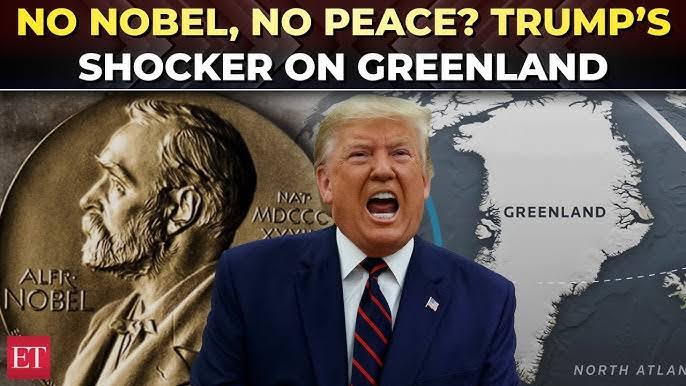
The US President wrote a letter complaining about not receiving the Nobel Peace Prize, saying that this decision is not under the Prime Minister of Norway. Today we will discuss about TrumpNorway:NoPeace,NobelSnub,GreenlandPush
TrumpNorway:NoPeace,NobelSnub,GreenlandPush
In early 2026, a dramatic diplomatic storm erupted between the United States and Norway after former U.S. President Donald Trump publicly linked his failure to receive the Nobel Peace Prize with a shift in his approach to global peace and security. What began as a symbolic grievance soon escalated into a serious geopolitical controversy involving Greenland, NATO unity, Arctic security, and the future of Western alliances.
This unprecedented episode — now widely referred to as the “Trump–Norway–Greenland confrontation” — has exposed deep tensions between personal politics and institutional diplomacy, reshaping debates about global leadership, power projection, and international norms.
The Nobel Snub That Sparked a Firestorm
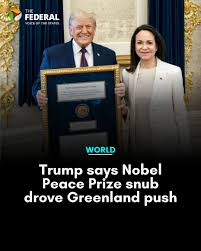
The controversy began when Trump expressed open frustration over not being awarded the Nobel Peace Prize, despite claiming credit for multiple international de-escalations and peace efforts. In a direct communication to Norway’s leadership, he reportedly argued that the lack of recognition had altered his sense of obligation toward pursuing purely peace-driven diplomacy.
Although Norway does not control the Nobel decision process — which is handled by an independent committee — the message carried symbolic weight. For many diplomats, the statement blurred the line between personal validation and national policy, raising alarms about the role of ego and grievance in high-level international decision-making.
The phrase “no peace without recognition” quickly spread across global media, interpreted as a warning that Trump’s foreign policy would now be guided less by multilateral consensus and more by strategic assertiveness.
Greenland: From Strategic Interest to Power Claim
At the heart of the escalation lies Greenland — the world’s largest island and one of the most strategically valuable territories in the Arctic. Rich in rare earth minerals, positioned along emerging polar shipping routes, and crucial for missile defense and early-warning systems, Greenland has become a focal point in the growing competition between the United States, Russia, and China.
Trump’s renewed insistence that U.S. security requires “complete control” of Greenland shocked European leaders. While the U.S. has long maintained military facilities there and close cooperation with Denmark, framing sovereignty as a necessity crossed a diplomatic red line.
This marked a shift from cooperation to coercive rhetoric, transforming Greenland from a partner territory into a strategic prize.
Norway’s Role and the Nobel Connection
Norway’s symbolic association with the Nobel Peace Prize placed it at the center of the storm. Even though the Norwegian government does not award the prize, Trump’s message made Oslo the focal point of his frustration.
Norwegian officials responded by reaffirming:
The independence of the Nobel Committee
Their commitment to international law
Full support for Denmark’s sovereignty over Greenland
They also emphasized that peace cannot be conditional on personal recognition, a statement widely interpreted as a rebuke of politicizing global institutions.
Europe Pushes Back
Across Europe, Trump’s statements triggered unified concern. Leaders warned that using economic pressure or security threats to influence territorial status would undermine the very foundations of NATO and the rules-based international order.
Several key fears emerged:
Alliance credibility: If one NATO member pressures another over territory, collective trust weakens.
Trade retaliation: Threats of tariffs or economic coercion could spiral into a transatlantic trade war.
Arctic militarization: Greenland becoming a flashpoint could accelerate arms deployment in the High North.
European capitals stressed that security in the Arctic must be achieved through cooperation, not unilateral dominance.
Greenland’s Own Voice
Perhaps the most overlooked dimension of the crisis is the perspective of Greenland itself. The island’s leadership and citizens made it clear that they reject any transfer of sovereignty and value their autonomy within the Danish realm.
Public demonstrations emphasized:
Self-determination
Respect for indigenous rights
Opposition to being treated as a bargaining chip between great powers
For Greenlanders, the issue is not merely strategic — it is existential.
Arctic Power Politics and the China–Russia Factor
Trump justified his Greenland push by pointing to the growing presence of China and Russia in Arctic affairs. Melting ice has opened new shipping lanes, while untapped resources have drawn global interest.
The U.S. sees Greenland as:
A shield against Russian missile trajectories
A counterweight to Chinese investment expansion
A cornerstone of Arctic dominance
Yet European allies argue that collective defense frameworks already address these concerns without challenging sovereignty.
Personality Politics vs Institutional Order
What makes this episode historically significant is not only its geopolitical implications, but its psychological and institutional dimensions.
The linkage of:
A personal award (Nobel Prize)
A sovereign territory (Greenland)
A military alliance (NATO)
represents a fusion of personal grievance with strategic doctrine. Analysts warn this sets a dangerous precedent, where symbolic slights could influence real-world power calculations.
Economic Fallout and Trade Tensions
Following the rhetoric, threats of new tariffs and economic pressure on European nations intensified fears of:
Supply chain disruption
Retaliatory trade barriers
Financial market instability
Business leaders cautioned that political brinkmanship could spill into economic confrontation, weakening transatlantic growth and investor confidence.
What Lies Ahead
Several scenarios now loom:
1. Diplomatic Reset
Quiet negotiations could de-escalate tensions, reaffirm NATO solidarity, and separate Nobel symbolism from strategic policy.
2. Arctic Militarization
If rhetoric hardens, the Arctic could become a new theater of military posturing, with Greenland at its center.
3. Alliance Recalibration
Europe may accelerate efforts toward strategic autonomy, reducing dependence on unpredictable U.S. leadership.
4. Institutional Safeguarding
Global bodies may strengthen protections against politicization of awards, treaties, and multilateral norms.
Conclusion
The Trump–Norway–Greenland episode is more than a dispute over a prize or an island. It reflects a deeper transformation in world politics, where:
Personal recognition collides with institutional legitimacy
Strategic ambition challenges legal sovereignty
Great-power competition redefines alliance trust
Whether this moment becomes a temporary storm or a turning point in transatlantic relations will depend on how leaders reconcile power, pride, and principle in the months ahead.
How useful was this post?
Click on a star to rate it!
Average rating 0 / 5. Vote count: 0
No votes so far! Be the first to rate this post.
About the Author

usa5911.com
Administrator
Hi, I’m Gurdeep Singh, a professional content writer from India with over 3 years of experience in the field. I specialize in covering U.S. politics, delivering timely and engaging content tailored specifically for an American audience. Along with my dedicated team, we track and report on all the latest political trends, news, and in-depth analysis shaping the United States today. Our goal is to provide clear, factual, and compelling content that keeps readers informed and engaged with the ever-changing political landscape.