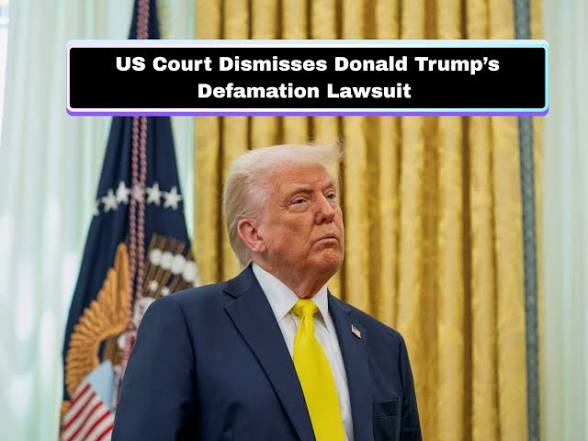
Trump Davos 2026: U.S. dominance push, Greenland remark sparks Europe tensions
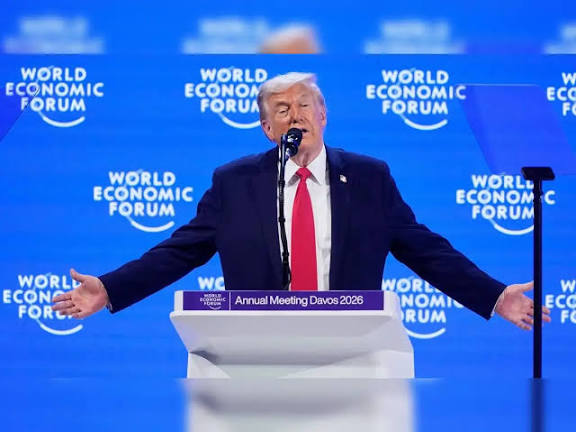
In a fiery speech, the president mocked European allies, criticized NATO and argued that the alliance should not hinder American ambitions. Today we will discuss about Trump Davos 2026: U.S. dominance push, Greenland remark sparks Europe tensions
Trump Davos 2026: U.S. dominance push, Greenland remark sparks Europe tensions
In a speech that reverberated across global political and economic circles, U.S. President Donald J. Trump delivered a high-stakes address at the World Economic Forum (WEF) that fused economic nationalism, geopolitical ambition, and blunt criticism of long-standing Western allies. While Trump articulated a sweeping vision for American ascendancy on the world stage, one remark — his call for control of Greenland — quickly overshadowed much of the forum’s proceedings and sparked tensions with Europe.
A Strategic Return to Davos
Trump’s appearance in Davos marked his most consequential foreign speech of 2026. Arriving amid widespread anticipation, he stepped onto the global stage with a message that was unapologetically centered on U.S. dominance, both economic and geopolitical. The president declared America as the “economic engine of the planet,” contrasting U.S. strength with what he characterized as Europe’s faltering trajectory.
While such rhetoric is familiar from Trump’s earlier years in office, the starkness of his language — especially regarding Europe — was remarkable even by historical standards. At several points, Trump did not merely promote American success; he openly critiqued allied policies and suggested that Europe was “not heading in the right direction,” citing issues like immigration, economic policy, and energy choices as part of his critique.
Economic Nationalism at the Core
Before delving into geopolitics, Trump spent considerable effort underscoring the strength of the U.S. economy. He touted robust growth figures, strong investment flows, and declining inflation — framing these as evidence of the success of his administration’s policies. “When America booms, the entire world booms,” Trump told the Davos audience, positioning the United States as indispensable to global prosperity.
Central to Trump’s economic vision was a renewed emphasis on tariffs and trade leverage. He reiterated his belief that tariffs are powerful tools for compelling better deals and rebalancing global trade dynamics. While claiming credit for improvements in the U.S. trade deficit, he also issued a stark warning: nations that resisted U.S. strategic initiatives — particularly his controversial Greenland push — could face escalating tariffs.
Trump’s stance triggered immediate reactions from business leaders and markets. Some expressed concern that aggressive trade policies could introduce uncertainty into global supply chains, while others acknowledged the need for the United States to assert its economic priorities more clearly.
Greenland: From Historical Footnote to Diplomatic Rift
The most explosive element of Trump’s Davos speech was his assertion that the United States should pursue control of Greenland — a vast Arctic territory that is part of the Kingdom of Denmark.
Trump invoked historical arguments, suggesting the United States had ceded Greenland “unwisely” after World War II and that its geographic and strategic location made it a natural fit for American security interests. While he insisted that the United States would not use military force to secure Greenland, his language underscored a determined push for negotiations or a transfer of control — a stance that quickly ignited diplomatic backlash.
In his address, Trump emphasized that Greenland’s strategic importance was tied to defense infrastructure and Northern Hemisphere security. He referenced a future missile defense system and suggested that U.S. control would benefit NATO’s collective security posture.
Europe Pushes Back
European reactions to Trump’s Greenland remarks were swift and sharp. Leaders across the continent, from Denmark to France and the United Kingdom, made clear that Greenland’s sovereignty was not up for negotiation.
Denmark, the sovereign nation responsible for Greenland’s foreign affairs and defense, reaffirmed its jurisdiction, stressing that Greenland is not for sale and remains a vital part of the Danish realm and the NATO alliance. Greenland’s own leaders and citizens also voiced resistance, underscoring that any external claims on the territory are unacceptable.
European responses were not limited to diplomatic statements. There were indications that the European Union was prepared to deploy economic countermeasures in response to U.S. pressure, including tariff preparations or restrictions on American goods and services if Washington escalated tensions.
French President Emmanuel Macron and other European officials criticized the notion of perceived U.S. territorial ambitions as bordering on “neo-colonialism,” further complicating transatlantic relations. Though NATO remains active as a security alliance, the Greenland episode threatened to deepen mistrust between the United States and its closest allies.
NATO, Sovereignty, and Strategic Priorities
Trump’s Greenland push also injected new strains into longstanding debates over NATO burden-sharing and alliance cohesion. Throughout his address, Trump reiterated his view that European nations had been insufficiently committed to defense spending and security coordination — an argument he has made repeatedly in past years.
But by tying Greenland to broader criticisms of NATO contributions, Trump’s message resonated differently. Rather than a technical discussion about military budgets, his remarks raised fundamental questions about sovereignty, strategic ambition, and alliance structures in a rapidly evolving global environment.
Several NATO officials — both within and outside the United States — expressed concern that the Greenland controversy could distract from collective priorities such as countering Russian aggression, managing China’s rise, and addressing cyber and space security threats. For an alliance built on shared values and mutual defense, the notion of one member seeking territorial control over land belonging to another poses a potentially destabilizing precedent.
Global Reaction and Broader Implications
Beyond Europe and NATO, Trump’s speech sparked reactions in other regions as well. Some global leaders welcomed America’s assertive outlook on security and economic issues, while others stressed the importance of cooperation over unilateral demands.
Critics argued that Trump’s rhetoric risked undermining global norms that have governed international relations since the end of World War II, particularly regarding sovereignty and territorial integrity. Supporters countered that existing international arrangements have sometimes hindered decisive action and that U.S. leadership was essential in resetting global dynamics to address emerging challenges such as Arctic competition and great-power rivalry.
In markets, analysts noted that the immediate focus on tariffs and trade conflicts could introduce volatility in key sectors, especially energy and manufacturing. Meanwhile, geopolitical strategists pointed to the broader implications of Trump’s Greenland emphasis — including the importance of Arctic resources, shipping lanes opening due to climate change, and the escalating contest for influence in polar regions.
The Arctic at the Center of 21st-Century Geopolitics
Trump’s elevation of Greenland to a central issue reflects a broader trend in global geopolitics: the Arctic has become a focal point for strategic competition. As melting ice opens new shipping routes and access to valuable minerals, nations including Russia, China, Canada, and the United States are recalibrating their interests in the region.
For Trump, Greenland was not merely symbolic. It represents a strategic nexus between defense, energy, and economic interests — a place where U.S. policy could shape the next chapter of geopolitical competition. Yet the strong European response highlighted that even strategically driven ambitions must contend with deeply rooted principles of sovereignty and international cooperation.
Conclusion: A Turning Point at Davos
The 2026 World Economic Forum in Davos may be remembered not for a consensus on global governance or shared prosperity, but as a moment of sharp confrontation — one where U.S. assertiveness collided with European sovereignty concerns.
Trump’s address reaffirmed his vision of American dominance, but the intense focus on Greenland shifted the conversation from economic cooperation to transatlantic diplomatic turbulence. Whether this episode will lead to a realignment of alliances, renegotiation of strategic priorities, or a cooling of tensions remains uncertain. What is clear, however, is that the echoes of Davos 2026 will extend far beyond the Alpine slopes — shaping debates about global order, alliance loyalty, and the future of international cooperation.
How useful was this post?
Click on a star to rate it!
Average rating 0 / 5. Vote count: 0
No votes so far! Be the first to rate this post.
About the Author

usa5911.com
Administrator
Hi, I’m Gurdeep Singh, a professional content writer from India with over 3 years of experience in the field. I specialize in covering U.S. politics, delivering timely and engaging content tailored specifically for an American audience. Along with my dedicated team, we track and report on all the latest political trends, news, and in-depth analysis shaping the United States today. Our goal is to provide clear, factual, and compelling content that keeps readers informed and engaged with the ever-changing political landscape.