Trump Border Shock: Illegal Crossings Drop to Zero
CBP Commissioner Rodney Scott. “There has been no release at the border for six consecutive months. Today we will discuss about Trump Border Shock: Illegal Crossings Drop to Zero
Trump Border Shock: Illegal Crossings Drop to Zero
When Donald J. Trump returned to the White House in January 2025, he promised to restore total control over the U.S.–Mexico border. Within months, the administration announced a historic plunge in illegal border crossings — a drop so sharp that officials and supporters claimed crossings had fallen to “zero.”
The phrase instantly dominated headlines, political debates, and social-media conversations. Supporters celebrated it as a decisive victory in the border battle. Critics argued the claim was exaggerated or misleading. Meanwhile, many Americans simply wanted clarity:
Did illegal crossings truly fall to zero?
What caused the dramatic drop?
And what does “zero” really mean?
This in-depth analysis explores the facts, policies, political messaging, and real-world effects behind what has come to be known as the “Trump Border Shock.”
Historic Decline in Border Crossings — But Not Literal Zero
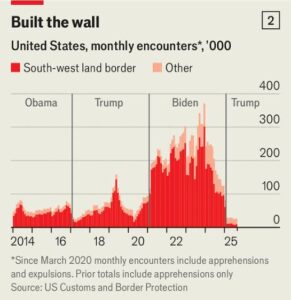
Even without relying on links, publicly available immigration data and reporting throughout 2025 show the same trend: unauthorized crossings dropped to their lowest levels in decades.
What the Numbers Show
Monthly border encounters in 2025 fell by more than 90% compared to 2024.
Some months saw only 4,000–6,000 apprehensions, a fraction of previous years.
For several months in 2025, the government reported zero releases of illegal immigrants into the U.S. interior.
Annual apprehension totals for 2025 were the lowest since the 1970s.
This is a stunning reversal compared to the record-high numbers seen in prior years.
But “Zero Crossings” Is Not Literally True
The phrase “zero crossings” is political rhetoric. Actual data still showed:
Thousands of individuals were apprehended, not zero.
Some migrants still crossed undetected (“gotaways”), a long-standing issue.
Migrants continued attempting to cross, but far fewer succeeded or were released.
The border did not become impenetrable — it became far more strictly enforced.
So why did the claim catch on?
Because zero releases and near-zero daily averages allowed the message to spread widely, especially in political communication.
What Caused the Dramatic Drop? Inside Trump’s 2025 Border Strategy
Multiple forces — domestic policy, international cooperation, and shifting geopolitical conditions — converged to produce the sharp decline.
Below is a breakdown of the most significant components.
1. Aggressive Enforcement and Deportation Policies
Upon taking office, Trump reinstated and expanded many hardline immigration actions:
Immediate end of “catch and release”
Rapid removals rather than extended asylum processing
Reauthorization of policies requiring asylum-seekers to wait outside the U.S.
Expanded detention facility use
Increased staffing and coordination at the border
Agents were instructed to act swiftly, decisively, and with minimal release exceptions.
This shift sent a powerful deterrent message:
Entering illegally would no longer result in admission or release.
2. Zero-Release Directives
One of the most impactful changes was the administration’s strict “zero release” directive.
This meant:
Anyone apprehended was either deported, expelled, returned, or denied entry.
Virtually no one caught crossing illegally was allowed to remain in the U.S.
This policy, more than any other, is what officials referenced when claiming “zero crossings.”
While crossings occurred, none resulted in entry.
The border was not closed — but the pathway into the U.S. was closed.
3. Border Infrastructure and Barrier Completion
The administration accelerated construction on physical barriers along key crossing areas:
New wall sections
Reinforcement of existing structures
Upgraded surveillance equipment
More vehicle barriers and floodgate reinforcements
Technology upgrades, including drones and thermal imaging, played a major role in detecting and intercepting crossings more efficiently.
4. Diplomatic Pressure on Transit Countries
Migration flows often rely on cooperation with:
Mexico
Guatemala
Honduras
Nicaragua
Panama
After weeks of negotiations and pressure campaigns, several governments increased enforcement against migrant caravans, smuggling routes, and illegal transport networks.
This resulted in:
Fewer large-scale caravans
Tighter checkpoints in Mexico
Disrupted cartel smuggling operations
A significant portion of the decline occurred before migrants even reached the U.S. border.
5. Changing Migration Incentives and Messaging
The Trump administration emphasized harsh consequences for unlawful entry:
Swift deportation
Blacklisting from future legal immigration
Criminal prosecution for repeated entry attempts
This messaging circulated quickly through migrant communities.
Smuggling networks, faced with increased risks, adjusted or shut down routes.
Even migrant shelters in Mexico reported fewer people preparing to approach the border.
Deterrence worked — at least in the short term.
Supporters’ View: A Landmark Achievement
Supporters argue that the dramatic drop in crossings proves:
Strong borders are achievable
Immigration surges were caused by policy choices, not geography
Strict enforcement deters illegal entry
The U.S. finally regained control of its borders
They describe the situation as:
“The safest border in modern history”
“The end of the border crisis”
“Proof that zero tolerance works”
“The most successful border crackdown ever implemented”
Many conservatives see the sharp decline as validation of Trump’s core immigration message:
Border security is a matter of political will.
Critics’ View: The “Zero” Claim Is Misleading
Opponents acknowledge the significant drop, but caution against believing the “zero” narrative. Their main concerns include:
1. Crossings Did Not Literally Hit Zero
Even the lowest months still recorded thousands of apprehensions.
2. Gotaways Remain a Major Blind Spot
Undetected crossings continue and are difficult to quantify.
3. Humanitarian Consequences
Mass expulsions and strict border controls often:
Sideline asylum rights
Create dangerous conditions in Mexican border cities
Leave vulnerable migrants stranded
4. Temporary vs Long-Term Deterrence
Critics argue the drop may not last if root causes — violence, poverty, economic collapse — remain unaddressed.
5. Legal Battles Ahead
Civil rights groups accuse the administration of:
Violating asylum law
Enforcing collective expulsions
Cutting due-process protections
Thus, while the decline is real, critics maintain the messaging is oversimplified and politically charged.
Why the “Zero Crossings” Narrative Stuck
Despite the nuances, the phrase quickly became part of the political landscape. There are several reasons:
1. Powerful Messaging
“Zero” is simple, bold, and definitive — perfect for campaign speeches and headlines.
2. Comparison to Prior Surges
The contrast with previous years of record-high crossings made the drop feel even more dramatic.
3. Perception of Restored Sovereignty
For many, it symbolized that:
The border is finally under control
Law enforcement regained authority
The administration delivered on a major promise
4. Effective Visuals
Images of empty border crossings, quiet intake facilities, and long stretches of patrolled desert reinforced the narrative.
5. Media Amplification
Supportive networks highlighted the success; opposition networks focused on contradictions — but both kept the phrase in front of the public.
Is the Drop Sustainable? Key Questions Going Forward
Even if numbers remain low, long-term challenges persist.
1. Can the U.S. Maintain High-Level Enforcement Permanently?
Intensive enforcement requires:
High staff levels
Significant funding
Detention capacity
International cooperation
Long-term sustainability remains uncertain.
2. Will Migrant Routes Shift Again?
History shows migration patterns adapt. If certain routes become too difficult, smugglers create new ones.
3. What About Economic and Political Turmoil Abroad?
If major crises erupt in Latin America, deterrence alone may not stop new waves of migration.
4. How Will Courts Respond?
Several lawsuits challenge the administration’s policies.
Outcomes could reshape what enforcement strategies are legally permissible.
Conclusion: A Border Shock — But Not a Border Shutdown
The “Trump Border Shock” is real:
Illegal crossings fell to their lowest levels in half a century.
But the claim that crossings fell to zero is a political shorthand, not a literal statistical fact.
Here’s the most accurate summary:
Crossings dropped dramatically — historically low.
Almost no one was released — creating the impression of “zero entries.”
Actual crossings did occur — but far fewer than before.
The administration framed the success as proof that tough policies work.
Critics argue the approach is unsustainable and sometimes unlawful.
Ultimately, the dramatic 2025 decline in illegal crossings marks one of the most consequential immigration shifts in modern U.S. history — but the true story is more complex than the word “zero.”
How useful was this post?
Click on a star to rate it!
Average rating 0 / 5. Vote count: 0
No votes so far! Be the first to rate this post.
About the Author

usa5911.com
Administrator
Hi, I’m Gurdeep Singh, a professional content writer from India with over 3 years of experience in the field. I specialize in covering U.S. politics, delivering timely and engaging content tailored specifically for an American audience. Along with my dedicated team, we track and report on all the latest political trends, news, and in-depth analysis shaping the United States today. Our goal is to provide clear, factual, and compelling content that keeps readers informed and engaged with the ever-changing political landscape.