Supreme Court Shock: New Immigration Rule Drops, Millions Stunned
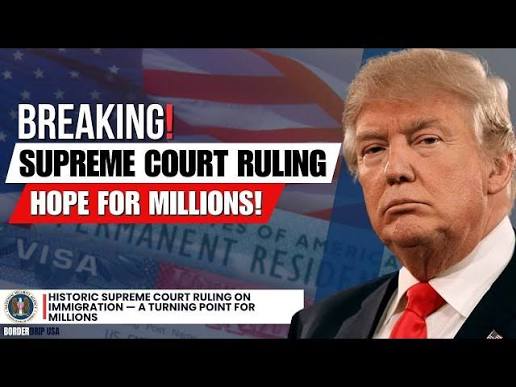
High Court rules that immigrants protected from deportation due to conditions in their homeland are not eligible for green cards. Today we will discuss about Supreme Court Shock: New Immigration Rule Drops, Millions Stunned
Supreme Court Shock: New Immigration Rule Drops, Millions Stunned
In 2025, the United States finds itself amid one of the most dramatic overhauls of immigration policy in decades — and at the center of the storm is the Supreme Court. A series of rulings from the high court have rapidly altered the legal status of hundreds of thousands of migrants, stripped away temporary protections, and cleared the way for aggressive deportations. For many immigrants — including long-term residents, asylum seekers, and children born in the United States — the consequences have been profound: legal limbo, fear, and uncertainty about their future in a country they called home. For millions worldwide, the implications are equally stark. In effect, the Supreme Court has become the fulcrum for a seismic shift in how America treats newcomers.
What Changed: Key Supreme Court Decisions

End of Parole & Temporary Legal Status for Over 500,000 Migrants
In a landmark ruling in May 2025, the Supreme Court allowed the U.S. government to revoke temporary legal status — often referred to as “parole” — for more than 500,000 migrants, primarily from Cuba, Haiti, Nicaragua, and Venezuela.
This “parole” status, granted under previous administrations for humanitarian reasons, permitted migrants to live and work legally in the United States for a fixed period. With the Court’s decision, the protections disappeared overnight — potentially making these people eligible for deportation while their legal claims remain unresolved in court.
For many, this means immediate crisis: loss of jobs, housing, and stability. Immigrant advocates have described the ruling as “the largest mass-illegalization event in modern American history.”
Broader Deportation Powers — Deportations to Third Countries Resumed
In another major move, the Court on June 23, 2025, cleared the way for the government to resume deporting migrants to “third countries” — that is, countries other than their countries of origin — without first giving them a chance to raise fears of torture, persecution, or death.
This overturns a lower-court injunction that had sought to ensure due process for vulnerable asylum seekers and migrants at risk. The Supreme Court’s short order — unsigned, specific reasoning withheld — triggered strong dissent from its liberal justices, who warned that the decision strips migrants of fundamental protections.
One immediate effect: individuals detained far from the U.S. (for example, at naval bases in foreign countries) are now vulnerable to expedited removal — sometimes to war-torn or unstable nations.
Systemic Shift in Judicial Oversight — Limits on Nationwide Injunctions
A less-noticed, but equally important, shift came via the ruling in Trump v. CASA, Inc. (2025). The Supreme Court determined that lower courts should not be allowed to issue “universal” nationwide injunctions blocking federal policies; instead, such injunctions should apply only to the specific plaintiffs in a case.
This matters because many previous challenges to immigration-related executive actions relied on nationwide injunctions to block enforcement across all jurisdictions. With this barrier removed, the federal government faces fewer legal obstacles to implementing sweeping immigration policies — even while litigation continues.
Potential Future Shock: Birthright Citizenship Under Review
Beyond deportations and status revocations, the Court has also weighed in on the issue of citizenship by birth. The High Court has agreed to review whether children born on U.S. soil to undocumented immigrants or temporary visa-holders should continue to be granted automatic citizenship under the 14th Amendment.
While no final ruling has yet been issued, the very fact that the Court has taken up the case has sent waves of fear through immigrant communities — and ignited global debate about what it means to be “American.”
Why the Rulings Are “Shocking”: Scale, Speed, and Legal Ramifications
A Scale of Impact Rarely Seen
Few immigration episodes in U.S. history have affected so many people so quickly. Over half a million migrants lost legal work and residency status overnight. Added to that are thousands more now exposed to rapid deportation under third-country removal rules. The potential ripple effects — on communities, families, workplaces, and local economies — are vast and unpredictable.
Undermining Stability & Legal Predictability
Temporary protections like parole or humanitarian programs often gave migrants a semblance of stability: permission to work, to raise families, to rebuild lives. The Court’s decision removed that stability retroactively. For migrants who arrived legally but fled danger or instability in their home countries, or who entered under humanitarian grounds, the abrupt reversal creates a climate of fear.
Furthermore, with the Court restricting nationwide injunctions, many immigrant-rights organizations find themselves in a legal maze: class-action lawsuits or widespread blocks may no longer be viable. Instead, each individual or family might have to fight their case separately — a daunting, resource-intense prospect.
Redefining the Boundaries of Presidential Authority
These rulings reflect a broader judicial deference to executive authority over immigration. By lifting judicial constraints — whether on deportations, status revocations, or third-country removals — the Court is effectively granting the government wide discretion. Critics argue this undermines the constitutional principle of due process and weakens judiciary oversight over immigration enforcement.
At the same time, the acceptance of challenges to birthright citizenship suggests the Court is willing to revisit foundational constitutional interpretations — a development that could reshape decades of precedent.
Human Impact: Lives on the Brink
To understand the real cost of these rulings, one must look beyond the legal texts and into human stories — families facing separation, workers losing livelihoods, children’s citizenship uncertain.
Many of the 532,000 migrants affected by the parole-termination lived in U.S. cities for years — working in health care, hospitality, agriculture, construction. With legal protections gone, they face deportation or precarious undocumented status.
Some families, previously stable under humanitarian parole, now must scramble to find legal recourse or risk losing everything.
As deportations to third countries resume, migrants — including asylum seekers and those fleeing persecution — have little opportunity to contest removal. Some may be sent to nations where they face violence, torture, or death.
The broader immigrant community across the U.S. — undocumented or documented, long-term or newly arrived — is enveloped in fear and uncertainty. For many, the sense of belonging has evaporated overnight.
These are not isolated cases, but a systemic upheaval affecting people at mass scale.
Reactions & Criticism: Courts, Advocates, Communities
Unsurprisingly, the rulings have drawn fierce criticism — from civil-rights organizations, immigrant-advocacy groups, legal experts, and even some former officials.
In the third-country deportation decision, three liberal justices dissented bitterly.
Leading immigrant-rights advocates have described the parole-revocation decision as “devastating,” warning of massive economic and social disruption.
Some legal scholars say the rulings signal a dangerous shift: by curbing judicial oversight and empowering executive discretion, the Court may have opened the door to future abuses of power.
At the same time, supporters of stricter immigration policies — including many in the current administration — view these decisions as overdue corrections: reasserting national sovereignty over borders, reducing what they argue are burdens on public services, and deterring illegal entry or overstays.
For many Americans, especially citizens concerned about jobs, security, and resources, the rulings align with a belief that immigration had become uncontrolled or unfair. For immigrants and their allies, it feels like a betrayal.
The Global Fallout: Implications Beyond U.S. Borders
Although these rulings are U.S.-centered, their ripple effects are global:
Immigrants from around the world who looked to the U.S. as a place of refuge — fleeing war, persecution, famine, natural disasters — are now facing increased risks. The reversal of humanitarian parole status may dissuade future migration, reduce asylum flows, and increase persecution risks.
Countries receiving deported migrants — sometimes “third countries” with tenuous human rights records — may see arrivals of traumatized individuals, raising humanitarian and diplomatic challenges.
The concept of birthright citizenship — a principle enshrined in U.S. constitutional tradition since the 19th century — is under threat. If altered, it could reshape global perceptions of what it means to be an American and affect diaspora communities worldwide.
Given the number of people affected, the long-term human consequences may continue to unfold for years — in unexpected ways.
What Happens Next: Legal Battles, Activism & Uncertainty
The dust hasn’t yet settled. Several key developments remain in motion:
The birthright citizenship case is pending. The Supreme Court’s decision to review it has already sent shockwaves through immigrant and diaspora communities.
Lower courts may still hear individual challenges — especially for migrants with fear-based claims of persecution or torture. But with fewer tools like nationwide injunctions, the path to relief will likely be harder and slower.
Immigration advocates and civil-rights groups are mobilizing — offering legal aid, public awareness campaigns, and pressure on lawmakers. Still, given the speed and scale of these changes, the challenge is enormous.
On the ground, people will be making life-altering decisions: stay in the U.S. hoping for a reprieve, return to uncertain homelands, or attempt dangerous journeys elsewhere.
In short: we are entering a phase of prolonged instability, in which migrants’ legal status — and indeed their very rights — can change overnight.
Conclusion
The recent decisions by the Supreme Court mark nothing less than a turning point in U.S. immigration history. The abrupt revocation of legal status for hundreds of thousands, the restoration of broad deportation powers, the limitation of judicial oversight, and the challenge to long-standing notions of birthright citizenship — all reflect a recalibration of America’s willingness to accommodate migrants and refugees.
For immigrants, these rulings represent fear, uncertainty, and in many cases, immediate peril. For the United States as a nation, they mark a shift toward a more exclusionary, enforcement-driven model of immigration — one with uncertain moral, social, and global consequences.
As millions look on, stunned, one thing is clear: the migration landscape has been forever altered.
How useful was this post?
Click on a star to rate it!
Average rating 0 / 5. Vote count: 0
No votes so far! Be the first to rate this post.
About the Author

usa5911.com
Administrator
Hi, I’m Gurdeep Singh, a professional content writer from India with over 3 years of experience in the field. I specialize in covering U.S. politics, delivering timely and engaging content tailored specifically for an American audience. Along with my dedicated team, we track and report on all the latest political trends, news, and in-depth analysis shaping the United States today. Our goal is to provide clear, factual, and compelling content that keeps readers informed and engaged with the ever-changing political landscape.