Philippines chaos spreads: ICC Duterte order ignites political firestorm

The arrest warrant of the International Criminal Court (ICC) against former Philippine President Rodrigo Duterte has sparked a storm of reactions. Today we will discuss about Philippines chaos spreads: ICC Duterte order ignites political firestorm
Philippines chaos spreads: ICC Duterte order ignites political firestorm
In early 2025, the Philippines became the center of both intense domestic turmoil and international legal scrutiny when former President Rodrigo Duterte was arrested and sent to the International Criminal Court (ICC) in The Hague to face charges of crimes against humanity. What might have been construed as a purely judicial decision instead triggered seismic political, social, and diplomatic aftershocks — rippling across the archipelago and beyond. The fallout exposed deep fractures within Philippine politics, inflamed polarized public opinion, and reignited debates about sovereignty, justice, and national identity.
Background: From Anti‑Drug War to ICC Arrest
Rodrigo Duterte’s presidency (2016–2022) was defined by a controversial “war on drugs” that claimed thousands of lives, primarily among urban poor communities. While official figures cited around 6,000 killings, human rights groups insist the real toll exceeds 30,000 extrajudicial deaths, with systematic abuses that may qualify as crimes against humanity.
In response, the ICC opened a formal investigation into alleged abuses committed during Duterte’s term. Although the Philippines withdrew from the ICC’s founding treaty, the Rome Statute, in 2019, the court still retained jurisdiction over crimes committed while the country was a member.
In March 2025, Philippine authorities acting on an ICC arrest warrant facilitated through Interpol apprehended Duterte at Manila’s main airport as he returned from Hong Kong. He was subsequently flown to The Hague to face charges tied to extrajudicial killings and abuses linked to his anti‑drug campaign.
Explosive Reactions: Nation Divided
The arrest ignited a political firestorm that cut across traditional political fault lines and social media networks, transforming what seemed like a judicial procedure into a national crisis.
Supporters: Sovereignty and “People Power”
Duterte’s supporters responded with alarm, framing the arrest as an attack on national sovereignty. Many rallied online and in public spaces, insisting that cooperation with the ICC undermined the Philippines’ independence and legal autonomy — especially given the nation’s formal withdrawal from the ICC in 2019.
Prominent government critics and Duterte loyalists called on citizens to exercise democratic rights, urging public demonstrations to defend not just Duterte, but the broader principle of Filipino self‑determination. Some echoed and amplified claims that the arrest amounted to an illegal “kidnapping” orchestrated by foreign powers — a narrative that rapidly proliferated across thousands of social media accounts.
This digital campaign — with repeated verbal framing and identically copied posts — demonstrates how information operations and online narratives have become central to political mobilization in the Philippines. Whether coordinated or organic, these posts were instrumental in shaping public perceptions and fostering distrust, particularly among Duterte’s die‑hard supporters.
Critics: Justice, Accountability, and Rule of Law
Human rights organizations, legal experts, and critics of Duterte’s tenure saw the arrest as a historic step toward accountability and an affirmation of international justice mechanisms. Groups described Duterte’s detention and transfer to The Hague as “long‑overdue” and a victory against impunity for state‑sanctioned abuses.
Many voices within and outside the Philippines argued that holding a former head of state accountable at the ICC could become a precedent for victims of serious abuses globally, potentially strengthening international criminal justice. Advocates contend this could signal a shift away from unchecked executive power — especially in countries where internal legal systems have failed to prosecute major abuses.
Political Earthquake: The Chaos Within
The reverberations of the ICC arrest extended well beyond legal circles, shaking the very foundations of Philippine political life.
Government and Institutional Responses
President Ferdinand “Bongbong” Marcos Jr., who succeeded Duterte’s administration, faced intense scrutiny over his government’s role in facilitating the arrest. Marcos defended the legal procedures and insisted that Philippine authorities complied with applicable processes, including cooperation through Interpol.
Still, opposition lawmakers and some members of his political bloc called for a senate inquiry into how the arrest was conducted and whether Philippine sovereignty had been compromised. These calls reflected broad concern within the political establishment — not limited to Duterte loyalists — about the legal and diplomatic ramifications of the ICC order.
Political Dynasties at Odds
The Duterte arrest exacerbated tensions between two powerful political families: the Dutertes and the Marcoses. Initially allies — even political partners — the relationship deteriorated sharply in the months leading up to the arrest. Analysts have speculated that this rift influenced the Marcos administration’s decision to cooperate with the ICC, marking an unprecedented break in their political alliance.
This intra‑elite conflict has intensified the perception that Philippine politics remains dominated by clan rivalries rather than issue‑based governance — with ordinary citizens often caught in the crossfire.
Social Polarization and Public Discourse
Perhaps one of the most striking consequences of the ICC arrest has been the deepening of social polarization — especially in public discourse and online interaction.
Misinformation, Memes, and Narrative Battles
The incident ignited a ferocious struggle over narratives. Within hours of the arrest, hundreds of coordinated social media posts framed it as an illegal “kidnapping,” flying in the face of legal realities. This campaign exploited gaps in public understanding of international law and judicial processes, while also mobilizing emotional responses rooted in nationalist sentiment.
Fact‑checking experts warned that such misinformation does not simply confuse the public; it poisons civic discourse, making it harder for citizens to engage with complex legal and policy issues on an informed basis.
Protests and Demonstrations
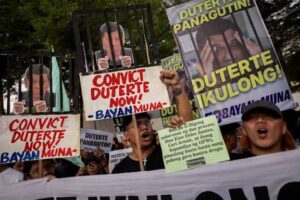
On the ground, protests and demonstrations erupted across multiple cities, with supporters of Duterte calling for his release and denouncing the Marcos administration. These rallies, some of which have persisted for months, illustrate how a legal case at the ICC has translated into sustained civil mobilization within the Philippines.
These movements are not limited to Duterte loyalists — they reflect broader frustrations with political corruption, elite dominance, and perceived inequities in the judicial system.
Legal and Sovereignty Debates
Central to the firestorm are debates over Philippine sovereignty and the legitimacy of international legal authority.
Critics of the ICC’s involvement argue that since the Philippines is no longer a member of the ICC, any warrant for arrest is invalid under domestic law and represents an intrusion on national jurisdiction. They point to the 2019 withdrawal from the Rome Statute as evidence that foreign judicial bodies have no standing in Philippine legal affairs.
Legal experts, by contrast, highlight that international justice instruments often retain jurisdiction over crimes committed while a country was still a signatory. The ICC’s authority in such cases — though contested — is widely recognized in international law.
This legal tension underscores the broader challenge facing the Philippines: reconciling national law with international commitments and norms — particularly in cases involving grave human rights violations.
Political and Election Season Turbulence
The timing of the ICC arrest coincided with critical phases of the 2025 Philippine elections, adding volatile momentum to an already contentious campaign season. Candidates and political parties quickly aligned with either “pro‑justice” or “pro‑sovereignty” narratives, hoping to harness public sentiment for electoral gain.
For some politicians, the arrest was an opportunity to decry corruption and call for systemic reforms. Others used it as a rallying cry against perceived external interference, seeking to mobilize nationalist fervor among voters.
This dynamic has injected new unpredictability into the electoral landscape, with analysts warning that the political chaos ignited by the ICC order could shape Filipino politics for years to come.
International Implications
Beyond domestic politics, Duterte’s arrest has significant global reverberations.
International human rights advocates hailed the ICC’s action as a vindication of global justice mechanisms, particularly at a time when many powerful states remain immune from international scrutiny. Such enforcement sends a powerful message about accountability — even for high‑profile leaders.
However, critics worry that reliance on external courts may deepen geopolitical tensions, especially in regions where nationalist movements and sovereignty concerns run deep. The Philippines — historically wary of foreign influence due to its colonial past — is emblematic of this struggle.
Looking Forward: Stability or Continued Chaos?
The Philippines now stands at a crossroads. On one path lies the possibility of structural reform and stronger alignment with global justice norms. On the other, the political firestorm sparked by Duterte’s ICC arrest might fuel continued instability, polarization, and erosion of public trust in institutions.
Key indicators to watch include:
How the Philippine government manages fallout from ongoing protests and political division.
Whether the Marcos administration will rejoin the ICC — a move some see as critical for enhancing the country’s international legal standing.
Long-term effects on electoral politics, including whether voters will punish or reward parties associated with either side of the Duterte arrest narrative.
Impacts on the broader Southeast Asian region, where concerns about sovereignty and international intervention are also highly sensitive.
Conclusion
What began as a legal action by the International Criminal Court has become a catalyst for profound political turbulence in the Philippines. The arrest of Rodrigo Duterte — a leader both reviled and revered — has revealed the deep divisions in Filipino society and brought into sharp relief the country’s struggle to balance sovereignty, justice, and democratic governance. Whether this moment ultimately leads to accountability and reform, or deeper factional chaos, remains one of the most consequential questions in contemporary Philippine history.
How useful was this post?
Click on a star to rate it!
Average rating 0 / 5. Vote count: 0
No votes so far! Be the first to rate this post.
About the Author

usa5911.com
Administrator
Hi, I’m Gurdeep Singh, a professional content writer from India with over 3 years of experience in the field. I specialize in covering U.S. politics, delivering timely and engaging content tailored specifically for an American audience. Along with my dedicated team, we track and report on all the latest political trends, news, and in-depth analysis shaping the United States today. Our goal is to provide clear, factual, and compelling content that keeps readers informed and engaged with the ever-changing political landscape.