Mikie Sherrill : New Jersey Power Shift, Cost Relief, Political Shock
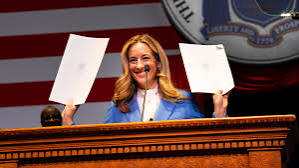
Democrat Mickey Sherrill was sworn in as the 57th Governor of New Jersey on January 20, 2026, after a decisive 14-point victory in 2025. Today we will discuss about Mikie Sherrill : New Jersey Power Shift, Cost Relief, Political Shock
Mikie Sherrill : New Jersey Power Shift, Cost Relief, Political Shock
Mikie Sherrill, a name once familiar mainly in congressional circles, has rapidly become one of the most consequential political figures in New Jersey. Her rise from military pilot to U.S. Congresswoman and now Governor of New Jersey marks a transformative power shift in Garden State politics. Sherrill’s leadership and policy agenda—especially her focus on cost relief and structural reforms—have ignited both enthusiasm and controversy across political lines. In this article, we explore her background, her policy priorities, and the broader political impact of her administration.
1. From Naval Helicopter Pilot to Governor: A Life of Service
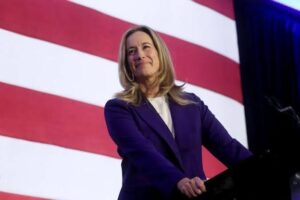
Rebecca Michelle “Mikie” Sherrill’s journey into public service began long before she entered the political fray. Born on January 19, 1972, she was driven from an early age by a deep commitment to serving her country—a commitment that led her to the United States Naval Academy, where she was part of the first class of women eligible for combat roles. After graduating in 1994, she spent nearly a decade as a Navy helicopter pilot, flying critical missions throughout Europe and the Middle East. Beyond aviation, she served as a Russian policy officer, working on nuclear treaty implementation and coordinating naval relations with the Russian Federation.
After leaving the Navy, Sherrill expanded her expertise with a Master’s in Global History from the London School of Economics and a Juris Doctor degree from Georgetown University. She served as a federal prosecutor in New Jersey, focusing on outreach and reentry programs that helped communities recover from crime and injustice.
Her career—spanning military, legal, and public service—set the stage for her political ascent, giving her a unique blend of leadership skills and policy knowledge that would later define her political identity.
2. A Congressional Career Marked by Bipartisanship and Effectiveness
Sherrill’s political profile rose significantly when she was first elected to represent New Jersey’s 11th Congressional District in 2018, flipping a long-held Republican seat. Over multiple terms in the House of Representatives, she became known for her bipartisan approach and focus on practical governance. The Common Ground Committee ranked her as one of the most bipartisan members of Congress, placing her in the top five percent of all U.S. legislators for working across the aisle.
During her time in Congress, Sherrill championed issues such as infrastructure investment, tax fairness (including advocacy for restoring the State and Local Tax — SALT — deduction cap relief), and lowering healthcare costs. Her legislative efforts sought to balance Democratic priorities with pragmatic solutions, a positioning that helped her appeal to moderate and independent voters alike.
3. The 2025 Gubernatorial Campaign: A New Chapter for New Jersey
In 2024, Sherrill announced her bid for governor of New Jersey, framing her campaign as a response to rising costs that strained households across the state. She positioned herself as a leader capable of tackling affordability issues—from healthcare and childcare to housing and energy bills. Her campaign drew on her record in Congress as well as her promise to bring results back home.
Sherrill weathered a competitive Democratic primary field and secured her party’s nomination. In the general election, she faced Republican Jack Ciattarelli, who had embraced former President Donald Trump’s endorsement—a factor that became a defining contrast in the campaign. President Trump publicly criticized Sherrill, calling her policies “terrible” and warning that her approach could hurt New Jersey’s economy.
Despite fierce political attacks, Sherrill won decisively, marking a historic moment for the state. Her victory ensured a third consecutive Democratic gubernatorial term in New Jersey—a feat not seen since the early 1960s.
4. A Power Shift in Trenton: Immediate Priorities and Executive Actions
Sherrill’s inauguration as New Jersey’s 57th governor on January 20, 2026, came with decisive action. Breaking swiftly into governance, she signed a series of executive orders aimed at addressing urgent issues facing New Jersey residents. Two of these orders declared a state of emergency in response to rapidly rising utility costs—an initiative designed to create immediate financial relief for households struggling with high energy bills.
The first order gives the state’s Board of Public Utilities broader authority to freeze electricity rates and consider rate adjustments that protect consumers. The second order is focused on accelerating clean energy projects and reducing regulatory barriers that have slowed infrastructure upgrades. Sherrill also formed a Nuclear Power Task Force to explore expanding nuclear energy as a reliable and cost-effective source of electricity.
These early moves reflect a willingness to use executive power aggressively to address cost pressures, but they also sparked debate. Critics argue that rate freezes may distort market signals and create long-term supply issues. Supporters counter that immediate relief is necessary while the state invests in modernizing its energy grid.
5. Tackling the Cost of Living: Policy Agenda for Relief
Central to Sherrill’s governance is a broad agenda focused on cost relief for New Jersey families. Rising costs for housing, healthcare, childcare, and energy have burdened the middle class, and Sherrill’s policy suite aims to alleviate these pressures through targeted reforms:
Energy and Utilities
Sherrill has emphasized that lowering energy costs requires both short-term relief and long-term infrastructure improvements. Her emergency order on utility costs is paired with initiatives to fast-track solar, battery storage, and nuclear projects to increase supply and reduce consumer prices.
Healthcare Transparency and Affordability
As governor, she plans to mandate greater transparency in healthcare pricing. This includes requiring insurers to justify premium increases and exploring state-level drug price negotiations—measures aimed at reducing both insurance costs and out-of-pocket expenses for families.
Tax Credits and Economic Support
Sherrill supports expanding the Child Tax Credit and Earned Income Tax Credit to reduce the tax burden on working families. She also backs a sales tax holiday for school supplies and tax incentives for housing and childcare affordability.
Housing and Childcare
Recognizing that affordable housing is a key part of economic security, her plans include tax incentives and loans for home construction and assistance programs for first-time home buyers. Efforts to train more childcare professionals and expand universal pre-K also form part of her cost-relief agenda.
These policy commitments illustrate a comprehensive approach to cost relief—not just temporary fixes, but structural reforms designed to make life more affordable for New Jersey’s residents.
6. Political Shockwaves and Opposition
Sherrill’s policies, especially on utilities and economic intervention, have not been universally embraced. Market advocates and conservative groups argue that rate freezes and increased regulation could distort energy markets and harm investment. Meanwhile, some progressive critics within her own party argue that her governance style is too conventional and insufficiently transformative on broader systemic issues.
National political dynamics have also shaped her governorship. In her inaugural address, Sherrill criticized former President Trump’s policies, portraying them as harmful to working families. This set a combative tone on national issues that resonated with many Democratic voters but also intensified partisan backlash.
The political shockwaves of her election extend beyond New Jersey. As a moderate Democrat with bipartisan credentials, Sherrill’s rise could signal a pragmatic centrist trend in the Democratic Party—a model that appeals to both urban and suburban voters in politically competitive regions.
7. Public Perception and Broader Impact
Public response to Sherrill’s first weeks in office has varied widely. Supporters praise her proactive stance on energy costs and her focus on practical issues affecting families. Critics remain skeptical of her long-term strategy and question whether executive orders are enough to solve deeply rooted structural problems.
Her emphasis on cost relief could reshape New Jersey politics by prioritizing everyday economic challenges over ideological battles. If successful, her policies may serve as a template for other states grappling with affordability crises.
Conclusion: A Governor for Changing Times
Mikie Sherrill’s evolution from Navy pilot to governor encapsulates a dramatic power shift in New Jersey politics. Her leadership now stands at the intersection of pragmatic reform, cost-focused governance, and strategic political positioning. At a time when economic pressures weigh heavily on families, her policy agenda aims to provide relief and restructure how government responds to affordability challenges.
As her governorship unfolds, Sherrill’s efforts will be judged not just by her decisive executive actions, but by their impact on the lives of the people she pledged to serve—a test that could define her political legacy for years to come.
How useful was this post?
Click on a star to rate it!
Average rating 0 / 5. Vote count: 0
No votes so far! Be the first to rate this post.
About the Author

usa5911.com
Administrator
Hi, I’m Gurdeep Singh, a professional content writer from India with over 3 years of experience in the field. I specialize in covering U.S. politics, delivering timely and engaging content tailored specifically for an American audience. Along with my dedicated team, we track and report on all the latest political trends, news, and in-depth analysis shaping the United States today. Our goal is to provide clear, factual, and compelling content that keeps readers informed and engaged with the ever-changing political landscape.