Martial Law Panic : viral rumors surge, Trump unrest talk, US legal reality cla
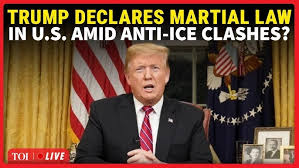
Viral rumors of martial law being imposed in the United States are false; No such declaration is currently in effect, and the U.S. Today we will discuss about Martial Law Panic : viral rumors surge, Trump unrest talk, US legal reality cla
Martial Law Panic : viral rumors surge, Trump unrest talk, US legal reality cla
In recent months, social media platforms have been flooded with alarming claims that the United States is on the brink of martial law. Viral videos, dramatic captions, and sensational headlines warn of military takeovers, suspended elections, and the collapse of civilian government. Much of this panic has been fueled by political tensions, talk of civil unrest, and references to emergency powers under past and present administrations, particularly involving former President Donald Trump.
While such rumors generate massive engagement and fear, the actual legal and constitutional reality of martial law in the United States is far more complex, limited, and restrained than what viral content suggests. Understanding the difference between speculation and law is essential in an age where misinformation spreads faster than facts.
This article explores why martial law panic is trending, how political unrest and Trump-era rhetoric contribute to public anxiety, and what U.S. law truly says about the possibility of military rule.
Understanding the Viral Panic
Social media thrives on urgency. Words like “lockdown,” “military takeover,” and “emergency powers” trigger emotional responses and rapid sharing. In politically divided times, even vague government actions can be interpreted as signs of something extreme.
Videos claiming “martial law is coming” often rely on:
Misinterpreted executive orders
Routine military exercises framed as domestic deployment
Historical references taken out of context
Fear-based speculation tied to elections, protests, or court rulings
The algorithmic nature of platforms favors shocking narratives, and once a rumor gains momentum, repetition creates the illusion of confirmation. This feedback loop fuels mass anxiety even when no factual basis exists.
Why Trump’s Name Is Central to the Narrative
Donald Trump’s presidency and post-presidency have been marked by unusually intense political polarization. His public discussions about “law and order,” use of federal forces during protests, and references to the Insurrection Act have made him a focal point in martial law speculation.
Supporters and critics alike often interpret his statements through extreme lenses:
Supporters fear a crackdown to “restore order”
Critics fear authoritarian overreach
Online groups amplify both interpretations for political or ideological gain
Every mention of military readiness, national emergency, or civil unrest becomes fuel for rumors that constitutional government could be replaced by force.
What Martial Law Actually Means
Contrary to popular belief, martial law is not a clearly defined switch that a president can simply flip.
In general terms, martial law refers to a temporary situation in which military authorities take over certain civilian functions when normal governance cannot operate due to extreme crisis such as war, rebellion, or total breakdown of civil order.
However:
The U.S. Constitution does not explicitly define martial law
No modern federal statute gives the president unlimited authority to impose it nationwide
Civil courts and state governments retain constitutional protections even during emergencies
Martial law is not the same as:
A national emergency
Deployment of the National Guard
Use of federal troops for disaster relief
Enforcement of curfews during riots
These actions operate under civilian control and constitutional oversight.
The Insurrection Act: Often Confused, Rarely Understood
Much of the panic centers on the Insurrection Act of 1807. This law allows the president to deploy the military within U.S. borders if state authorities cannot or will not protect constitutional rights or suppress rebellion.
However, invoking the Insurrection Act does not mean:
Civilian government is dissolved
The Constitution is suspended
Military courts replace civilian courts
Elections are cancelled
The military acts in support of civil authority, not in replacement of it. Governors, courts, and legislatures continue functioning.
Constitutional Barriers to Military Rule
The U.S. legal system contains multiple safeguards that make nationwide martial law extremely unlikely:
1. Civilian Supremacy
The military is constitutionally subordinate to elected leadership and civilian law. Even during war, civilian courts retain authority.
2. Supreme Court Precedent
Historic rulings have established that military tribunals cannot replace civilian courts where the judicial system remains operational.
3. Federalism
States retain sovereignty. A single federal declaration cannot simply override all state governments without massive legal confrontation.
4. Congressional Oversight
Emergency powers are subject to legislative limits, funding control, and judicial review.
Any attempt to impose broad martial law would trigger immediate constitutional challenges and political resistance across all branches of government.
Historical Context: When Martial Law Actually Occurred
The United States has experienced limited martial law in specific circumstances:
Civil War territories
Hawaii during World War II after Pearl Harbor
Localized state declarations during riots or natural disasters
In every case:
The scope was geographically limited
The duration was temporary
Civil authority was restored as quickly as possible
Courts later reviewed and restricted military power
There has never been a modern nationwide suspension of constitutional government.
The Psychological Roots of Fear
Martial law rumors thrive in environments of uncertainty. Economic stress, political conflict, and rapid information flow create a fertile ground for catastrophic thinking.
Common psychological drivers include:
Loss of trust in institutions
Historical memory of authoritarian regimes abroad
Apocalyptic thinking during elections or crises
Online echo chambers reinforcing worst-case scenarios
Fear becomes self-sustaining when people feel they lack reliable information or control.
The Role of Social Media Algorithms
Platforms reward:
Emotional intensity
Simplified narratives
Visual drama
Conspiracy framing
A calm legal explanation cannot compete with a 30-second video claiming “the military is about to take over.” As a result, false certainty spreads faster than complex truth.
The Real Legal Reality
Despite the noise:
No declaration of nationwide martial law is legally pending
No constitutional process allows permanent military rule
No evidence supports claims of imminent suspension of elections or courts
Emergency powers remain bound by judicial review and congressional authority
Even during major unrest, the U.S. system is designed to function under stress without abandoning civilian rule.
Why the Rumors Are Dangerous
Unchecked panic has real consequences:
Public distrust in democratic processes
Economic anxiety and market instability
Radicalization of political beliefs
Potential for real-world unrest triggered by false expectations
When people believe collapse is inevitable, they may act in ways that make instability more likely.
Final Perspective
The phrase “martial law” carries enormous emotional weight. In popular imagination, it conjures images of tanks in streets, suspended rights, and military rule. But in the American constitutional system, such a scenario faces towering legal, political, and institutional barriers.
Viral rumors thrive on fear, not law. Political tension and dramatic rhetoric may create anxiety, but the legal structure of the United States remains firmly rooted in civilian control, separation of powers, and constitutional limits.
How useful was this post?
Click on a star to rate it!
Average rating 0 / 5. Vote count: 0
No votes so far! Be the first to rate this post.
About the Author

usa5911.com
Administrator
Hi, I’m Gurdeep Singh, a professional content writer from India with over 3 years of experience in the field. I specialize in covering U.S. politics, delivering timely and engaging content tailored specifically for an American audience. Along with my dedicated team, we track and report on all the latest political trends, news, and in-depth analysis shaping the United States today. Our goal is to provide clear, factual, and compelling content that keeps readers informed and engaged with the ever-changing political landscape.