Luigi Mangione : murder charges, federal court, criminal defense, legal fallout

The defense argues that prosecutors failed to prove the underlying “crime of violence” required for federal murder through a firearm charge. Today we will discuss about Luigi Mangione : murder charges, federal court, criminal defense, legal fallout
Luigi Mangione : murder charges, federal court, criminal defense, legal fallout
Luigi Mangione is at the center of one of the most controversial criminal cases in modern American legal history. A young, highly educated man accused of assassinating a powerful healthcare executive, Mangione’s case has sparked debates that go far beyond the courtroom. It has raised questions about corporate power, public anger toward the healthcare system, the limits of political violence, and the reach of federal criminal law.
Charged with the murder of UnitedHealthcare CEO Brian Thompson, Mangione now faces both state and federal prosecutions—an unusual and legally complex scenario. With the federal government signaling its intent to seek the death penalty, the stakes could not be higher.
This article examines the murder charges against Luigi Mangione, the unfolding federal court battle, his criminal defense strategy, and the broader legal and social fallout surrounding the case.
Who Is Luigi Mangione?
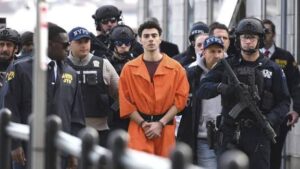
Luigi Mangione was born in 1998 and raised in Maryland. He was known as a high-achieving student and later attended the University of Pennsylvania, one of the most prestigious universities in the United States. Friends and former classmates described him as intelligent, reserved, and deeply analytical.
Before his arrest, Mangione lived largely outside the public spotlight. That changed dramatically in December 2024, when his name became headline news across the country following the killing of a major corporate executive in New York City.
Mangione’s educational background and apparent ideological writings quickly became central to public discussion, with commentators debating how someone with such privilege and opportunity could allegedly commit a violent act of this magnitude.
The Killing of UnitedHealthcare CEO Brian Thompson
The Shooting
On December 4, 2024, Brian Thompson, the chief executive officer of UnitedHealthcare, was shot and killed outside a Midtown Manhattan hotel. The shooting occurred in broad daylight and was captured by nearby surveillance cameras.
Prosecutors allege that Mangione followed Thompson, waited for an opportunity, and then fired multiple shots at close range using a handgun equipped with a sound suppressor. Thompson was pronounced dead shortly afterward, sending shockwaves through the healthcare industry and corporate America.
The targeted nature of the attack immediately raised concerns about executive security and politically motivated violence.
Arrest and Evidence
Nationwide Manhunt
Following the shooting, law enforcement agencies launched a nationwide search for the suspect. Mangione fled New York and traveled across state lines, prompting federal involvement early in the investigation.
He was arrested several days later in Altoona, Pennsylvania, after being recognized by a restaurant employee. Authorities reported that Mangione was carrying false identification at the time of his arrest.
Recovered Items
Police allegedly recovered several key pieces of evidence, including:
A 9mm handgun believed to be the murder weapon
A sound suppressor
Written materials described as a manifesto or planning notebook
Clothing similar to what was worn by the shooter in surveillance footage
Prosecutors argue this evidence establishes intent, planning, and execution of a targeted killing.
State Charges in New York
Initial Indictment
In New York State, Mangione was initially charged with multiple serious offenses, including second-degree murder and terrorism-related murder counts. Prosecutors argued that the killing was intended to intimidate or influence a civilian population by targeting a powerful corporate figure.
Under New York law, terrorism-related murder carries harsher penalties and symbolic weight.
Dismissal of Terrorism Charges
In a major legal setback for prosecutors, a New York judge later dismissed the terrorism-related murder counts. The court ruled that while the killing was violent and deliberate, the prosecution failed to meet the legal standard required to prove terrorism under state law.
The judge found insufficient evidence that Mangione intended to terrorize the general public or coerce government policy.
Remaining State Charges
Despite the dismissal of terrorism counts, Mangione still faces second-degree intentional murder charges and weapons-related offenses in New York. These charges carry the possibility of decades in prison or life with parole eligibility.
Federal Charges and the Death Penalty
Federal Indictment
Separate from the state case, federal prosecutors charged Mangione with multiple offenses, including:
Murder through the use of a firearm
Interstate stalking resulting in death
Use of a firearm equipped with a silencer during a violent crime
The federal government argues that Mangione crossed state lines, used interstate communication tools, and engaged in stalking behavior prior to the killing—bringing the case under federal jurisdiction.
Death Penalty Decision
The U.S. Attorney General authorized prosecutors to seek the death penalty, making this one of the rare modern federal capital cases. The decision has intensified scrutiny of the prosecution and drawn criticism from civil rights groups and defense attorneys.
If convicted on the most serious federal counts, Mangione could face execution under federal law.
Criminal Defense Strategy
Mangione’s legal team has mounted an aggressive and multi-layered defense, focusing on constitutional rights, procedural violations, and challenges to federal authority.
1. Suppression of Evidence
One of the defense’s central arguments is that key evidence was obtained unlawfully. Defense attorneys claim that police searched Mangione’s belongings without a valid warrant and outside the scope of permissible searches.
If the court suppresses the firearm, writings, or other physical evidence, it could significantly weaken the prosecution’s case.
2. Miranda Rights and Interrogation Issues
The defense has also raised concerns that Mangione may not have been properly advised of his Miranda rights before making statements to police. Any statements obtained unlawfully could be excluded from trial.
3. Dual Prosecution Concerns
Mangione’s lawyers argue that being prosecuted in both state and federal court for the same conduct is fundamentally unfair. While courts generally allow dual prosecutions under the “separate sovereigns” doctrine, the defense continues to challenge the sequencing and scope of the cases.
4. Challenging Death Penalty Eligibility
The defense is also contesting whether the federal charges legally qualify for capital punishment. They argue that recent court rulings may limit which crimes can serve as predicates for the death penalty.
This issue could become one of the most consequential legal questions in the entire case.
Public Reaction and Legal Fallout
Polarized Public Opinion
The Luigi Mangione case has deeply divided public opinion. Some members of the public have expressed sympathy for Mangione, framing the killing as a response to perceived injustices within the U.S. healthcare system.
Others strongly reject this narrative, emphasizing that violence against individuals—regardless of motive—cannot be justified.
Security and Corporate Impact
The killing has led many corporations to reassess executive security measures. Healthcare companies in particular have increased protective protocols for senior leadership.
Bizarre Side Incidents
The intense attention surrounding the case has led to unusual incidents, including an attempted prison break by an individual impersonating a federal agent. Though unsuccessful, the episode highlighted the level of fixation the case has generated.
What Happens Next?
Federal Trial Timeline
The federal case is expected to move slowly due to its complexity and death-penalty status. Jury selection is currently projected for late 2026, with trial proceedings likely extending well beyond that.
State Trial Progress
The New York state case continues through pretrial hearings and motions. Depending on court rulings, the state trial could occur before or after the federal proceedings.
Legal experts expect extensive appeals regardless of the outcome in either court.
Conclusion
Luigi Mangione’s case is more than a criminal prosecution—it is a defining legal and cultural moment. It raises difficult questions about justice, political anger, corporate power, and the boundaries of lawful protest.
With murder charges in state court and a possible death sentence looming at the federal level, Mangione faces a legal battle that will likely shape U.S. criminal law discussions for years to come.
As courts weigh evidence, constitutional claims, and public scrutiny, the final outcome remains uncertain. What is clear is that the Luigi Mangione case will leave a lasting mark on the American legal landscape.
How useful was this post?
Click on a star to rate it!
Average rating 0 / 5. Vote count: 0
No votes so far! Be the first to rate this post.
About the Author

usa5911.com
Administrator
Hi, I’m Gurdeep Singh, a professional content writer from India with over 3 years of experience in the field. I specialize in covering U.S. politics, delivering timely and engaging content tailored specifically for an American audience. Along with my dedicated team, we track and report on all the latest political trends, news, and in-depth analysis shaping the United States today. Our goal is to provide clear, factual, and compelling content that keeps readers informed and engaged with the ever-changing political landscape.