Indiana Revolt: GOP blocks Trump’s map, party tension rises
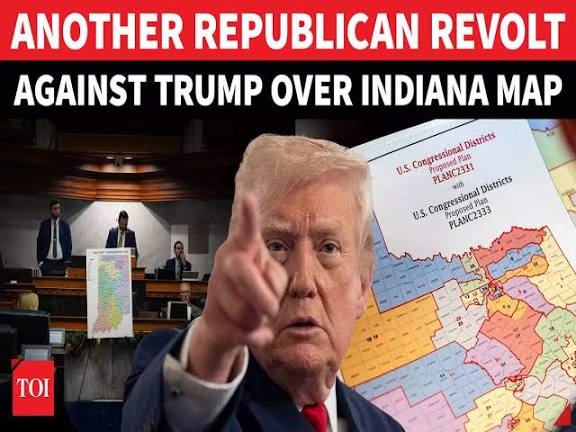
A major political revolt has erupted inside the Republican Party as Indiana’s GOP-controlled Senate overwhelmingly rejected Donald Trump. Today we will discuss about Indiana Revolt: GOP blocks Trump’s map, party tension rises
Indiana Revolt: GOP blocks Trump’s map, party tension rises
In a stunning break with national party leadership, Indiana’s Republican-controlled State Senate has rejected a congressional redistricting map strongly backed by former President Donald Trump. The event—widely described as an Indiana revolt—marks one of the most dramatic acts of internal defiance inside the GOP in years. It highlights the growing tension between the priorities of state-level Republicans and the aggressive national strategy Trump has pursued to secure future control of Congress.
Although Indiana is one of the most reliably Republican states in the country, the vote demonstrated that even in the heart of Trump country, loyalty has limits. Fear, pressure, intimidation, and political brinkmanship collided in a way that tested party unity and revealed deep divisions ahead of the 2026 midterm elections.
This is the inside story of how Indiana became the epicenter of a GOP civil war—and what it means for the future of American politics.
A High-Stakes Battle Over Voting Maps

Trump’s Push for Mid-Decade Redistricting
Redistricting normally happens once every decade after the census. But in 2025, Trump launched an unprecedented initiative to reshape congressional maps in key Republican-controlled states midway through the decade. His objective was clear: secure as many GOP-held congressional districts as possible before the 2026 elections.
Indiana was one of his prime targets. With a current congressional delegation consisting of seven Republicans and two Democrats, national GOP strategists saw an opportunity. The Trump-backed map aimed to break apart Democratic strongholds—especially Indianapolis—and redraw lines to engineer an overwhelmingly Republican 9–0 delegation.
The Indiana House of Representatives, firmly controlled by Republicans, quickly approved the proposal. But the plan would soon run into fierce resistance in the State Senate, where concerns about political overreach, constituent backlash, and escalating threats would transform the battle into a statewide political firestorm.
The Stunning Senate Rejection
The Vote No One Expected
On a tense December afternoon, the Indiana Senate voted 31 to 19 to reject the Trump-supported redistricting map. What shocked observers even more was the breakdown of the vote:
21 Republicans joined all 10 Democrats to block the plan.
In a state where Republican loyalty to Trump has long seemed unwavering, the defeat left national strategists stunned. Many expected the Senate to pass the new map with ease. Instead, Indiana delivered a symbolic and powerful blow—one that no other GOP-led state had dared to make.
Why the Map Failed
As lawmakers later explained, three major forces shaped the revolt:
1. Strong Constituent Pushback
Republican senators reported receiving an unexpected wave of opposition from their own voters.
Residents objected to having their counties split apart and paired with distant communities solely for political gain. Rural voters disliked being merged into districts with suburban or urban areas. Local officials warned the plan would weaken community representation.
For many GOP senators, the message was clear: their own base did not want this map.
2. Frustration With National Pressure
Multiple senators revealed that they were subjected to constant lobbying, phone calls, and warnings from national GOP figures. Trump allies pressed Indiana lawmakers to fall in line. Advocacy groups suggested that those who opposed the plan could lose funding or face primary challengers.
What might have been normal political pressure escalated into what lawmakers described as “intimidation.” Instead of persuading senators, the heavy-handed tactics backfired—pushing them toward defiance.
3. Intimidation, Threats, and Safety Concerns
As the vote approached, several legislators and local officials were hit with harassment, threats, and even swatting incidents. Homes were targeted, police were misled into responding to false emergencies, and some legislators feared for their families.
Though no single group was definitively blamed, the atmosphere of fear created resentment. Many senators felt the process was spiraling into something dangerous and undemocratic.
For some, rejecting the map became a matter of principle and safety—not just politics.
What the Rejected Map Would Have Changed
The Trump-backed map was one of the most aggressive partisan gerrymanders proposed in the country. If approved, it would have:
Completely eliminated Indiana’s two Democratic congressional seats
Broken Indianapolis into four oddly shaped districts stretching into rural counties
Created an engineered layout designed to guarantee Republicans control of all nine U.S. House seats
Forced Democratic incumbents into overwhelming Republican districts, effectively ending their political careers
The map was a direct strategic attempt to maximize Republican control of Congress in 2026. Its defeat now leaves Indiana’s current map—still Republican-leaning but more balanced—intact.
Trump’s Reaction and National Fallout
Trump made redistricting a key part of his strategy to regain influence over the House of Representatives. Indiana was supposed to be an easy win. But when the Senate rebelled, Trump’s allies erupted in anger.
Pressure, Warnings, and Political Threats
Before the vote, Trump personally urged Indiana lawmakers to approve the map. High-ranking party officials, including top congressional Republicans and national strategists, placed repeated calls to senators.
The message was consistent:
Support the map
Strengthen the GOP for 2026
Or face political consequences
But once the Senate said no, Trump’s team quickly shifted to frustration, accusing state senators of undermining the national party.
A Rare Public Rejection of Trump’s Influence
The Indiana revolt marks one of the few times in recent years that Republican lawmakers have openly defied Trump—not behind closed doors, but in a formal vote.
Analysts now see the vote as a warning: Trump’s influence, though still strong, may not be as absolute as it once was.
GOP Civil War: Internal Divisions Exposed
The Indiana vote revealed the growing fault lines within the Republican Party:
1. State vs. National Priorities
Indiana Republicans prioritized community integrity and local concerns over national strategy. For many state senators, answering to their constituents mattered more than answering to Washington or Mar-a-Lago.
2. Traditional Conservatives vs. Hardline Trump Loyalists
Some GOP members saw the map as too extreme—a step too far in manipulating political boundaries. Others believed not supporting Trump was a betrayal of the movement.
This ideological clash is becoming more visible across the country.
3. Rural Conservatives vs. National Strategists
Rural Republicans rejected being carved into strange districts for political outcomes. Their refusal demonstrates that grassroots conservatives do not automatically support every national GOP directive.
Implications for the 2026 Midterms
Democrats Benefit—But Only Slightly
The failure of the map means Indiana will keep its existing congressional districts. Democrats will likely retain their two seats, avoiding the existential threat posed by the Trump-backed rewrite.
But the overall balance remains heavily Republican.
GOP National Strategy Takes a Hit
Because the House margin is tight, every district matters. Losing the chance to turn Indiana into a 9–0 GOP stronghold is a significant setback for Republican national planners.
Now they must find new ways to gain seats—without Indiana’s help.
Trump’s Influence Faces New Tests
Political observers expect Trump to:
Support primary challengers against Indiana Republican senators who voted down the map
Intensify redistricting pressure in other states
Make Indiana a symbolic battleground to reassert control
But the Indiana vote proves that not all Republicans are willing to yield—especially at the state level.
Why Indiana’s Revolt Matters Nationally
Indiana is not a swing state. It is deeply red, reliably conservative, and broadly supportive of Trump. That’s why this revolt has national significance:
1. If Trump Can’t Control Indiana, What About Harder States?
If Indiana Republicans feel confident enough to reject Trump’s agenda, GOP lawmakers in other states may feel empowered to do the same.
2. Local Republican Identity Is Reasserting Itself
For years, national politics overshadowed state priorities. Now, states like Indiana are reminding the country that local representation still matters.
3. A New Model of Defiance for Traditional Conservatives
Indiana has offered a blueprint for moderate or traditional conservatives who feel alienated by Trump’s political style but have been afraid to say so.
What Comes Next in Indiana Politics
Indiana Republicans who opposed the map may now face:
Primary challengers
National pressure
Political attacks from Trump-aligned groups
But many have signaled they are ready to defend themselves, insisting they voted according to constituent wishes and democratic fairness.
The state will likely see:
Heated primaries in 2026
Intensified political activism
Renewed debates over the direction of the GOP
What started as a redistricting battle may evolve into a statewide referendum on party identity.
Conclusion: A Turning Point for the GOP
The Indiana revolt is more than just a legislative vote. It marks a dramatic turning point in the Republican Party’s internal struggle. What was meant to be a routine partisan maneuver became a fight over principles, power, and the future of representation.
The outcome shows:
Trump’s influence is powerful—but not unstoppable
State-level Republicans can push back when national pressure goes too far
Grassroots voters still hold sway in America’s political landscape
As 2026 approaches, the Indiana revolt may be remembered as the moment when the GOP’s internal divisions burst into the open—and when the party was forced to confront the competing visions within its own ranks.
How useful was this post?
Click on a star to rate it!
Average rating 0 / 5. Vote count: 0
No votes so far! Be the first to rate this post.
About the Author

usa5911.com
Administrator
Hi, I’m Gurdeep Singh, a professional content writer from India with over 3 years of experience in the field. I specialize in covering U.S. politics, delivering timely and engaging content tailored specifically for an American audience. Along with my dedicated team, we track and report on all the latest political trends, news, and in-depth analysis shaping the United States today. Our goal is to provide clear, factual, and compelling content that keeps readers informed and engaged with the ever-changing political landscape.