Immigration Freeze: Trump Blocks 19 Nations, Washington Erupts in Fury
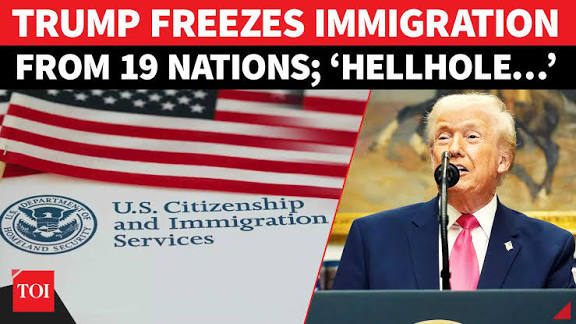
The Trump administration has halted processing of all immigration applications, including green card requests. Today we will discuss about Immigration Freeze: Trump Blocks 19 Nations, Washington Erupts in Fury
Immigration Freeze: Trump Blocks 19 Nations, Washington Erupts in Fury
In early December 2025, the Trump administration launched one of the most sweeping shifts in U.S. immigration policy in modern history. Through a directive issued by U.S. Citizenship and Immigration Services (USCIS), immigration applications from individuals born in 19 non-European countries were abruptly frozen. This includes green-card petitions, citizenship applications, asylum claims, visa renewals, family sponsorships, and other immigration benefits.
The freeze applies not only to new applicants but also to many who were already deep in the process — some even days away from citizenship ceremonies. The administration framed the move as a national-security necessity, while critics denounced it as discriminatory, unconstitutional, and inhumane. The announcement sent shockwaves through Washington, triggering immediate outrage from lawmakers, advocacy organizations, and immigrant communities.
This article breaks down what the freeze entails, who is affected, why the administration implemented it, and the legal, social, and economic implications that now loom over millions.
What the Immigration Freeze Actually Involves
The 19 Countries Targeted
The block applies to nationals — including dual citizens and people born in these nations — from a list of 19 countries. The selection includes nations once placed under earlier U.S. travel restrictions, along with others deemed “high-risk” by the administration.
The countries are:
Afghanistan, Chad, Republic of the Congo, Equatorial Guinea, Eritrea, Haiti, Iran, Libya, Myanmar, Somalia, Sudan, Yemen, Burundi, Cuba, Laos, Sierra Leone, Togo, Turkmenistan, and Venezuela.
These nations span Africa, the Middle East, Asia, and Latin America — the majority of them developing states experiencing political instability, conflict, or fragile governance.
Which Immigration Processes Are Halted?
The freeze covers nearly every major immigration channel, including:
Green-card applications (permanent residency)
Naturalization (U.S. citizenship)
Asylum and refugee processing
Family-based immigration petitions
Work permits and legal-status renewals
Travel permits and humanitarian visas
The directive orders a “comprehensive national-security re-review” of all pending and many previously approved cases. For thousands, this means canceled interviews, lost appointments, and files being dragged back into administrative review.
For many applicants, what was once a 6–18 month process may now stretch indefinitely — possibly years.
Why the Freeze Was Enacted
The administration cited national-security concerns following the killing of two National Guard members in Washington, D.C., in late November — an attack allegedly committed by an Afghan national who had previously been granted asylum.
Officials argued this incident exposed vulnerabilities in the vetting system and justified a temporary halt to reassess risk profiles. They claim the freeze is a precautionary measure to protect Americans while vetting procedures undergo reevaluation.
However, critics argue the action is far from “targeted.” Instead, it is a sweeping, disproportionate response that penalizes entire countries and millions of innocent people.
Why Washington Erupted: The Core Criticisms
1. Accusations of Discrimination and Collective Punishment
Lawmakers, civil-rights groups, and immigrant advocates quickly condemned the freeze as discriminatory. Because the list includes mostly non-European, developing nations, opponents say the freeze disproportionately affects Black, Brown, and Muslim immigrants.
Critics warn the policy resembles collective punishment: the actions of one individual are being used to justify punishing entire nationalities, most of whom have no connection to crime or terrorism.
Many viewed it as a revival — and amplification — of previous policies known colloquially as “travel bans,” but now extended into the domain of legal immigration, settlement, and citizenship itself.
2. Constitutional and Legal Concerns
Legal experts argue the freeze may violate due-process rights and principles of equal protection. The U.S. Constitution restricts broad discrimination by national origin, especially when it impacts residents already legally in the country.
Lawsuits are expected to challenge:
Whether the executive branch has authority to suspend immigration benefits en masse
Whether the freeze violates basic due-process protections
Whether national-origin-based restrictions are constitutional
Whether individuals already in the U.S. can be retroactively subjected to new security standards
Because the freeze affects people mid-process — including those with established legal rights — it is widely seen as ripe for judicial scrutiny.
3. Humanitarian Crisis: Families Divided and Lives on Hold
Thousands of families now face heartbreaking uncertainty. Many applicants had waited years to reunite with spouses, children, or parents — and now must wait indefinitely.
Reports emerged of:
Citizenship ceremonies canceled with no explanation
Green-card holders unable to travel or extend status
Asylum seekers facing renewed trauma and uncertainty
Family reunification cases frozen
For refugees fleeing war, disaster, or persecution, the freeze feels like an abandonment of America’s historical role as a refuge.
4. Economic Fallout: Labor Shortages and Lost Talent
Economists warn that cutting off access to legal immigrants from these regions could harm U.S. industries that rely on international workers — particularly health care, technology, logistics, manufacturing, and agriculture.
Immigrants from the affected nations contribute significantly to:
Workforce shortages in nursing and elder care
STEM innovation
Entrepreneurship
Service-sector labor gaps
Tax revenues that support local and state governments
The freeze risks stalling economic growth, reducing productivity, and weakening the nation’s competitive edge.
5. Damage to U.S. Global Reputation
Foreign-policy analysts argue the freeze undermines the U.S.’s image as a welcoming, humanitarian nation. Allies and international organizations have expressed concern that the United States is abandoning its moral obligation to protect vulnerable populations.
Critics warn this could weaken U.S. soft power, strain diplomatic relationships, and deter international students, researchers, and skilled workers from choosing America.
Voices from the Ground: What Immigrants and Advocates Are Saying
Activists and community leaders have described the freeze as “devastating,” “cruel,” and “an assault on immigrant communities.”
Immigrant families report shock and fear:
Parents unsure whether they can remain employed
Students uncertain whether they can continue studies
Refugees terrified they may never see family again
Permanent residents fearing their status could be reviewed or revoked
Lawyers describe a wave of panicked calls from clients asking whether they will be deported, lose benefits, or have to reapply under new rules.
Civil-rights advocates argue the freeze encourages xenophobia by framing immigrants from certain regions as inherently dangerous — despite evidence showing no such correlation between nationality and crime.
Historical Context: How This Freeze Compares to Past Restrictions
While the U.S. has implemented nationality-based restrictions before, none have been as far-reaching as this one.
Key comparisons:
Earlier travel bans restricted entry, not legal immigration benefits from people already inside the U.S.
Post-9/11 policies imposed special screening on certain nationalities, but did not halt naturalization or green-card processing entirely
Past restrictions rarely expanded into revoking or reviewing previously approved applications, as the current directive does
The 2025 freeze marks a dramatic expansion of executive power over immigration — potentially setting new precedents with long-lasting consequences.
Short- and Mid-Term Consequences
1. An Overloaded Immigration System
USCIS offices, already suffering from years of backlogs, now face even more chaos. Interviews are being canceled without notice. Applications are being returned for re-review. Processing times are expected to skyrocket.
For many, work permits may expire before cases are revisited, leading to job loss and immense personal disruption.
2. Economic Uncertainty and Workforce Disruptions
Industries reliant on immigrants from Africa, the Middle East, Latin America, and Asia will face shortages in:
Hospitals and nursing homes
Transportation and logistics
Food service and hospitality
Scientific research
Manufacturing
Businesses warn of long-term damage to competitiveness if the freeze persists.
3. Humanitarian and Social Impact
Communities with large diaspora populations from the targeted nations fear increased stigma, surveillance, and discrimination. Many immigrants are now afraid to engage with government agencies, affecting everything from healthcare access to crime reporting.
Families are left in painful uncertainty, with reunification delayed indefinitely and immigration status disrupted.
4. Political and Legal Fallout
Members of Congress, civil-rights groups, and state attorneys general are preparing legal challenges. Public protests have already erupted in several cities.
Lawmakers argue the freeze exceeds presidential authority and undermines basic constitutional protections.
Global Implications
Refugee and Humanitarian Crises
Many of the targeted countries are experiencing war, political instability, or economic collapse. By shutting down U.S. resettlement pathways, the freeze could worsen global displacement and burden neighboring countries already struggling to host refugees.
Brain Drain and Diaspora Disruption
Highly educated professionals from these 19 countries may now choose Europe, Canada, or Asia instead of the U.S. This shift could reduce America’s access to critical global talent.
Soft-Power Decline
The perception of the U.S. as a hostile or unpredictable destination may deter students, investors, researchers, and skilled workers — individuals who historically fueled innovation and contributed to national prosperity.
What Happens Next?
1. Legal Battles
Courts may block or narrow the freeze, especially for individuals already inside the U.S. or those with pending legal rights.
2. Congressional Action
Lawmakers may attempt to pass legislation limiting nationality-based bans or requiring oversight.
3. Potential Expansion
Officials have floated the possibility of adding more countries — raising fears of a near-global freeze targeting most developing nations.
4. Permanent Policy Shifts
Even if partially reversed, the freeze may reshape immigration norms for years, creating chilling effects on legal migration and international recruitment.
Conclusion
The 2025 immigration freeze marks a profound turning point in America’s approach to legal immigration. It is one of the broadest, most far-reaching restrictions in modern U.S. history — halting green-card applications, citizenship processes, asylum cases, and family reunification for millions of people from 19 nations.
Supporters view it as necessary for national security. Critics say it is discriminatory, unconstitutional, economically damaging, and morally indefensible. What is clear is that the freeze has created immediate chaos for families, employers, students, refugees, and lawful residents.
Its legacy will depend on what happens next: court rulings, congressional intervention, and public response. Ultimately, this moment will likely shape the national debate on immigration for a generation — raising fundamental questions about identity, fairness, security, and the future of the American promise.
How useful was this post?
Click on a star to rate it!
Average rating 0 / 5. Vote count: 0
No votes so far! Be the first to rate this post.
About the Author

usa5911.com
Administrator
Hi, I’m Gurdeep Singh, a professional content writer from India with over 3 years of experience in the field. I specialize in covering U.S. politics, delivering timely and engaging content tailored specifically for an American audience. Along with my dedicated team, we track and report on all the latest political trends, news, and in-depth analysis shaping the United States today. Our goal is to provide clear, factual, and compelling content that keeps readers informed and engaged with the ever-changing political landscape.