Virginia Supreme Court Shock: Redistricting Map Thrown Out, Election Battle Explodes
The political world was shaken after the Virginia Supreme Court delivered a blockbuster ruling that overturned a voter-approved congressional redistricting plan in Virginia. The decision immediately triggered outrage, celebration, legal debate, and fears of an escalating national election war ahead of the 2026 midterm elections.
At the center of the controversy is a map that Democrats hoped would help flip several Republican-held congressional seats. Republicans argued the process behind the map violated Virginia’s constitution. In a narrow 4-3 ruling, the court sided with Republican challengers and declared the referendum and resulting maps invalid.
The decision could have massive consequences for control of the U.S. House of Representatives and may reshape how states approach redistricting battles nationwide.
What Happened in Virginia?
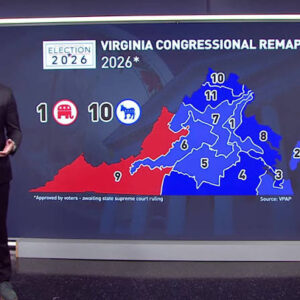
The dispute began after Virginia lawmakers approved a constitutional amendment allowing temporary mid-decade congressional redistricting. The measure was later narrowly approved by voters during a statewide referendum.
Democrats supported the move because the new map was expected to significantly improve their chances in multiple congressional districts. Analysts believed Democrats could potentially gain up to four seats under the revised boundaries.
However, Republicans filed lawsuits claiming the amendment process violated constitutional procedures. Their core argument focused on timing. According to Virginia law, constitutional amendments must pass through two legislative sessions with an intervening election between them.
The legal controversy centered on whether early voting counted as part of that “intervening election.” Republicans argued that lawmakers approved the amendment after early voting had already started, making the process unconstitutional.
The Virginia Supreme Court ultimately agreed.
Why the Court Threw Out the Map
In its ruling, the court declared that the constitutional process had not been properly followed. The majority concluded that once early voting began, the election was effectively underway. Because lawmakers acted after that point, the amendment process violated Virginia’s constitutional requirements.
The court therefore invalidated the referendum results and restored the previous congressional map.
The ruling immediately erased what Democrats viewed as one of their biggest opportunities to reclaim House seats in 2026.
According to reports, more than 1.3 million votes had already been cast when the disputed legislative action occurred. The majority opinion argued that allowing the process to continue would undermine constitutional safeguards.
Republicans celebrated the decision as a victory for constitutional order and election integrity.
Democrats, meanwhile, accused the court of blocking the will of voters and protecting partisan power.
Why Redistricting Matters So Much
Redistricting is one of the most powerful tools in American politics. Every district line can influence which party has an advantage in elections.
When states redraw maps, even small boundary changes can dramatically alter congressional outcomes.
In Virginia, the rejected map would reportedly have shifted the state toward a much stronger Democratic advantage. Current House representation in Virginia is relatively competitive, but Democrats hoped the new map would create favorable conditions in multiple districts.
Because control of the U.S. House often comes down to just a handful of seats, Virginia became one of the most important political battlegrounds in America.
National Political Fallout
The ruling arrives during a nationwide redistricting war between Democrats and Republicans.
Across the country, both parties are aggressively attempting to redraw congressional districts before the midterms. States including Texas, Missouri, North Carolina, South Carolina, Louisiana, and others are involved in ongoing map disputes.
Many Democrats viewed Virginia as a counterbalance to Republican-led redistricting efforts elsewhere.
Now that strategy has suffered a major setback.
Political analysts say the ruling could strengthen Republican hopes of maintaining House control in 2026.
The decision also highlights how state supreme courts are becoming increasingly influential in national politics.
Democrats React With Fury
Democratic leaders and activists responded with anger and disbelief.
Some lawmakers described the ruling as anti-democratic, arguing that voters had already approved the referendum. Others accused the court of prioritizing technical procedure over voter intent.
Reports suggest Democratic-aligned groups spent tens of millions of dollars supporting the referendum campaign.
Online reactions were equally intense. Social media exploded with criticism from progressive activists who claimed the ruling undermined democratic participation.
Reddit discussions reflected deep frustration among Democratic voters. Some users argued that the decision effectively nullified a public vote, while others questioned whether procedural arguments were being selectively enforced.
Not all criticism came from Democrats. Some independent observers expressed concern about public trust in elections whenever courts overturn voter-approved measures.
Republicans Call It a Constitutional Victory
Republicans framed the decision very differently.
GOP leaders argued that constitutional rules matter regardless of political outcomes. They said Democrats attempted to rush through a partisan redistricting scheme without following proper legal procedures.
Conservative commentators described the map as an aggressive gerrymander designed to heavily favor Democrats. Some reports suggested the proposed map could have dramatically reshaped Virginia’s congressional delegation.
Republicans also argued that Virginia voters had already approved a bipartisan redistricting system years earlier and that the new amendment improperly attempted to sideline that process temporarily.
For many conservatives, the court’s decision represented a defense of constitutional structure rather than partisan politics.
Understanding Gerrymandering
The Virginia battle has reignited debate over gerrymandering nationwide.
Gerrymandering happens when political districts are drawn to benefit one party over another. Politicians can shape districts to dilute opposing voters or strengthen their own electoral advantage.
Critics argue gerrymandering weakens democracy by allowing politicians to choose voters instead of voters choosing politicians.
Supporters of redistricting efforts often argue that map changes are necessary to reflect demographic realities or counter unfair maps in other states.
The Virginia case demonstrates how deeply polarized the issue has become.
Academic research continues to show that district design can significantly affect electoral fairness and representation.
Could the Fight Continue?
Even though the Virginia Supreme Court has ruled, political and legal battles may continue.
Democrats could pursue alternative legislative strategies or future constitutional amendments. Activists may also push for broader election reform efforts.
Meanwhile, Republicans are likely to defend the restored map aggressively ahead of the 2026 elections.
Some legal experts believe the case may influence future court rulings in other states dealing with similar constitutional questions surrounding redistricting procedures.
The broader national battle over election maps is far from over.
How This Impacts the 2026 Midterms
The timing of the ruling is especially important.
Midterm election campaigns are already ramping up, and candidates in Virginia had begun preparing under the assumption that new district lines might take effect.
Now campaigns may need to rapidly adjust.
Political strategists believe the ruling improves Republican odds in several districts that Democrats had hoped to target. Since the House majority is expected to remain extremely close, even a few districts could determine control of Congress.
Virginia has therefore become a symbol of the broader national struggle over political power, election rules, and constitutional interpretation.
Public Trust and Election Legitimacy
One of the most significant consequences of the ruling may involve public trust.
Whenever courts invalidate voter-approved measures, many citizens feel frustrated or disconnected from the political process.
Supporters of the ruling argue that constitutional rules exist precisely to prevent governments from bypassing safeguards.
Opponents argue that rejecting the referendum after voters already approved it damages confidence in democracy itself.
This tension between procedural legality and democratic participation sits at the heart of the Virginia controversy.
The Bigger Picture
The Virginia Supreme Court decision is about far more than one state.
It reflects a growing national trend in which courts, election laws, and redistricting fights increasingly shape political outcomes before voters even cast ballots in November.
The battle also reveals how fragile political balances have become in modern American elections.
With control of Congress potentially hanging on only a few seats, every district line now carries enormous political significance.
Virginia’s ruling may ultimately become one of the defining political moments of the 2026 election cycle.
FAQs
What did the Virginia Supreme Court decide?
The court struck down a voter-approved congressional redistricting referendum and invalidated the new maps, ruling that the amendment process violated constitutional procedures.
Why was the redistricting map controversial?
Democrats supported the map because it could help them gain multiple congressional seats, while Republicans argued it was an unconstitutional partisan gerrymander.
What was the legal issue in the case?
The dispute centered on whether lawmakers approved the amendment after the election process had already begun through early voting. The court ruled that they did.
How does this affect the 2026 elections?
The ruling restores the previous congressional map, likely improving Republican chances in Virginia and potentially affecting control of the U.S. House.
What is gerrymandering?
Gerrymandering is the practice of drawing political district boundaries in ways that benefit a particular political party.
Could Virginia redraw maps again in the future?
Yes. Lawmakers or voters could attempt future constitutional amendments or legislative actions, although additional legal challenges are likely.
Why is Virginia important nationally?
Virginia is considered a politically competitive state, and its congressional districts could help determine which party controls the House of Representatives.
Are other states facing similar redistricting battles?
Yes. States including Texas, North Carolina, Missouri, and Louisiana are also involved in major redistricting disputes.
How useful was this post?
Click on a star to rate it!
Average rating 0 / 5. Vote count: 0
No votes so far! Be the first to rate this post.
About the Author

usa5911.com
Administrator
Hi, I’m Gurdeep Singh, a professional content writer from India with over 3 years of experience in the field. I specialize in covering U.S. politics, delivering timely and engaging content tailored specifically for an American audience. Along with my dedicated team, we track and report on all the latest political trends, news, and in-depth analysis shaping the United States today. Our goal is to provide clear, factual, and compelling content that keeps readers informed and engaged with the ever-changing political landscape.