Gordie Howe Bridge : US Canada trade leverage, border politics shift
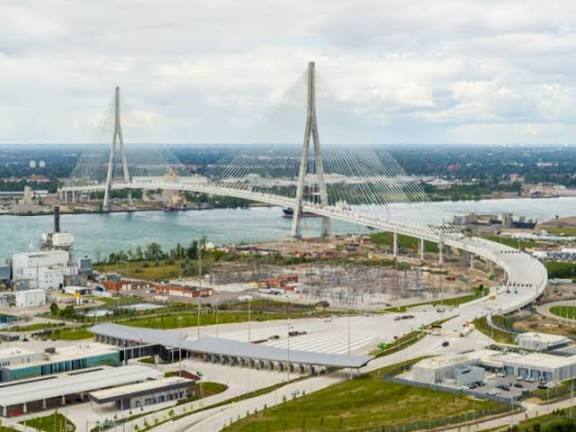
The Gordie Howe International Bridge, a monumental bi-national infrastructure project connecting Detroit, Michigan, and Windsor, Ontario, is emerging as more than just a gateway for trucks, cars, and pedestrians. Designed to improve the efficiency of one of the busiest trade corridors between the United States and Canada, the bridge has recently taken on new geopolitical significance. In 2026, evolving border politics and trade disputes have turned this long-anticipated crossing into a fulcrum of international leverage, pushing bilateral relations into uncharted territory.
While originally celebrated as a symbol of cooperation and economic interdependence, recent political currents have reframed the bridge as a site of tension and negotiation. This article explores that transformation, its implications for commerce, and what it means for one of the most important cross-border relationships in the world.
🚧 The Gordie Howe International Bridge: A Historic Overview
The Gordie Howe International Bridge is a cable-stayed bridge spanning the Detroit River between Windsor, Ontario, and Detroit, Michigan. With six traffic lanes and space for pedestrians and cyclists, it is designed to significantly improve cross-border mobility over existing crossings like the Ambassador Bridge and the Detroit-Windsor Tunnel.
📍 What It Is & Why It Matters
Strategic Corridor: The Windsor-Detroit crossing is the busiest commercial land border crossing between the U.S. and Canada, with millions of trucks hauling goods worth hundreds of billions annually.
Design: The bridge’s cable-stayed architecture includes six lanes for vehicles and a separate multi-use pathway for cyclists and pedestrians.
Funding: Unusually, Canada financed the majority of the project—including the portion on U.S. soil—because the U.S. government declined to contribute construction funding. Toll revenue will recoup costs over time.
Timeline: Construction began in 2018, with an expected opening in early 2026.
Named after legendary hockey player Gordie Howe—whose career spanned both cities—the bridge was intended to enhance economic links and ease congestion that previously cost billions in lost productivity.
🛃 Trade Significance: The Economic Link Between Two Nations
The United States and Canada share the largest bilateral trading relationship in the world, with nearly $900 billion in annual trade prior to 2025. About 25–30% of truck-borne commercial trade passes over the Windsor-Detroit corridor.
🚚 Why the Bridge Was Built
The bridge addresses several persistent challenges:
Traffic congestion and delays, which cost both economies billions annually.
Supply chain inefficiencies, especially for automotive parts and agriculture, where cross-border production is deeply integrated.
Infrastructure limitations, as older crossings struggle under growing freight volumes.
The Gordie Howe Bridge was poised to boost trade flows, cut transit times, and create thousands of jobs in both Canada and the U.S. by streamlining border processing and improving connectivity.
🇺🇸🇨🇦 Border Politics Shifting: From Cooperation to Confrontation
Despite its once-universal appeal as a trade booster, the bridge has become a political flashpoint.
🔥 2026: New Tensions and Trade Leverage
In February 2026, U.S. President Donald Trump threatened to block the opening of the bridge until Canada agreed to trade concessions and compensated the U.S. for perceived imbalances. Trump cited issues such as:
Canada’s ownership structure of the bridge,
Tariffs on U.S. dairy and other products,
The use of non-U.S. steel in construction,
Broader disagreements over Canadian trade policy, including engagement with China.
He insisted that the United States should receive partial ownership of the bridge or other forms of compensation before allowing it to open—a demand that frustrated many Michigan officials who argue that delaying the bridge could harm regional economies.
⚠️ Domestic Backlash
Local leaders on both sides of the aisle in Michigan have criticized the U.S. administration’s stance, warning that blocking or delaying opening could:
Disrupt supply chains,
Increase costs for manufacturers and consumers,
Hurt jobs in Michigan and Ontario,
Undermine regional economic stability.
Their position reflects deep economic interdependence across the border, even if political leadership diverges on strategy.
🔎 What This Means for US-Canada Trade
📈 Economic Impact
If the Gordie Howe Bridge becomes fully operational without political disruption, it is expected to:
Reduce crossing times substantially,
Create redundancy in critical freight capacity,
Support industries that depend on just-in-time delivery,
Generate jobs and investment throughout the Great Lakes region.
However, trade disputes and tariffs—including recent U.S. tariffs on Canadian imports—have already clouded prospects for smooth cooperation. Some Canadian industries have faced increased costs, while U.S. manufacturers dealing with Canadian inputs have seen prices rise.
🛠 Supply Chains Under Strain
Border delays and tariff disputes can add unpredictability to supply chains. The automotive sector, for example, trades parts back and forth across international borders multiple times during production. Uncertainty over bridge access or broader policies could ripple through costs and production schedules.
🧠 Strategic Importance Beyond Economics
The Gordie Howe Bridge is about more than freight and customs; it is symbolic of North American integration. It represents:
Infrastructure cooperation between major economic partners,
Economic diplomacy where trade policy influences infrastructure use,
Regional identity, especially in cities like Detroit and Windsor where communities are culturally and economically intertwined.
The fact that such an infrastructure asset is now part of political calculus illustrates how intertwined domestic politics and international economics have become.
🧩 Challenges & Future Outlook
⏰ Potential Delays and Political Negotiations
If political conditions continue to sour, the opening could be delayed or conditioned on broader trade negotiations—setting a precedent for using infrastructure as leverage.
🔄 Changing Global Dynamics
Canada’s expanding trade relationships, including deeper engagements with other global partners, may reduce the relative political weight of the U.S. in Ottawa’s calculus, adding complexity to bilateral negotiations.
❓ FAQs (Frequently Asked Questions)
Q1: What is the Gordie Howe International Bridge?
A: It’s a new bi-national bridge connecting Windsor, Ontario, and Detroit, Michigan, designed to improve cross-border trade and reduce congestion at one of North America’s busiest commercial border crossings.
Q2: Why is the bridge politically controversial in 2026?
A: Recent U.S. political actions have linked the opening of the bridge to broader trade concessions from Canada, elevating it from an infrastructure project to a leverage point in US-Canada border politics.
Q3: How will the bridge benefit trade?
A: It will increase capacity for freight, reduce wait times, create jobs, and provide a modern crossing alternative to older infrastructure like the Ambassador Bridge.
Q4: Who funded the bridge?
A: The project is primarily funded by Canada, even for the portion on U.S. soil, with the expectation of recouping costs via toll revenue.
Q5: Could the bridge be delayed due to political disputes?
A: Yes. If political leaders use the bridge as leverage in trade negotiations, its opening could be postponed or conditioned on unresolved policy issues between the U.S. and Canada.
🧭 Conclusion
The Gordie Howe International Bridge stands today at the intersection of economics, diplomacy, and politics. What began as a long-awaited infrastructure project to improve trade flows and regional connectivity has evolved into a symbol of shifting US-Canada relations in the context of trade policy and border security politics.
Whether it ultimately functions as a conduit for prosperity or becomes entangled in geopolitical bargaining will shape not only the economies of Ontario and Michigan but also the broader narrative of North American cooperation in an increasingly complex global landscape.
How useful was this post?
Click on a star to rate it!
Average rating 0 / 5. Vote count: 0
No votes so far! Be the first to rate this post.
About the Author

usa5911.com
Administrator
Hi, I’m Gurdeep Singh, a professional content writer from India with over 3 years of experience in the field. I specialize in covering U.S. politics, delivering timely and engaging content tailored specifically for an American audience. Along with my dedicated team, we track and report on all the latest political trends, news, and in-depth analysis shaping the United States today. Our goal is to provide clear, factual, and compelling content that keeps readers informed and engaged with the ever-changing political landscape.