IRAN WAR: Consequences More Powerful, Trump Warns Tehran After Netanyahu Meet
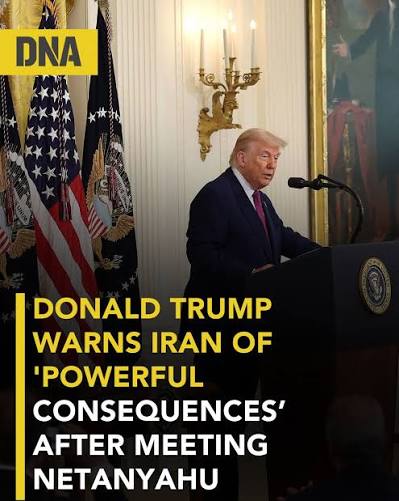
Iranian President Massoud Pezeshkian responded to a warning on Tuesday by promising a harsh response to any attack. Today we will discuss about IRAN WAR: Consequences More Powerful, Trump Warns Tehran After Netanyahu Meet
IRAN WAR: Consequences More Powerful, Trump Warns Tehran After Netanyahu Meet
In late December 2025, global geopolitics reached a new flashpoint as U.S. President Donald Trump issued one of his most forceful warnings yet to Iran, following a high-profile meeting with Israeli Prime Minister Benjamin Netanyahu in Florida. Trump’s rhetoric centered on the possibility of renewed U.S. military action should Tehran attempt to rebuild its nuclear or missile capabilities — warning that any response could be “more powerful than the last time.”
This development comes amid a broader, complex backdrop of conflicts across the Middle East — involving Israel, Iran, proxy groups like Hezbollah and Hamas, and the volatile aftermath of a 12-day military confrontation earlier in 2025. The warnings to Tehran represent not just diplomatic saber-rattling, but a manifestation of deep strategic concerns held by Washington and Jerusalem about Iran’s nuclear ambitions and its regional influence.
This article provides a comprehensive, analytical overview of the event and its implications — political, military, economic, and humanitarian.
1. The Trump–Netanyahu Summit: Setting the Stage
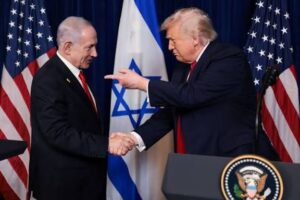
On December 29, 2025, President Trump welcomed Israeli Prime Minister Benjamin Netanyahu at his Mar-a-Lago estate in Florida for a high-level diplomatic meeting. The agenda was anchored on the Gaza peace process and perceived threats from Iran — particularly regarding its nuclear program and ballistic missile capabilities.
At a joint press conference, Trump delivered a stark warning to Tehran. He cited intelligence suggesting Iran may be attempting to reconstitute aspects of its nuclear infrastructure outside previously targeted sites. Trump warned that if these reports were verified, the U.S. would be prepared to intervene militarily, with consequences potentially “more powerful than the last time.”
Trump’s comments were framed in the context of his broader foreign policy goals: maintaining U.S. influence in the Middle East, reassuring key ally Israel, and signaling deterrence to adversaries. Netanyahu, for his part, reiterated concerns about Iran’s capabilities and emphasized unity on the issue. This convergence of American and Israeli strategic interests fuels tensions with Tehran and raises questions about future military confrontations.
2. Why Iran Is at the Center of Tension
Iran has long been at the heart of regional security debates. Its nuclear program, ballistic missile development, and support for proxy militias such as Hezbollah and Hamas place it at odds with both Israel and the United States. Despite Tehran’s claims that its nuclear activities are peaceful, there is persistent skepticism from Western capitals and Israeli intelligence.
Earlier in 2025, a 12-day conflict erupted between Iran and a U.S.–Israeli coalition, resulting in significant destruction of Iranian nuclear facilities and military infrastructure. The June war saw extensive air strikes that targeted enrichment plants and ballistic missile stockpiles.
Iran responded with missiles and drones aimed at Israeli territory, generating civilian casualties in both nations. While that crisis ended with a ceasefire, the situation remained fragile. Trump’s recent warnings indicate that Washington believes Tehran might be attempting to regain lost ground in its weapons infrastructure.
Iran’s foreign ministry quickly dismissed the latest U.S. allegations, characterizing them as psychological operations against Tehran. Iranian officials reaffirmed their stance that the nation would strongly defend its sovereignty and deny intentions of developing nuclear weapons.
3. Tehran’s Response: Defiance and Retaliation Threats
Iran has not taken Trump’s warnings passively. Senior officials, including President Masoud Pezeshkian, issued stern threats in response, declaring that Iran would respond harshly and “discouragingly” to any aggression.
State and military voices in Iran have amplified this message. Iran’s armed forces publicly warned of “costly retaliation” against any threat to national security, stressing they were fully prepared and would not tolerate miscalculations by adversaries.
Tehran’s rhetoric frames the conflict with the West as not only a regional struggle but a broader confrontation with the U.S., Europe, and Israel — a “full-scale war” in the words of some Iranian officials.
Such language signals not only defiance but also a strategy to deter Western forces from renewed strikes. However, it also raises the risk of misinterpretation, overreaction, and escalation — especially given the proximity of conflicting military interests and alliances.
4. Strategic Implications: Military and Diplomatic Dimensions
Military Escalation Risk
At the heart of the conflict lies the question of military escalation. Trump’s repeated warnings about powerful consequences are fundamentally deterrence tools — intended to dissuade Iran from resuming nuclear work or maximizing missile capabilities.
Yet deterrence risks miscalculation. Even ambiguous signals, if misread, could trigger preemptive strikes or retaliatory action. Past reports suggest U.S. and Israeli air force capacity to strike Iranian targets remains robust, including strategic bomber deployments.
Meanwhile, Tehran’s missile forces — though weakened from past strikes — have not been eliminated. Experts believe Iran retains missile stockpiles capable of striking deep into Israeli territory. The specter of renewed air raids and counter-attacks fuels fears of prolonged conflict.
Diplomatic Ripples
Diplomatically, the Trump–Netanyahu meeting reflects shifting global alignments. The U.S. is signaling unwavering support to Israel while pushing a hawkish stance on Iran. This may solidify alliances with some regional actors but alienate others who favor diplomatic engagement over military confrontation.
Despite Trump’s warnings, some Western analysts argue that diplomacy remains vital. A negotiated deal, similar in spirit to the 2015 Iran nuclear agreement (before the U.S. withdrawal in 2018), could provide a framework for de-escalation. Tehran claims to support negotiation on nuclear matters but refuses to discuss limits on its missile program, a key point of contention.
5. Humanitarian and Global Security Consequences
Human Cost
Renewed hostilities between the U.S., Israel, and Iran could have catastrophic consequences for civilian populations in the region. Even limited conflicts have previously resulted in hundreds of deaths, destruction of infrastructure, and displacement — as seen in Gaza and during the June 2025 air war.
A full escalation could involve proxy actors — Hezbollah in Lebanon, militias in Iraq and Syria, and various aligned groups — drawing multiple states into a wider war.
Economic Disruption
Beyond the battlefield, economic repercussions would be significant. Iran’s economy, already under strain due to sanctions and internal protests over currency collapse and unemployment, could deteriorate further with renewed conflict.
Global energy markets would feel the shock as well. Iran sits astride critical shipping lanes and oil production networks. Disruptions to oil flows through the Strait of Hormuz — a key chokepoint — could spike energy prices worldwide.
Global Security Architecture
On a broader level, renewed confrontation could undermine international security norms. The use of unilateral military action without broad Security Council approval, and the bypassing of diplomatic mechanisms like the International Atomic Energy Agency (IAEA) inspections, challenge the established global order.
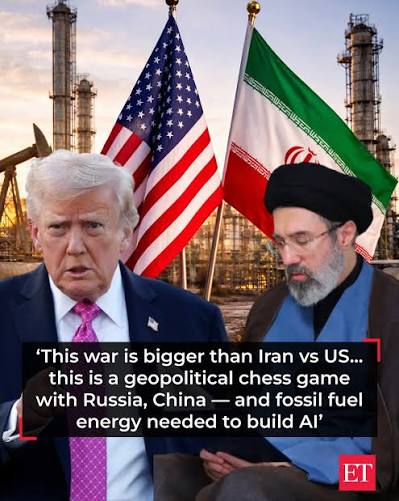
Moreover, increased tensions with Iran could push Tehran closer to rival powers such as Russia and China — reshaping global geopolitical alignments and complicating Western strategies in other theaters like Ukraine and East Asia.
6. The Future: De-escalation or Escalation?
The path ahead is uncertain. Trump’s warnings are clear: should Iran rebuild its nuclear or missile capabilities, the U.S. is prepared to act with overwhelming force — possibly even more powerfully than in previous strikes.
Yet Tehran’s defiance and its framing of the conflict as total war suggests that diplomatic avenues remain fraught. Iran has denied pursuing nuclear weapons and claims readiness to defend itself rigorously.
For now, global attention rests on whether diplomatic engagement can temper the rhetoric and avoid direct military clashes. Key indicators will include:
Whether Iran pursues nuclear enrichment or missile development openly
The responses of major powers (e.g., Russia, China, European Union)
Internal political dynamics within Iran amid economic unrest
The progress (or breakdown) of the Gaza ceasefire and broader Middle East peace efforts
The coming months could determine whether this phase of tension becomes a full-blown regional war or transitions back toward negotiated stasis.
Conclusion
The latest warning by President Trump — that consequences for Iran could be “more powerful” than previous strikes — represents a critical inflection point in Middle Eastern geopolitics. It underscores not only longstanding distrust between Tehran and Washington but also the complexity of balancing deterrence with diplomacy.
Iran’s signaling of strong retaliation, coupled with deep strategic disagreements over nuclear and missile programs, means the region remains on edge. The international community watches closely, aware that any misstep could escalate into a confrontation with repercussions far beyond the Middle East.
How useful was this post?
Click on a star to rate it!
Average rating 0 / 5. Vote count: 0
No votes so far! Be the first to rate this post.
About the Author

usa5911.com
Administrator
Hi, I’m Gurdeep Singh, a professional content writer from India with over 3 years of experience in the field. I specialize in covering U.S. politics, delivering timely and engaging content tailored specifically for an American audience. Along with my dedicated team, we track and report on all the latest political trends, news, and in-depth analysis shaping the United States today. Our goal is to provide clear, factual, and compelling content that keeps readers informed and engaged with the ever-changing political landscape.