Myanmar military junta crackdown : protests, US sanctions, human rights crisis

Since the military coup on February 1, 2021, Myanmar’s junta has carried out a brutal nationwide crackdown aimed at suppressing. Today we will discuss about Myanmar military junta crackdown : protests, US sanctions, human rights crisis
Myanmar military junta crackdown : protests, US sanctions, human rights crisis
Myanmar has been trapped in one of the gravest political and humanitarian crises in Southeast Asia since the military seized power in February 2021. What began as a sudden overthrow of an elected government has evolved into a prolonged national emergency marked by mass protests, brutal military crackdowns, sweeping U.S. sanctions, armed resistance, and a rapidly deteriorating human rights situation. The Myanmar military junta’s actions have not only destabilized the country but have also raised serious concerns across the international community about accountability, democracy, and civilian protection.
This article explores the origins of the Myanmar military junta crackdown, the rise of protests, the violent suppression of dissent, U.S. sanctions, and the growing human rights catastrophe that continues to unfold.
The Coup That Shattered Myanmar’s Democratic Transition
On February 1, 2021, Myanmar’s military, known as the Tatmadaw, overthrew the civilian government that had been elected just months earlier in a landslide victory. Senior military leaders detained top political figures, including the country’s civilian leadership, and declared a state of emergency. The military justified its takeover by alleging widespread election fraud, claims that were rejected domestically and internationally.
The coup abruptly ended Myanmar’s fragile experiment with democracy, which had been underway for roughly a decade. For many citizens, the takeover felt like a return to the darkest chapters of military rule that had dominated Myanmar for much of its modern history.
Public anger was immediate and widespread.
Nationwide Protests and the Civil Disobedience Movement
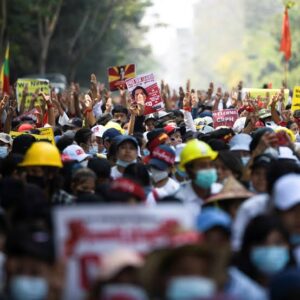
Within days of the coup, massive protests erupted across major cities and rural regions alike. Citizens from all walks of life—students, doctors, teachers, factory workers, civil servants, monks, and artists—took to the streets demanding the restoration of democracy.
A defining feature of the resistance was the Civil Disobedience Movement (CDM). Government employees refused to work under military authority, paralyzing key sectors such as healthcare, education, banking, and transportation. The movement was largely peaceful in its early stages, relying on strikes, symbolic protests, and mass demonstrations.
The scale of public participation was unprecedented in Myanmar’s history. Millions openly challenged the military, despite knowing the risks involved.
Violent Crackdown on Protesters
The military junta responded to peaceful demonstrations with escalating violence. Security forces used live ammunition, rubber bullets, stun grenades, and heavy weaponry against unarmed civilians.
Reports from across the country documented:
Protesters shot in the head or chest
Security forces firing indiscriminately into crowds
Nighttime raids targeting activists and protest organizers
Arbitrary arrests without warrants
Torture and abuse in detention centers
Entire neighborhoods were subjected to collective punishment, including arson, curfews, and mass arrests. Some of the deadliest crackdowns occurred in industrial townships and regional centers where resistance was strongest.
Thousands of civilians were killed within the first two years of military rule, and many more were injured or imprisoned.
From Peaceful Resistance to Armed Struggle
As repression intensified, many protesters concluded that peaceful resistance alone could not protect them. This led to the emergence of armed resistance groups known as People’s Defense Forces (PDFs), often formed by young activists who had participated in protests.
These groups began coordinating with long-established ethnic armed organizations that had been fighting the military for decades. What followed was a rapid expansion of armed conflict across large parts of the country.
Myanmar gradually descended into a situation resembling a nationwide civil war, with clashes occurring in multiple regions simultaneously. The military responded with airstrikes, artillery attacks, and scorched-earth tactics, particularly in areas suspected of supporting resistance forces.
Collapse of Civil Liberties and Rule of Law
Under military rule, basic freedoms have been systematically dismantled. Emergency laws grant sweeping powers to security forces, allowing arrests without charge and prolonged detention.
Key areas affected include:
Media Suppression
Independent media outlets were shut down, journalists arrested, and newsrooms raided. Reporting on military abuses became punishable by long prison sentences, forcing many journalists into exile or underground operations.
Judicial Manipulation
Courts have been weaponized to legitimize repression. Political opponents are prosecuted under vague charges such as sedition, terrorism, or spreading misinformation. Trials are often held behind closed doors, with no due process.
Targeting of Healthcare and Education
Doctors and teachers participating in civil disobedience were fired, arrested, or attacked. Hospitals were raided, and universities shut down, crippling public services and deepening social collapse.
The rule of law has effectively ceased to exist for ordinary citizens.
Human Rights Crisis Deepens
Human rights organizations describe the situation in Myanmar as one of the worst crises in the region. Abuses are widespread, systematic, and ongoing.
Documented violations include:
Extrajudicial killings
Torture and sexual violence
Forced disappearances
Attacks on villages and civilian infrastructure
Use of airstrikes against populated areas
Ethnic minority regions have been particularly hard hit, repeating patterns of abuse seen long before the coup. However, since 2021, violence has expanded nationwide, affecting communities that had never before experienced active conflict.
Humanitarian Emergency and Economic Collapse
The political crisis has triggered a severe humanitarian disaster.
Millions of people have been displaced internally, fleeing violence and destruction. Others have crossed borders seeking refuge, placing pressure on neighboring countries.
The economy has collapsed due to sanctions, instability, and mass labor strikes. Inflation, unemployment, and food insecurity have soared. Entire families struggle to afford basic necessities, while access to healthcare and education remains limited or nonexistent.
Humanitarian aid faces major obstacles, including military restrictions, insecurity, and lack of funding.
U.S. Sanctions Against the Military Junta
In response to the coup and human rights abuses, the United States imposed a series of targeted sanctions aimed at pressuring the military leadership.
These measures include:
Sanctions on senior military leaders and their families
Restrictions on military-owned companies that fund junta operations
Export controls to prevent the transfer of weapons and surveillance technology
Financial restrictions targeting military revenue streams
The goal of U.S. sanctions is to isolate the junta economically and diplomatically while avoiding broad harm to ordinary civilians.
Limitations of Sanctions
While sanctions have increased pressure on the military, they have not been sufficient to force a change in behavior. The junta continues to generate income from natural resources, trade partnerships, and regional allies.
Critics argue that uneven global enforcement and continued engagement by some countries undermine the effectiveness of sanctions. As a result, the military retains access to weapons, fuel, and funding despite international condemnation.
International and Regional Response
The global response to Myanmar’s crisis has been fragmented.
Western democracies have condemned the coup and imposed sanctions, while other powerful nations continue diplomatic and economic ties with the junta. This division has prevented strong collective action at international forums.
Regional organizations have attempted mediation, but their efforts have been criticized as slow and ineffective. Calls for dialogue have produced limited results, while violence continues on the ground.
Military-Controlled Elections and Legitimacy Crisis
The junta has attempted to legitimize its rule through tightly controlled elections. Opposition parties were banned, leaders imprisoned, and voters intimidated.
These elections were widely viewed as lacking credibility, transparency, and fairness. For most citizens and the international community, they failed to provide any genuine pathway back to democratic governance.
Resilience of Civil Society and Resistance
Despite overwhelming repression, resistance inside Myanmar persists.
Civil society groups continue to document abuses, provide humanitarian assistance, and support displaced communities. Underground networks distribute information and organize aid despite constant threats.
The resilience of ordinary people—teachers holding informal classes, doctors running secret clinics, and communities protecting one another—stands in stark contrast to the violence of military rule.
The Road Ahead for Myanmar
Myanmar’s future remains uncertain. The military shows no sign of relinquishing power voluntarily, while resistance forces lack the resources to secure a decisive victory.
Possible paths forward include:
Stronger and more coordinated international pressure
Expanded humanitarian access and protection for civilians
Long-term accountability for human rights crimes
Inclusive political dialogue involving democratic forces and ethnic groups
Any sustainable solution must prioritize the voices and safety of Myanmar’s people.
Conclusion
The Myanmar military junta crackdown represents a tragic convergence of authoritarian power, human rights abuse, and international failure. What began as a coup has transformed into a nationwide crisis marked by mass protests, violent repression, U.S. sanctions, and immense human suffering.
As the conflict drags on, millions of civilians remain trapped between military brutality and political uncertainty. Myanmar’s struggle is no longer just a domestic issue—it is a global test of commitment to democracy, justice, and human dignity.
How useful was this post?
Click on a star to rate it!
Average rating 0 / 5. Vote count: 0
No votes so far! Be the first to rate this post.
About the Author

usa5911.com
Administrator
Hi, I’m Gurdeep Singh, a professional content writer from India with over 3 years of experience in the field. I specialize in covering U.S. politics, delivering timely and engaging content tailored specifically for an American audience. Along with my dedicated team, we track and report on all the latest political trends, news, and in-depth analysis shaping the United States today. Our goal is to provide clear, factual, and compelling content that keeps readers informed and engaged with the ever-changing political landscape.