Congress Breakdown: Budget Talks Stall, Shutdown Pressure Mounts

Keep an eye on the impending government shutdown as Democrats’ demands threaten federal services for millions of people. Americans do not agree with the actions of the Democrats. Today we will discuss about Congress Breakdown: Budget Talks Stall, Shutdown Pressure Mounts
Congress Breakdown: Budget Talks Stall, Shutdown Pressure Mounts
In the halls of the U.S. Capitol and beyond, the atmosphere has turned grim: as budget negotiations collapse, government shutdown looms — and so does widespread uncertainty. Lawmakers in United States Congress appear locked in a bitter standoff, with both sides digging in and no compromise in sight. For millions of Americans, the stakes are real: furloughs, delays in essential services, and economic disruption.
What’s the Crisis?
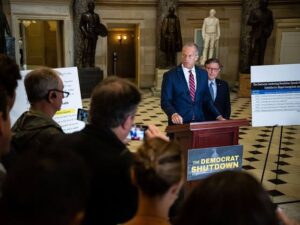
At the heart of the deadlock is the annual process to approve the federal budget — a normally routine task that this year has been thrown into turmoil under a combination of partisan polarization, executive maneuvers, and sweeping policy demands.
Congress must pass a set of appropriations bills (or a “continuing resolution” in lieu of full bills) before the start of the fiscal year, or else risk a government shutdown.
For fiscal year 2026, the deadline passed without a final agreement. Attempts at temporary stop‑gap funding measures have repeatedly failed — especially as tension flared over health‑care subsidies, spending cuts, and foreign‑aid rescissions.
A controversial tactic by the administration — using a “pocket rescission” to cancel billions in foreign aid approved by Congress — has deepened mistrust.
With no agreement in sight, the government is now operating under contingency plans; non‑essential services are stalled, and many federal workers face furloughs or are working without guaranteed pay.
In short: the budget process — once seen as a technocratic chore — has been transformed into a political battlefield, with potential national consequences.
What’s Driving the Breakdown
Several converging factors have turned this year’s budget — and shutdown fight — into arguably the most acrimonious in recent memory:
• Unilateral Moves on Spending & Cuts
The current administration has actively pursued sweeping cuts and spending freezes, even on funds previously approved by Congress. By ordering agencies to halt disbursements — including for infrastructure, foreign aid, and domestic programs — it has fundamentally challenged the conventional “power of the purse” wielded by Congress.
These moves have deeply rattled lawmakers from both parties. Such unilateral impoundments are considered a serious affront to the federal process.
Furthermore, the renewed use of the rarely invoked “pocket rescission” mechanism has underscored the administration’s willingness to bypass Congress, prompting alarm even among some members of the president’s own party.
• Partisan Polarization & Policy Demands
Republicans and Democrats remain deeply divided over core policy issues — from spending levels and foreign aid to health‑care subsidies and welfare programs. The Democratic caucus has pressed for protections for social programs and extensions of health‑insurance subsidies under the Affordable Care Act (ACA), while Republicans — holding both the presidency and a working majority in the House — have pushed for steep cuts and fiscal discipline.
The divide over ACA subsidies has become especially sharp. Repeated attempts to pass short-term funding measures have failed — largely because Democrats refuse to support any deal that doesn’t address escalating healthcare costs and subsidy deadlines.
• Deepening Distrust & Strategic Deadlock
Beyond policy differences, there’s now an institutional crisis of trust. Many Democrats believe the administration’s track record of unilateral spending freezes and rescissions undermines any future agreement — fearing that even a negotiated budget could be undercut retroactively.
On the other side, some Republicans argue that Democrats are leveraging the shutdown — and workers’ livelihoods — as a bargaining chip. As a result, both sides have hardened their positions, making compromise increasingly elusive.
The Fallout: What a Shutdown Means
If the stalemate continues and no deal is reached, the consequences could be profound — not just for government workers and agencies, but for the broader economy and American public.
• Furloughs, Service Disruptions, Worker Hardship
When funding lapses, non-essential government offices shut down. That means national parks close, passport applications slow, processing of certain benefits and applications halt, and many smaller contracts and grants are frozen. Federal employees — numbering in the hundreds of thousands — often face furloughs or may be forced to work without pay until the budget is restored.
While back pay is eventually restored (by law), immediate financial hardship can loom large for many. Frozen paychecks, disrupted services, and the uncertainty of when — or if — things will return to normal take a personal toll.
• Economic Shockwaves — Domestically & Globally
Beyond federal workers, a shutdown ripples outward — stalling infrastructure contracts, halting government‑funded research, freezing regulatory approvals, and suspending economic data releases, such as labor statistics.
Global markets have already started reacting: uncertainty over U.S. economic data and delays in policy implementation generate volatility. Some analysts warn that protracted shutdowns could shave off growth, depress consumer confidence, and impair long-term investment.
• Policy Priorities on Hold & Governance Paralysis
Vital programs — foreign aid, social welfare, infrastructure, research grants — may remain dormant for weeks or months. The inability to plan and fund ahead undermines long-term governance and strategic planning.
Moreover, repeated shutdowns erode public trust in government and feed cynicism about congressional effectiveness. For many citizens, budget brinkmanship may feel like gamesmanship with real-world consequences — not least for the most vulnerable who depend on social programs and federal support.
What Happened So Far — Key Milestones
Early 2025 — attempts to extend funding: Early in the year, lawmakers attempted to pass lighter stopgap measures to carry the government through, but failed to reach agreement on overall funding levels and conditions.
Spring 2025 — deepening disagreement: A proposed long‑term funding plan was blocked in the Senate due to lack of bipartisan support, even though it had passed the House. Republicans lacked the 60 votes needed to overcome a filibuster.
Summer 2025 — executive rescissions raise the stakes: The administration’s decision to cancel billions in foreign aid through a pocket rescission deeply alarmed lawmakers — especially since it bypassed the normal approval process.
September 2025 — approaching fiscal deadline: As the fiscal year loomed, full-year appropriations remained unresolved. House and Senate leaders scrambled to negotiate, but could not bridge their differences; short-term proposals failed.
October 1, 2025 — shutdown begins: With no deal reached, the federal government began shutting down. Many non-essential services ceased, and hundreds of thousands of workers faced furloughs or worked without pay.
As of now, weeks into the shutdown, there remains no clear path forward. Leaders on both sides have traded blame, but show little sign of shifting strategy.
Why This Time Feels Different
Some shutdowns in past years were more of a temporary nuisance — short-lived and resolved quickly. But several factors make this standoff far more serious, and potentially more lasting:
Institutional trust is eroded: The unilateral rescissions and freezes have eroded Congress’s confidence that future deals will be respected. For many Democrats, any agreement now must include strong safeguards.
Polarization is more intense: The partisan divide is deeper, and key issues — health care, foreign aid, social programs — are more contentious than typical fiscal-year funding fights. Combined with strong ideological commitments on both sides, the political will to compromise is weak.
Economic and global stakes are higher: The U.S. stands at a delicate juncture: inflation concerns, global market volatility, geopolitical tensions, and fragile economic growth mean that a prolonged shutdown could have outsized effects.
The showdown is now tied to broader governance reforms: The disputes over rescissions, agency funding, and presidential priorities suggest this is not just about “passing bills,” but about the future structure of governance — who controls what gets funded, and under what conditions.
In short: this is not a typical “end-of-fiscal-year delay.” It’s a structural crisis over how America will govern — and whether Congress or the executive will have the final say.
What Each Side Is Saying
Republicans / Administration
They argue that deep spending cuts are necessary to rein in deficits, reduce government waste, and reset priorities — especially after years of rising debt and expanding entitlement costs.
Some Republicans view Democratic demands — especially on healthcare subsidies — as red lines that must be dealt with separately, and not as conditions for funding the entire government. They want to decouple policy fights from the funding process.
On rescissions, supporters claim the executive has the right — under certain interpretations — to freeze or rescind funds, especially if Congress-authorized programs are viewed as wasteful or misaligned with priorities.
Democrats / Budget Opponents
For Democrats, the unilateral rescissions and freezes represent a dangerous overreach — undermining Congressional authority over the budget and weakening agencies before Congress even votes.
The party is demanding protections for social programs, healthcare subsidies, and assurances that essential services will not be slashed arbitrarily.
Democrats have signaled they are willing to sit tight — even if it means letting the shutdown drag on — rather than agree to a funding bill that fails to address their priorities.
What Happens If the Shutdown Drags On — Worst‑Case Scenarios
Major economic disruption: Economic data releases may halt, spooking global financial markets, eroding investor confidence, and dampening economic growth.
Social and public-service collapse for vulnerable groups: Social welfare programs, veterans’ benefits, public-health services, and foreign aid may remain frozen — harming millions.
Long-term loss of trust and institutional damage: Repeated shutdowns erode public faith in government and weaken U.S. global standing.
Political instability and electoral consequences: Public anger may rise, and both parties risk reputational damage.
What Could Resolve the Deadlock — and What’s Blocking It
Possible Paths to Resolution
Bipartisan compromise on a short-term continuing resolution: To reopen the government and buy time for negotiations.
Modular appropriation bills: Passing smaller bills for “safe” areas first, while negotiating contested programs separately.
Guarantees / safeguards: Legal assurances that funds won’t be unilaterally rescinded.
Executive-legislative negotiation reset: The President or White House may step in to broker a deal, restoring trust and offering concessions.
Why Those Options Are Stalled
Republicans remain split: some fear concessions will undercut the “fiscal discipline” agenda.
Democrats mistrust the administration’s willingness to abide by future agreements.
The issues aren’t just financial, but ideological: healthcare, social welfare, foreign policy.
As the shutdown drags on, pressure mounts not only from voters, but also from within parties — making compromise politically difficult.
Broader Implications — What’s at Stake for America
Power dynamics: Success of executive rescissions could shift the balance of power toward the presidency.
Precedent for future budgets: Other administrations may follow similar tactics, making shutdowns more common.
Erosion of public trust: Repeated shutdowns deepen cynicism about government and reduce civic engagement.
Global ripple effects: Delays in foreign aid and international commitments may weaken U.S. influence abroad.
Long-term economic damage: Uncertainty over funding may discourage investment, delay infrastructure, and harm contractors dependent on government contracts.
In other words: this is more than a budget fight. It’s a test of governance, constitutional norms, and America’s capacity to sustain functioning government in a polarized age.
What to Watch Next
Whether a new “clean” continuing resolution emerges and clears the Senate filibuster.
Whether the White House intervenes directly, offering concessions or a negotiating reset.
The response of federal employees, contractors, and public services.
The reaction of markets, investors, and global economic partners.
Public opinion and pressure, especially if the shutdown affects everyday services and economic stability.
Conclusion
The current budget breakdown in Congress is not just a routine political standoff — it is a crisis of trust, institutions, and governance. What lies ahead is not merely a question of who yields first, but of whether the structures that have governed U.S. federal spending for decades can hold up under partisan pressure.
With federal workers furloughed, essential services frozen, and billions of dollars caught in limbo, the American public is already paying the cost. Unless leaders on both sides find a way to compromise, the consequences could be severe and long-lasting.
How useful was this post?
Click on a star to rate it!
Average rating 0 / 5. Vote count: 0
No votes so far! Be the first to rate this post.
About the Author

usa5911.com
Administrator
Hi, I’m Gurdeep Singh, a professional content writer from India with over 3 years of experience in the field. I specialize in covering U.S. politics, delivering timely and engaging content tailored specifically for an American audience. Along with my dedicated team, we track and report on all the latest political trends, news, and in-depth analysis shaping the United States today. Our goal is to provide clear, factual, and compelling content that keeps readers informed and engaged with the ever-changing political landscape.