White House Move, America Reacts: New Strategy Could Change 2026 Election Map

The new Texas map endorsed by Donald Trump has spurred similar efforts at partisan redistricting across the US. Today we will discuss about White House Move, America Reacts: New Strategy Could Change 2026 Election Map
White House Move, America Reacts: New Strategy Could Change 2026 Election Map
In late 2025, the United States found itself in the midst of a political and cultural turning point. The White House — both as a symbol and as a seat of executive power — became the center of two dramatic, simultaneous changes. One was physical and highly visible: the demolition of the historic East Wing to make way for an enormous new state ballroom. The other was ideological: a sweeping shift in U.S. national security strategy that signaled a pronounced turn toward hemispheric dominance and a redefinition of America’s global role.
Individually, each change might have generated controversy. Together, they created shockwaves felt across the political spectrum. They are now reshaping public sentiments, energizing activists, and influencing early forecasts of the 2026 congressional map.
These developments are not isolated events. They are part of a broader political climate in which institutions are under pressure, norms are being rewritten, and the American public is deeply divided over the direction of the nation. As a result, the 2026 midterms are shaping up to be more than a referendum on party performance — they are becoming a judgment on the future identity of the United States.
II. The East Wing Demolition: Tradition Meets the Wrecking Ball
A Historic Structure Removed
The White House’s East Wing has stood in one form or another for more than a century. It housed the offices of First Ladies, served as the public entrance for millions of visitors, and played a quiet but essential role in the daily functioning of the executive branch. Its removal stunned Americans who saw it as a permanent part of national heritage.
When demolition began, photos of wreckage replaced images of quiet corridors and iconic architecture. For many, it felt like witnessing the tearing down of a shared memory. Historians and preservationists described the move as reckless and unnecessary, arguing that it severed a tangible link to the past.
A Ballroom That Divides Public Opinion
The proposed replacement — a massive, nearly 100,000-square-foot ballroom — is designed to host large gatherings, state dinners, and high-profile events. Supporters argue that such a space would modernize a building strained by security demands and outdated facilities. They see it as an investment in the future of presidential diplomacy and domestic functionality.
Critics see something altogether different.
To them, the ballroom symbolizes vanity, personalization, and the transformation of a national landmark into a monument to individual power. Public polling shows a clear majority opposing the demolition and skeptical of the project’s necessity. Even within the president’s own political base, enthusiasm for the ballroom is far from universal.
A Cultural Flashpoint
If America has always viewed the White House as the “people’s house,” the demolition has triggered fears that this identity is being reshaped. Messages flooding social platforms from across the political spectrum describe the project as unnecessary, indulgent, or disrespectful. Many consider the destruction of such a historic structure a symbolic rupture — a statement that tradition is expendable.
In that sense, the ballroom has become more than architecture. It is a metaphor. And metaphors, especially highly visible ones, have power in politics.
III. A Radical Shift in National Security Strategy
While the East Wing fell, the administration unveiled a sweeping national security doctrine that represented a dramatic break from decades of American foreign policy philosophy.
A New Doctrine Rooted in Dominance
The new strategy places strong emphasis on hemispheric leadership, regional power, and a scaled-down role in global multilateral institutions. It suggests that the United States should prioritize strategic dominance close to home rather than broad commitments abroad.
The language is bold: reclaiming primacy, securing influence in the Western Hemisphere, and re-evaluating alliances that no longer serve what the White House describes as “core national interests.”
Signals to Allies — and Rivals
The doctrine has startled long-time allies, particularly in Europe, who see the shift as a departure from decades of partnership based on shared democratic values. Some foreign leaders warn that the change could weaken collective security, empower rival powers, and destabilize established global norms.
Others argue that the U.S. is simply acknowledging geopolitical realities, focusing on regions where its leverage is strongest and its interests clearest.
Domestic Reactions: Support, Skepticism, and Strategic Anxiety
On the domestic front, reactions to the new doctrine are mixed:
Supporters praise what they see as a long-overdue reassertion of national sovereignty.
Critics fear the move signals a retreat from global leadership.
Analysts warn that sudden strategic shifts can produce unintended consequences, from diplomatic friction to economic instability.
Elected officials on both sides of the aisle are grappling with what the new foreign policy will mean in the long term — and whether voters will embrace it in 2026.
IV. The 2026 Election Map: Redrawn Boundaries and Rising Stakes
As the White House transforms physically and strategically, another major development is occurring nationwide: aggressive redistricting that may influence control of Congress.
Redistricting Battles Intensify
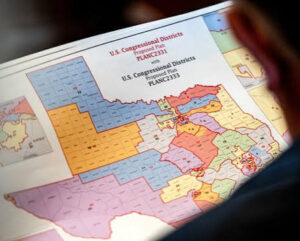
Several states have introduced new congressional maps that dramatically alter district boundaries. Critics argue these maps entrench partisan interests and reduce the number of competitive seats.
This trend, combined with increasing geographic polarization — urban, diverse districts voting heavily Democratic, and rural regions trending decisively Republican — has created an electoral landscape with fewer swing districts and more predictable outcomes.
Political Power May Be Less About Votes and More About Boundaries
Analysts warn that under these new maps:
A party may win a majority of seats without winning a majority of national votes.
Traditional “battleground districts” may disappear.
Control of the House could hinge on a handful of states where district lines are most aggressively drawn.
In this environment, 2026 could produce outcomes that feel disconnected from broad public sentiment — deepening distrust in elections and institutions.
V. Public Sentiment: Anger, Nostalgia, and an Identity Crisis
The overlap of White House demolition, strategic recalibration, and electoral redistricting has intensified emotional reactions nationwide.
A Feeling of Loss
The removal of the East Wing strikes many Americans as a needless destruction of heritage. Even people who generally support the administration express discomfort at seeing part of the White House reduced to rubble.
What they are mourning is not just architectural history, but a sense of continuity — the idea that some elements of national identity remain untouched, no matter which party holds power.
Polarization Deepens
For critics, the ballroom symbolizes excess, personalization of government, and a disregard for shared institutions. For supporters, it represents modernization and the right of an elected president to shape the executive residence.
This divide mirrors the larger political rift within the country: competing visions of what America should be, who should lead it, and how its institutions should evolve.
Fear and Uncertainty
The new foreign policy doctrine adds another layer of anxiety. Voters across the political spectrum worry about America stepping away from long-standing alliances, or about entering new geopolitical confrontations as it asserts dominance in the Western Hemisphere.
Together, these shifts have created an atmosphere of uncertainty — a feeling that the country is entering territory unlike anything in recent memory.
VI. What the White House Shift Could Mean for 2026
1. The Midterms May Become a Referendum on Identity
The ballroom, the demolition, and the foreign policy overhaul are not just policy decisions. They’ve become cultural symbols. As a result, the 2026 midterms may function less as a traditional evaluation of congressional performance and more as a national verdict on the direction of American identity.
2. Congressional Control Could Shift Even Without Changing Minds
Because of new district boundaries, both parties face a political map in which structural advantages may matter more than broad public sentiment. The outcome may depend heavily on turnout strategies, court rulings on redistricting, and local political dynamics rather than national viewpoints.
3. Public Trust Is at Stake
Perhaps the greatest consequence of the White House changes is the potential erosion of public confidence. When national symbols are altered, policy doctrines rewritten, and electoral maps redrawn all at once, voters may feel the ground shifting beneath them.
The question facing the nation is no longer simply “Who should win?” It’s: “What kind of country do we want to be?”
VII. Conclusion: A Country at a Pivotal Moment
The United States is witnessing a convergence of events unprecedented in modern history:
A dramatic physical alteration of its most iconic structure.
A sharp redefinition of national security priorities.
A contentious redrawing of the electoral map.
Each of these developments would be significant on its own. Together, they suggest that the 2026 elections may be one of the most consequential political moments of the decade.
The demolition of the East Wing is more than the loss of a building; it has become a symbol of deeper shifts in national values. The new strategic doctrine represents a redirection of American identity on the global stage. And the redistricting battles point toward a changing, and perhaps more fragile, democratic landscape.
As America reacts — with anger, hope, nostalgia or determination — one thing is clear: the White House move has started a national conversation that will not end soon. In many ways, 2026 will not simply determine political control — it will help define what future generations understand America to be.
How useful was this post?
Click on a star to rate it!
Average rating 0 / 5. Vote count: 0
No votes so far! Be the first to rate this post.
About the Author

usa5911.com
Administrator
Hi, I’m Gurdeep Singh, a professional content writer from India with over 3 years of experience in the field. I specialize in covering U.S. politics, delivering timely and engaging content tailored specifically for an American audience. Along with my dedicated team, we track and report on all the latest political trends, news, and in-depth analysis shaping the United States today. Our goal is to provide clear, factual, and compelling content that keeps readers informed and engaged with the ever-changing political landscape.