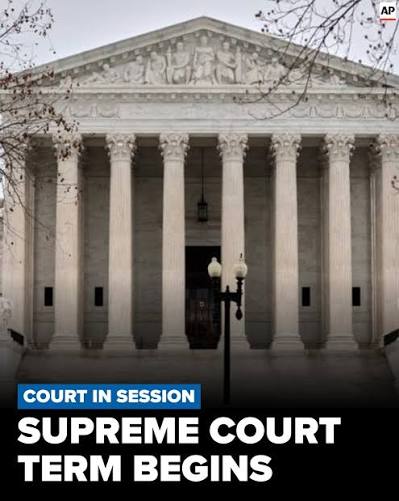
Supreme Court Shock: New Ruling, Parties Split
The Supreme Court rejected the petition of political parties demanding imposition of tax. The political class can join hands, create division in the movement and cause sabotage. Today we will discuss about Supreme Court Shock: New Ruling, Parties Split
Supreme Court Shock: New Ruling, Parties Split
In a stunning development that reverberated across the American political landscape, the United States Supreme Court issued a ruling that instantly jolted both parties and reignited national debates over voting rights, redistricting, and democratic fairness. In a 6–3 decision along ideological lines, the Court reinstated a controversial Texas congressional map that a lower court had previously struck down as an unconstitutional racial gerrymander.
The ruling came at a critical moment — just months before candidate filing deadlines for the 2026 midterm elections — and its immediate effect was to greenlight a map widely believed to favor Republican control of several key districts. The outcome shocked many observers not only because of its timing, but because it overrode detailed fact-finding by a lower court, raised fundamental questions about representation, and solidified the Supreme Court’s increasingly decisive role in partisan redistricting battles.
The decision has drawn cheers from conservatives and fierce criticism from civil-rights groups and Democratic lawmakers. But beyond the immediate political fallout, the ruling signals a much deeper transformation in how America’s highest court views election law — one that could shape democratic processes for years to come.
Background: How the Case Reached the Supreme Court

Texas’ 2025 Congressional Map
In mid-2025, Texas lawmakers passed a new congressional map following population changes recorded in the census and rapid demographic shifts across the state. The Republican-controlled legislature defended the map as a routine update necessary to reflect growth and ensure balanced representation.
However, voting-rights groups and several Democratic-aligned organizations swiftly challenged the map in federal court. They argued that the redrawn districts were engineered with the deliberate intent to dilute the voting strength of minority communities — especially Black and Hispanic voters — by either packing them into a small number of districts or spreading them thinly across multiple districts to reduce their collective influence.
The Lower Court’s Findings
A three-judge federal panel in El Paso spent weeks reviewing extensive testimony, demographic data, and expert analysis. Their ruling concluded that Texas lawmakers used racial data as a key input when drawing boundaries, resulting in districts that disadvantaged minority voters.
The court blocked the map from being used in the 2026 elections, directing the state to create a new map or use an alternative plan that did not rely on racial classifications.
Texas immediately appealed.
The Supreme Court’s Ruling: A Divided, High-Stakes Decision
On December 4, 2025, the Supreme Court issued its decision reinstating the Texas map. While the order was unsigned, the 6–3 split left no doubt: the conservative majority supported Texas’ request, while the three liberal justices dissented sharply.
Key Points of the Majority Opinion
Although brief, the Court’s rationale rested on several pillars:
Timing Concerns
The majority argued that the lower court’s decision came too close to the 2026 election cycle. Federal courts, the justices wrote, should avoid altering election rules when primaries are already in motion, as doing so risks voter confusion and administrative chaos.Deference to State Legislatures
The ruling emphasized that legislatures should be presumed to act in “good faith” unless challengers provide overwhelming evidence of unconstitutional intent. According to the Court, the lower court did not sufficiently defer to that principle.Partisan vs. Racial Gerrymandering
Some conservative justices acknowledged that the map likely favored Republicans but maintained that partisan gerrymandering — unlike racial gerrymandering — is not itself unconstitutional. Because the state framed the design as a partisan strategy, the Court found limited grounds for intervention.Alternative Maps
The Court noted that challengers had not presented a viable alternative map that met legislative aims without compromising political considerations.
The Liberal Dissent
Justice Elena Kagan, writing for the three liberal justices, issued a blistering dissent.
She argued that:
The lower court’s extensive record — including thousands of pages of evidence and dozens of witnesses — clearly demonstrated the use of racial data in designing the map.
The Supreme Court overstepped by dismissing that record without full review.
The majority’s position effectively weakens constitutional safeguards for minority voters.
Elevating timing concerns above substantive findings undermines the judiciary’s role as guardian of equal protection.
Her dissent warned that the Court’s decision “rewards racial gerrymandering so long as it is disguised within partisan intent.”
Political Fallout: A Deep National Divide
The decision immediately triggered celebrations in some political circles and outrage in others.
Republican Response: Triumph and Strategy
Republican officials in Texas and nationwide hailed the ruling as a major victory:
State leaders framed the decision as a vindication of legislative authority.
Party strategists quickly predicted that the map would strengthen the GOP’s hold on several competitive districts.
Some Republican state governments hinted that they might pursue similar redraws, interpreting the ruling as a green light for more aggressive gerrymandering.
In short, conservatives viewed the ruling not only as a win in Texas, but as an opportunity to reshape electoral maps across multiple states before the 2026 midterms.
Democratic and Civil-Rights Reaction: Shock and Alarm
Democratic lawmakers, voting-rights advocates, and civil-rights organizations condemned the ruling as a setback for minority representation. Their criticisms centered on several themes:
The Court ignored exhaustive evidence of racial discrimination.
The ruling undermines protections guaranteed by the Voting Rights Act and Constitution.
The decision emboldens states to enact maps that entrench partisan power at the expense of fair competition.
Some described the decision as “a new era of sanctioned gerrymandering,” warning that democracy itself is at risk if courts fail to intervene against discriminatory maps.
Why the Ruling Is Being Called a “Supreme Court Shock”
This decision stands out not simply because of its outcome, but because of the broader signals it sends about election law and judicial philosophy.
1. A Sudden and Significant Reversal
The lower court’s ruling was detailed and forceful, based on an extensive factual record. The Supreme Court’s reinstatement of the map — without full hearings or prolonged review — struck many as abrupt.
2. Timing and Political Consequences
Issuing such a consequential ruling so close to the start of the 2026 campaign cycle amplifies its political implications. It immediately reshapes the electoral landscape and alters congressional prospects in a high-stakes midterm year.
3. A Shift in Judicial Attitude
For years, the Court has signaled reluctance to intervene in redistricting disputes. This ruling appears to take that hesitation even further: essentially declaring that unless racial intent is overwhelmingly proven, legislatures retain near-complete authority to shape districts for partisan advantage.
4. Spillover Effects Beyond Texas
Because Texas is one of the largest and most politically influential states, its redistricting battles often serve as a preview of national trends. States with similar legislative majorities may now attempt ambitious redraws, expecting judicial deference.
5. Implications for Minority Voting Rights
The decision may weaken minority communities’ ability to challenge discriminatory maps in future cases, raising concerns that political power could shift even further away from demographic realities.
Long-Term Consequences for Democracy and Representation
Impact on Minority Voters
For Black, Hispanic, and Asian American communities — many of whom reside in rapidly growing urban or suburban areas — the reinstated map could reduce political influence for years. Gerrymandering often results in:
Fewer competitive districts
Reduced representation even where populations are large
Lower overall turnout due to perceived disenfranchisement
Many activists fear the ruling will discourage lawsuits against future discriminatory maps, as courts may continue to prioritize procedural timing over substantive fairness.
Political Power and House Control
Strategists across both parties agree: this ruling could significantly affect control of the U.S. House of Representatives. Texas alone holds 38 congressional seats, and even minor adjustments in district lines can swing several key races.
Some analysts believe the decision may prompt a wave of redistricting efforts in other GOP-controlled states before 2026 — a phenomenon that may reshape electoral competitiveness nationwide.
Trust in the Judiciary
The ruling also fuels ongoing questions about the Supreme Court’s impartiality. A decision that aligns so closely with a single party’s political fortunes — especially in a 6–3 ideological split — risks deepening public doubts about judicial neutrality.
Critics argue that the Court is becoming an increasingly political actor, while supporters claim it is simply enforcing procedural consistency.
Either way, public perception is changing.
Global Resonance: Why Other Democracies Are Watching
Although the ruling concerns American elections, its implications extend far beyond U.S. borders.
Courts worldwide frequently face similar disputes over electoral boundaries, minority rights, and political fairness. When the U.S. Supreme Court — often viewed internationally as a model institution — issues a ruling that appears to validate partisan gerrymandering, it sends an influential message.
For emerging democracies or politically fragmented nations, decisions like this may serve as justification for:
Using redistricting to entrench power
Weakening independent electoral commissions
Undermining minority representation
In this sense, the “shock” is not just domestic — it resonates globally.
What Happens Next?
1. More State-Level Redistricting Efforts
Republican-led states are likely to pursue new or revised maps before 2026, testing how far the Supreme Court’s logic can be extended.
2. Renewed Push for Federal Legislation
Democratic leaders and voting-rights groups may escalate calls for national redistricting standards — including independent commissions or stronger Voting Rights Act protections.
3. Court Reform Debates
Discussions about Supreme Court reform — from term limits to expansion — may gain renewed urgency among activists who view the Court as increasingly partisan.
4. Grassroots Mobilization
Voting-rights organizations may shift their strategy toward voter registration, turnout campaigns, and community organizing to counteract the effects of gerrymandering on the ground.
5. Ongoing Legal Battles
Even with this ruling, challenges may continue in lower courts on separate grounds. Future lawsuits could focus on intent, turnout data, or alternative evidence of discrimination.
Conclusion: A Turning Point for U.S. Democracy
The Supreme Court’s reinstatement of the Texas congressional map is more than a procedural ruling. It is a defining moment that exposes deep divisions in American politics and raises fundamental questions about fairness, representation, and constitutional protections.
For some, the decision restores stability and respects state authority. For others, it undermines decades of progress in securing equal voting power for minority communities.
What is certain is that the ruling will influence not just Texas, but the national political landscape — from the 2026 midterms to future redistricting cycles and beyond. Whether history views this moment as a course correction or a democratic backslide will depend on what comes next: in courts, legislatures, and ultimately, at the ballot box.
How useful was this post?
Click on a star to rate it!
Average rating 0 / 5. Vote count: 0
No votes so far! Be the first to rate this post.
About the Author

usa5911.com
Administrator
Hi, I’m Gurdeep Singh, a professional content writer from India with over 3 years of experience in the field. I specialize in covering U.S. politics, delivering timely and engaging content tailored specifically for an American audience. Along with my dedicated team, we track and report on all the latest political trends, news, and in-depth analysis shaping the United States today. Our goal is to provide clear, factual, and compelling content that keeps readers informed and engaged with the ever-changing political landscape.