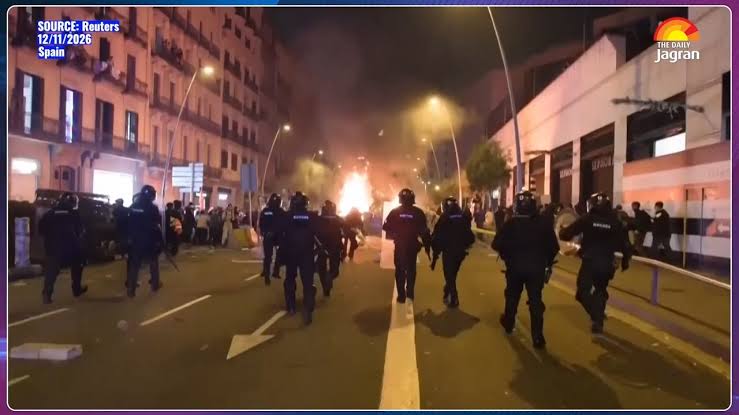
Tension, smoke, and fury gripped the major urban centers of Spain as police clash with protesters in Spain during what has become one of the most volatile days of civil unrest in recent European history. The streets of Madrid, Barcelona, Valencia, and other major cities transformed into battlegrounds as a historic general strike—the first nationwide 24-hour labor stoppage in 14 years—boiled over into violent skirmishes.
The unrest represents the culmination of months of mounting public rage over soaring housing costs, predatory property speculation, declining purchasing power, and intense economic pressure. With a snap general election looming, the chaotic scenes across the Iberian Peninsula have thrust socio-economic grievances to the absolute center of national politics.
Anatomy of a Nationwide Explosion

The seeds of the current crisis were planted over a decade of compounding financial strain, but the immediate catalyst for the mass mobilization erupted following a wave of public outrage over evictions and skyrocketing rental markets. Over the past ten years, average rents across Spain have surged by roughly 80 percent, while the overall cost of homeownership has climbed by 63 percent. For millions of working-class citizens and young adults, finding stable, affordable housing has transformed into an insurmountable challenge.
The boiling point was reached after a series of high-profile housing scandals and the tragic post-eviction death of elderly citizens, most notably 87-year-old Maricarmen Abascal, who was forced from her lifelong home. Grassroots tenant unions, labor syndicates, and civil rights groups quickly organized, demanding strict rent controls, the prohibition of corporate “vulture funds” from buying residential properties, and enforceable protections for vulnerable tenants.
When political wrangling in the Spanish parliament resulted in key housing reform decrees being voted down or stalled, public patience evaporated. Labor organizations called for an absolute nationwide shutdown, urging workers to abandon their posts and take to the streets.
The General Strike Paralyzes the Country
Despite severe weather warnings and heavy rainstorms battering parts of the country, millions of workers participated in the historic 24-hour general strike. Transport hubs, major industrial estates, and commercial markets were heavily disrupted from the early hours of the morning.
Picket Lines and Roadblocks: In Catalonia and Andalusia, unions reported exceptionally high participation.Protesters erected roadblocks using burning tires and debris, bringing public transportation and major arteries like the AP-7 motorway to a standstill.
Commercial Shutdowns: Along Madrid’s famed Gran Vía and Barcelona’s central shopping districts, local businesses drew down their metal shutters early as massive columns of demonstrators marched past chanting slogans such as “No more rents! Rent strike now!”
Disputed Turnout: While organizers and tenant unions claimed that up to 4 million workers participated nationwide, business federations such as the Spanish Confederation of Business Organizations (CEOE) downplayed the impact, characterizing participation as uneven and noting that electricity consumption dropped by only about five percent.
When Protests Turn Violent: Police Clashes Escalate
As day turned to evening, peaceful marches in major metropolitan hubs gave way to intense confrontations. In downtown Madrid and central Barcelona, groups of masked and hooded individuals splintered away from the main demonstrations, hurling paving stones, glass bottles, and other projectiles at riot police.
Security forces—including Spain’s National Police and Catalonia’s regional Mossos d’Esquadra—responded aggressively to disperse the crowds. Officers deployed tear gas, pepper spray, rubber bullets, and baton charges to clear streets and protect commercial properties from vandalism and looting.
Law enforcement agencies reported at least 73 to over 80 arrests nationwide stemming from more than 1,000 separate incidents involving industrial blockades, structural damage to street furniture, and clashes with authorities. Numerous injuries were reported among both demonstrators and police officers as emergency services scrambled to respond to hundreds of calls regarding street fires and property damage.
Key Factors Driving the Spanish Unrest
Political Fallout and the Upcoming Snap Election
The widespread social upheaval has sent shockwaves through the Spanish political establishment. Prime Minister, whose administration has faced intense scrutiny over its handling of the housing crisis, called an early snap general election scheduled for November 29.
The timing of the election is viewed by political analysts as a high-stakes gamble. With far-right and conservative opposition parties gaining momentum by capitalizing on public discontent, the general strike and subsequent street violence serve as a stark litmus test of voter anger.
Tenant union leaders and activist spokeswomen have vowed to maintain pressure on whichever coalition emerges victorious in November. In fiery public addresses, organizers declared that a new era of militant labor and housing activism has been born in Spain—one that will not accept empty political promises.
As cleanup crews sweep away the debris from Madrid and Barcelona’s central plazas, the fundamental question remains whether institutional politics can successfully resolve a housing affordability crisis that has driven thousands to the barricades.
Frequently Asked Questions (FAQs)
1. Why did police clash with protesters in Spain?
Clashes erupted during a nationwide general strike called to protest Spain’s severe housing affordability crisis, soaring rents, cost-of-living pressures, and stagnant purchasing power. While most demonstrations were peaceful, sporadic violence broke out when small groups of protesters threw projectiles at police and vandalized property, prompting security forces to use tear gas and rubber bullets.
2. How many people participated in the general strike?
Unions and organizers reported that approximately 4 million workers took part in the 24-hour nationwide stoppage, with hundreds of thousands joining street rallies in Madrid and Barcelona. Business associations disputed these figures,arguing that economic disruption was uneven and limited.
3. What caused the housing crisis in Spain?
Over the past decade, average rental prices across Spain have surged by roughly 80 percent, driven by property speculation, short-term tourist rentals, gentrification, and a lack of affordable housing supply.
4. How many people were arrested during the protests?
Law enforcement authorities reported at least 73 to over 80 arrests nationwide following various incidents, including industrial blockades, street fires, and clashes with riot police.
5. Are there upcoming elections in Spain?
Yes. Amid mounting political pressure and deadlock over housing legislation, an early snap general election has been scheduled for November 29.
6. What are the main demands of the protesters?
Protesters are demanding strict regulation of rental prices, a ban on evictions of vulnerable tenants, restrictions on corporate property buyers (“vulture funds”), and comprehensive legislative action to guarantee housing as a fundamental human right.
Millions in Spain join general strike, protesting housing crisis
This news report covers the massive turnout and ground-level realities of the nationwide general strike and housing protests across Spain.
About the Author