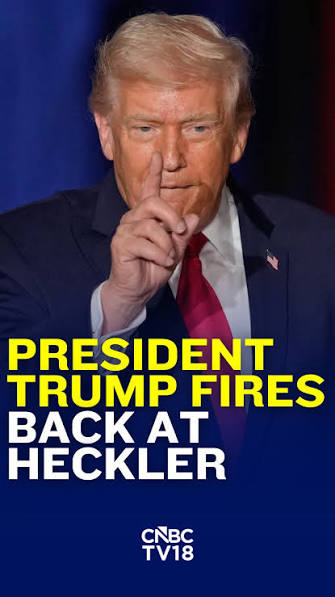
President Donald Trump turned a brief interruption at a South Carolina campaign rally into one of the most talked-about moments of the event after joking that a heckler was “going home to mom.”
The exchange happened during Trump’s August 21, 2026, rally at the Myrtle Beach Convention Center, where he was campaigning for Republican Senate candidate Darline Graham. A protester interrupted the president while he was speaking before police and venue staff escorted the person from the room.
Trump responded almost immediately, telling the crowd that the person was “going home to mom” and would be scolded because, according to Trump, the protester’s mother was voting for Trump.
The remark generated laughter and cheers from Trump’s supporters and quickly spread across social media and news platforms.
The Trump heckler roast was only a brief part of a much longer political speech, but it captured attention because it combined Trump’s familiar rally style with a simple personal joke aimed at an interrupter.
What Happened During Trump’s Rally?
Trump was speaking in Myrtle Beach as part of his effort to help Darline Graham in the Republican Senate primary runoff.
According to reporting on the event, a protester stood up during Trump’s remarks and disrupted the rally. The person was wearing a black T-shirt with a provocative message and was subsequently escorted from the convention center.
Rather than allowing the interruption to dominate the event, Trump briefly addressed it.
He joked that the protester would be going home to their mother and suggested that the mother supported Trump.
The president then returned to his speech.
A transcript of the rally records the exchange and shows that Trump quickly moved back to his broader political message after making the joke.
That response was important because political rallies frequently face interruptions, but Trump’s approach was designed to keep the audience engaged rather than turn the moment into a prolonged confrontation.
Why the “Going Home to Mom” Comment Got Attention
The phrase became the defining soundbite from the incident because it was short, personal and easy to repeat.
Trump has frequently used humor and improvisation during campaign rallies. His political style often involves responding directly to people in the crowd, including supporters, protesters and hecklers.
In this case, the joke transformed an interruption into entertainment for the audience.
The line also fit the atmosphere of the rally. Trump’s supporters reacted positively, while clips of the exchange began circulating online.
Fox News highlighted the incident under the headline “Trump mocks heckler: ‘Going home to mom.’”
Other outlets similarly focused on Trump’s suggestion that the protester’s mother supported him. The Times of India reported that Trump brushed off the interruption with a quip about the demonstrator’s mother.
The moment therefore became more than a simple interruption. It became a viral political clip.
Trump Heckler Roast Comes as GOP Focuses on Turnout
The timing of the incident is significant.
Trump was not in Myrtle Beach simply to deliver a general political speech. He was there to campaign for Darline Graham ahead of the Republican Senate runoff.
Trump repeatedly emphasized the importance of Republican turnout.
One of his central arguments was that his supporters needed to vote even though his own name would not appear on the ballot.
Trump encouraged South Carolina Republicans to treat the election as though he himself were running, using the phrase “pretend I’m on the ballot” as a way to motivate his supporters.
That message reveals the larger political objective behind the rally.
The heckler exchange may have generated headlines, but the real purpose of the event was electoral: helping Graham secure the Republican nomination and encouraging Trump’s political base to participate.
Who Is Darline Graham?
Darline Graham is running for a full Senate term in South Carolina after being appointed to fill the seat previously held by her late brother, Senator Lindsey Graham.
The Republican primary runoff is a major test of Trump’s influence over South Carolina’s GOP voters.
Trump has strongly backed Graham and used his appearance in Myrtle Beach to urge supporters to vote for her.
Graham’s initial primary performance placed her ahead of Rep. Ralph Norman, setting up a runoff between the two candidates. Reporting on the race said Graham received 32.7% of the vote, while Norman received 24.6%.
The runoff therefore became an important contest within the Republican Party.
Trump’s decision to campaign personally for Graham demonstrates how seriously his political network is treating the race.
Is There Really “GOP Panic”?
The phrase “GOP panic” in discussions surrounding the rally should be understood carefully.
There is no clear evidence from the reported heckler incident itself that Republicans were experiencing a party-wide panic.
Instead, the broader concern is about turnout.
Trump openly acknowledged that Republican candidates can face a challenge when he himself is not on the ballot. His argument was that some voters who strongly support him may be less motivated to participate in elections involving other Republican candidates.
That is why he urged supporters to imagine that Trump was personally on the ballot.
The issue is particularly important ahead of the 2026 midterm elections.
Control of Congress will depend heavily on turnout, candidate strength and the ability of both parties to mobilize their supporters.
For Republicans, Trump’s popularity among his core supporters can be a major electoral asset, but it also creates a strategic question: can that enthusiasm transfer effectively to other candidates?
The Heckler Incident Was Brief
Despite the attention surrounding the exchange, the interruption itself was extremely short.
The protester was escorted out, Trump made his comment and the president continued with his speech.
A White House pool report cited in news coverage placed the interruption at approximately 7:28 p.m.
This is important because some social-media posts can make a short rally moment appear to be a much larger confrontation.
There was no extended debate between Trump and the protester.
Trump did not leave the stage.
The rally continued.
The incident was essentially a few seconds of unscripted political theater during a much longer campaign event.
Trump’s Use of Humor at Political Rallies
Trump’s political communication has long relied on humor, nicknames, repetition and direct engagement with crowds.
That style allows him to respond quickly when something unexpected happens.
Instead of ignoring the heckler completely, Trump incorporated the disruption into his remarks.
His “going home to mom” comment gave the crowd a simple narrative: the protester had been removed, the president had responded with a joke, and the rally could continue.
For supporters, that can reinforce the perception that Trump is comfortable under pressure.
For critics, however, such comments can be viewed as another example of Trump’s tendency to personalize political confrontations.
That divide is part of what makes Trump’s rally moments so likely to generate online discussion.
Why Social Media Amplifies Moments Like This
Modern political campaigns operate far beyond the physical rally venue.
A campaign speech that lasts more than an hour can produce dozens of short video clips. The most memorable moments are often not the central policy announcements but unexpected exchanges.
The Trump heckler roast is a perfect example.
The full event focused heavily on the South Carolina Senate race, Republican turnout and Trump’s political agenda.
Yet a short exchange involving a protester and a reference to the protester’s mother became one of the most shareable moments.
This happens because short clips are easy to understand without additional context.
A viewer does not need to watch the entire rally to understand the joke.
That makes the moment particularly suitable for platforms such as X, Facebook, YouTube and short-video services.
The Bigger Political Message Behind the Rally
Although the heckler exchange dominated some headlines, Trump’s broader message was about the Republican Party’s future.
He warned supporters that Democrats could gain control of Congress if Republicans fail to turn out.
He also framed the South Carolina Senate contest as part of the larger fight over his administration’s agenda.
According to reporting from the rally, Trump highlighted issues including taxes, immigration, military policy and economic concerns while urging Republicans to support Graham.
That strategy reflects the continuing importance of Trump’s personal political brand.
Even when his name is absent from a ballot, Trump wants voters to see Republican candidates as representatives of his broader political movement.
Could the Moment Help Republican Turnout?
It is too early to determine whether the heckler exchange will have any measurable effect on turnout.
Political campaigns depend on many factors, including advertising, candidate organization, voter concerns, debates, early voting and the strength of party machinery.
A viral moment can generate attention, but attention does not automatically translate into votes.
The larger significance of the rally is Trump’s effort to activate his supporters.
His message was straightforward: Republican voters should not stay home simply because Trump himself is not a candidate in the particular race.
That message may be more consequential for the GOP than the joke about the heckler.
Supporters and Critics See the Moment Differently
Trump’s supporters are likely to view the exchange as another example of his ability to respond quickly and humorously to an interruption.
The crowd’s reaction suggested that many attendees enjoyed the remark.
Critics, meanwhile, may see the comment as unnecessarily dismissive or mocking.
That disagreement is unlikely to disappear.
Trump’s political communication has always generated sharply different reactions. The same sentence can be celebrated by supporters and criticized by opponents.
The “going home to mom” comment fits that pattern.
It is a small moment, but it illustrates the broader polarization surrounding Trump’s public appearances.
What Happens Next in South Carolina?
The immediate political focus is the Republican Senate runoff involving Darline Graham and Ralph Norman.
The winner will move forward toward the November general election.
Trump’s endorsement gives the race national attention, while the Republican primary itself offers a test of his influence over voters.
The president’s appearance also demonstrates how important South Carolina remains to Republican politics.
Trump’s goal is not simply to generate headlines. He wants his supporters to participate in the election and help Republican candidates win.
The rally’s message was therefore much larger than the heckler incident.
Trump Heckler Roast: The Viral Moment in Context
The Trump heckler roast is likely to remain a memorable clip from the Myrtle Beach rally because it was spontaneous, humorous and easy to share.
But the incident should not be confused with the central political purpose of the event.
Trump was there to support Darline Graham and mobilize Republican voters.
The interruption lasted only briefly.
Trump responded with a joke about the protester going home to mom and then returned to his broader speech.
The viral reaction illustrates how modern politics works: a few seconds can become a national headline even when the larger event is about a completely different issue.
For the GOP, however, the more important question is whether Trump’s ability to generate enthusiasm can translate into actual voter turnout.
That question will extend far beyond one rally and one heckler.
Conclusion
The Trump heckler roast at the Myrtle Beach rally became a viral political moment after President Donald Trump joked that an escorted protester was “going home to mom” and suggested the protester’s mother supported him.
The exchange was brief, but it perfectly captured Trump’s improvisational rally style.
The larger story, however, was Trump’s campaign appearance for Darline Graham and his effort to convince South Carolina Republicans to vote in the Senate runoff.
Rather than simply focusing on the interruption, Trump used the rally to emphasize turnout and his broader political agenda.
Whether the viral moment has any impact on the election remains uncertain. What is clear is that Trump’s ability to turn an unexpected interruption into a memorable soundbite continues to attract significant attention.
As the Republican Party prepares for key elections, the real test will not be whether a rally produces viral clips. It will be whether that energy translates into ballots cast.
FAQs
What happened with the Trump heckler?
A protester interrupted Trump’s speech at a Myrtle Beach, South Carolina, rally on August 21, 2026. Police and venue staff escorted the person out, after which Trump joked that the person was “going home to mom.”
What did Trump say about the heckler’s mother?
Trump said the person would be going home to their mother and suggested the mother would scold them because she was voting for Trump.
Where did the Trump heckler incident happen?
The incident occurred at the Myrtle Beach Convention Center in Myrtle Beach, South Carolina, during Trump’s campaign rally for Darline Graham.
Why was Trump in Myrtle Beach?
Trump was campaigning for Republican Senate candidate Darline Graham ahead of the South Carolina Republican primary runoff.
Who is Darline Graham?
Darline Graham is a Republican Senate candidate in South Carolina. She was appointed to her late brother Lindsey Graham’s Senate seat and is seeking election to a full term.
Did the heckler confront Trump directly?
The protester interrupted Trump’s speech but was escorted from the venue by police and convention center staff. Trump briefly commented on the incident before continuing his speech.
Why did Trump tell supporters to pretend he was on the ballot?
Trump argued that some of his supporters might be less motivated to vote when he is not personally a candidate. He therefore urged South Carolina Republicans to act as if he were on the ballot and turn out for Graham.
Is the Trump heckler roast evidence of GOP panic?
Not by itself. The incident was primarily a brief rally interruption. The broader Republican concern highlighted by Trump was voter turnout in elections where he is not personally on the ballot.
Could the viral moment affect the election?
There is no evidence yet that the heckler exchange itself will change voting behavior. Its main impact so far is generating media and social-media attention.
What is the bigger story behind the rally?
The bigger story is Trump’s effort to mobilize Republican voters behind Darline Graham and demonstrate his continued influence over the GOP ahead of the 2026 elections.
About the Author