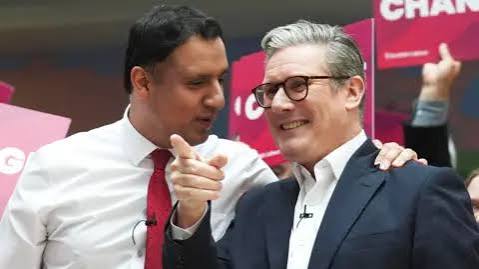
The Anas Sarwar Starmer exit call became one of the most dramatic moments in Labour’s recent political history. In February 2026, Sarwar, then leader of Scottish Labour, publicly called on Prime Minister and Labour leader Keir Starmer to step down.
The intervention was extraordinary because Sarwar was not an opposition politician. He was a senior Labour figure challenging the leader of his own party.
Sarwar argued that Westminster had become a damaging distraction and that Labour needed a change of leadership. His intervention came after a difficult period for Starmer’s government, including controversy surrounding the appointment of Peter Mandelson as UK ambassador to the United States and the subsequent political fallout.
ITV described Sarwar’s intervention as an “extraordinary act of rebellion” against his own party leader.
However, the political story did not end with Starmer’s resignation demand. The months that followed dramatically changed Sarwar’s own position. After Labour’s disappointing performance in Scotland, Sarwar eventually left the Scottish Labour leadership and moved into a ministerial role under Prime Minister Andy Burnham.
That makes the Anas Sarwar Starmer exit call more complicated than a simple leadership rebellion. It became part of a much wider story about Labour’s divisions, Scotland’s political future and the party’s struggle to rebuild public support.
Why Did Anas Sarwar Call for Starmer to Resign?

Sarwar’s decision was driven by growing concerns about Labour’s political direction.
At the time, Scottish Labour faced an important electoral challenge. Sarwar believed that problems surrounding Starmer’s government were damaging Labour’s prospects in Scotland.
The controversy over Peter Mandelson became a major flashpoint. Starmer faced criticism over Mandelson’s appointment as ambassador after questions emerged about his past links to Jeffrey Epstein. Starmer’s chief of staff Morgan McSweeney subsequently left his position, while communications director Tim Allan also departed.
ITV reported that Sarwar believed the continuing Westminster turmoil was hurting Scottish Labour and that the party needed a change at Downing Street.
Sarwar attempted to separate his personal relationship with Starmer from his political judgment. He described Starmer as a friend and a decent man, but argued that Labour needed a different political direction.
That distinction was important.
The revolt was not presented simply as a personal attack. Sarwar claimed that his responsibility was to Scottish Labour and Scottish voters.
A Major Challenge to Keir Starmer
The Anas Sarwar Starmer exit call immediately increased pressure on Starmer.
Before Sarwar spoke publicly, there had already been intense speculation about the prime minister’s future. Labour MPs were reportedly frustrated, while disagreements inside Downing Street were becoming increasingly visible.
Sarwar became the first major senior Labour figure to openly call for Starmer to leave.
That gave the rebellion much greater significance.
A leadership challenge from a senior figure can create a domino effect. Once one prominent politician breaks ranks, others may feel more comfortable expressing their own concerns.
But that domino effect did not immediately materialise.
Starmer remained defiant.
He told Labour MPs that he was not prepared to walk away. Other senior Labour figures also rallied behind him. The immediate attempt to force a change in leadership therefore failed.
The episode nevertheless exposed serious tensions inside Labour.
Labour Meltdown: Was the Party Really Falling Apart?
The phrase Labour meltdown captures the political atmosphere surrounding the crisis, but it needs some context.
Labour was not formally collapsing as a political organisation. The party remained in government.
The problem was political credibility.
Internal disagreements, leadership speculation, controversial appointments and poor electoral expectations created the impression of a government struggling to maintain control.
For Scottish Labour, the situation was particularly serious.
The party needed to rebuild its support after years of SNP dominance. Sarwar had positioned himself as the politician capable of reversing Labour’s decline in Scotland.
That made his criticism of Starmer especially significant.
He feared that unpopular decisions at Westminster could become an electoral liability in Scotland.
Sarwar’s Political Gamble
Calling for a sitting prime minister from your own party to resign is a huge political gamble.
If the leader falls, the politician who challenged them can gain influence.
But if the leader survives, the rebel can become politically isolated.
Sarwar faced both possibilities.
His intervention raised his national profile, but it also created questions about his own political future.
Critics could argue that he was undermining Labour unity at a critical moment. Supporters could argue that he was showing political courage by putting Scotland’s interests before party loyalty.
The disagreement reflected a broader question:
Should Scottish Labour follow the Westminster Labour leadership closely, or should it develop a more independent political identity?
That question remains important because Labour’s long-term challenge in Scotland is not simply winning individual elections. It is rebuilding a durable coalition of voters.
The 2026 Scottish Election Changed Everything
The May 2026 Scottish Parliament election became a major test for Sarwar.
Scottish Labour failed to achieve the breakthrough it wanted. The party’s representation fell to 17 seats, leaving it level with Reform UK in second place behind the SNP.
The result intensified debate over Sarwar’s leadership.
His decision to challenge Starmer had been partly justified by the argument that Labour needed to change direction to improve its Scottish prospects.
But the election did not produce the breakthrough that many Labour supporters wanted.
That created a difficult political equation.
If Starmer was supposedly the central problem, why had Scottish Labour still struggled under Sarwar?
This became an uncomfortable question for the party.
Sarwar’s Own Exit From Scottish Labour
The most dramatic twist came later.
Sarwar eventually stepped down as Scottish Labour leader and moved towards a ministerial role in Andy Burnham’s government.
The move followed Labour’s poor Scottish election result and created another wave of controversy.
The Guardian reported that Sarwar resigned as Scottish Labour leader to join Burnham’s government after being elevated to the House of Lords.
The Times subsequently reported that Sarwar’s departure exposed deep divisions inside Scottish Labour and triggered a leadership contest.
This development transformed the meaning of the earlier Starmer revolt.
Sarwar had once demanded that the leadership in Downing Street change.
Now, he himself had left the Scottish Labour leadership.
That contrast has inevitably generated criticism.
Who Could Replace Sarwar?
Sarwar’s departure opened a new leadership contest within Scottish Labour.
The contest has featured competing visions for the party’s future.
Candidates and potential candidates have differed over economic policy, social issues, the constitutional question and how closely Scottish Labour should align itself with the wider UK Labour movement.
Recent reporting indicated that the contest had narrowed, with Michael Marra and Joe Fagan among those competing for the leadership. Monica Lennon had failed to secure enough nominations to remain on the ballot.
The leadership contest is therefore about much more than replacing one politician.
It is about deciding what Scottish Labour should become.
Why Scotland Matters to Labour
Scotland has historically been important to Labour.
For decades, Labour maintained a powerful electoral presence north of the border. That dominance was dramatically weakened by the rise of the SNP.
The challenge for Labour is now to convince Scottish voters that it can offer something different from both the SNP and its other competitors.
The problem is complicated by constitutional politics.
Many Scottish voters continue to see independence as a defining political issue. Labour, meanwhile, remains committed to the United Kingdom.
That means Scottish Labour must appeal to voters who may have different priorities from Labour supporters elsewhere in Britain.
Sarwar understood this challenge.
His criticism of Starmer reflected concerns that Westminster politics could overwhelm Labour’s Scottish message.
The Starmer Question After Sarwar’s Revolt
One of the biggest questions is whether Sarwar’s intervention ultimately damaged or strengthened Starmer.
In the short term, the rebellion increased pressure on the prime minister.
But Starmer survived.
The episode also allowed Starmer’s allies to argue that Labour needed stability rather than another leadership contest.
A leadership change can be disruptive. It can dominate headlines, distract ministers and create uncertainty over policy.
That was one reason many Labour figures opposed an immediate change.
The wider political lesson is that leadership challenges do not automatically succeed simply because a government is unpopular.
A challenger needs numbers, organisation and a credible alternative.
Sarwar’s intervention provided the shock.
It did not provide the parliamentary mechanism needed to remove Starmer.
What Does the Revolt Mean for Labour?
The Anas Sarwar Starmer exit call revealed three major problems facing Labour.
1. Leadership credibility
A government can survive difficult headlines, but repeated political controversies can weaken public confidence.
The Starmer period demonstrated how quickly internal disagreements can become public.
2. Scottish Labour’s identity
Scottish Labour must decide how closely it should follow Westminster.
Too much distance could create conflict with the UK party.
Too little distance could make Scottish Labour appear unable to respond to Scotland-specific concerns.
Finding the balance will be critical.
3. Internal party unity
Labour needs to maintain unity while competing against the SNP, Conservatives, Reform UK and other parties.
Public disagreements between senior figures can reinforce the impression of instability.
At the same time, suppressing disagreement can create resentment inside the party.
The challenge is therefore not simply preventing rebellion. It is managing disagreement without allowing it to become political paralysis.
Is Labour Really Facing a Meltdown?
Calling the situation a Labour meltdown is politically dramatic, but the evidence suggests a more complicated picture.
There have certainly been serious internal disputes.
There has also been leadership instability in Scottish Labour.
But Labour remains a major political force, and the wider party has continued to operate as a governing organisation.
Recent polling has even shown Labour performing more strongly under Andy Burnham’s premiership in some measures. The Guardian reported in July that Labour had moved ahead of Reform UK in voter-intention polling for the first time in more than a year.
Therefore, the story is not simply about collapse.
It is about political transition.
Labour has moved through one leadership era into another, while Scottish Labour is simultaneously attempting to redefine itself.
Anas Sarwar’s Political Legacy
Sarwar’s legacy will be debated for years.
Supporters will argue that he was willing to challenge Starmer when others were unwilling to do so.
Critics will argue that he helped deepen Labour’s internal divisions before eventually leaving the Scottish leadership himself.
His political journey illustrates the difficult choices facing politicians inside a large governing party.
He first needed to establish himself as a credible Scottish Labour leader.
Then he needed to challenge Westminster.
After the Scottish election, he needed to decide whether remaining at Holyrood was the best way to influence Labour’s future.
His move into national government represents a significant change in strategy.
Whether that decision strengthens or weakens his long-term reputation will depend largely on what happens next.
What Happens Next for Scottish Labour?
The new Scottish Labour leadership will inherit a difficult situation.
The party needs to rebuild after its disappointing election result.
It must reconnect with voters who have moved towards the SNP, Reform UK and other parties.
It must also establish a clear message on the economy, public services, jobs and Scotland’s constitutional future.
Perhaps most importantly, Scottish Labour needs to demonstrate that it can offer voters a reason to return.
A leadership contest can help if it produces a clear strategy.
But another prolonged internal battle could make the party’s problems worse.
The coming months will therefore be crucial.
Final Thoughts
The Anas Sarwar Starmer exit call was one of the most significant Labour rebellions of 2026.
Sarwar’s decision to demand Keir Starmer’s resignation exposed the frustration within parts of Labour and highlighted the difficult relationship between Westminster and Scottish Labour.
But the story did not end with Starmer.
Starmer survived the challenge, while Sarwar later left the Scottish Labour leadership after a disappointing election result and moved into a national political role.
That reversal makes the episode particularly fascinating.
The real question is no longer simply whether Sarwar was right to call for Starmer to go.
The bigger question is whether Labour can learn from the turmoil.
For Scottish Labour, the task is even more difficult: rebuild trust, develop a clear identity and compete effectively against the SNP and other rising parties.
The party’s future will depend less on leadership drama and more on whether it can convince voters that Labour has answers to the issues that matter most to them.
Frequently Asked Questions
Why did Anas Sarwar call for Keir Starmer to resign?
Anas Sarwar called for Starmer to step down in February 2026 because he believed the problems surrounding the Labour government were damaging the party, particularly in Scotland. The controversy surrounding Peter Mandelson’s appointment was a major factor.
Was Anas Sarwar part of the UK Labour government?
At the time of his Starmer resignation demand, Sarwar was leader of Scottish Labour. He later left that position and moved into a ministerial role under Prime Minister Andy Burnham.
Did Keir Starmer resign after Sarwar’s call?
No. Starmer rejected the pressure to step aside and remained prime minister following Sarwar’s intervention.
What happened to Anas Sarwar after the 2026 Scottish election?
Following Labour’s disappointing performance in the Scottish Parliament election, Sarwar eventually stepped down as Scottish Labour leader and moved into a role in Andy Burnham’s government.
How did Scottish Labour perform in the 2026 election?
Scottish Labour won 17 seats in the 2026 Scottish Parliament election, down from its previous total, leaving the party level with Reform UK in second place behind the SNP.
Why is Scottish Labour struggling?
Scottish Labour faces competition from the SNP, Reform UK and other parties. The party also faces the challenge of developing a distinct Scottish identity while remaining part of the wider UK Labour movement.
Is Scottish Labour holding a leadership contest?
Yes. Sarwar’s departure triggered a leadership contest. Recent reporting has identified Michael Marra and Joe Fagan among the candidates, while Monica Lennon failed to secure enough nominations.
What does the Anas Sarwar revolt mean for Labour?
The revolt highlighted divisions over Labour’s leadership, Westminster strategy and Scottish political priorities. It also demonstrated how difficult it can be for senior Labour figures to challenge a sitting party leader without triggering wider instability.
Could Anas Sarwar become a future Labour leader?
Sarwar’s national political career remains significant, but his future leadership prospects will depend on his performance in government, his relationship with Labour’s wider leadership and how Scottish Labour’s current transition develops.
What is the main issue facing Scottish Labour now?
The biggest challenge is rebuilding support among Scottish voters. The party must develop a persuasive political message while addressing questions about public services, the economy, constitutional politics and its relationship with the UK Labour government.
About the Author